Showing posts with label Concerts. Show all posts

Wednesday, March 12, 2025

Talea Ensemble Residency

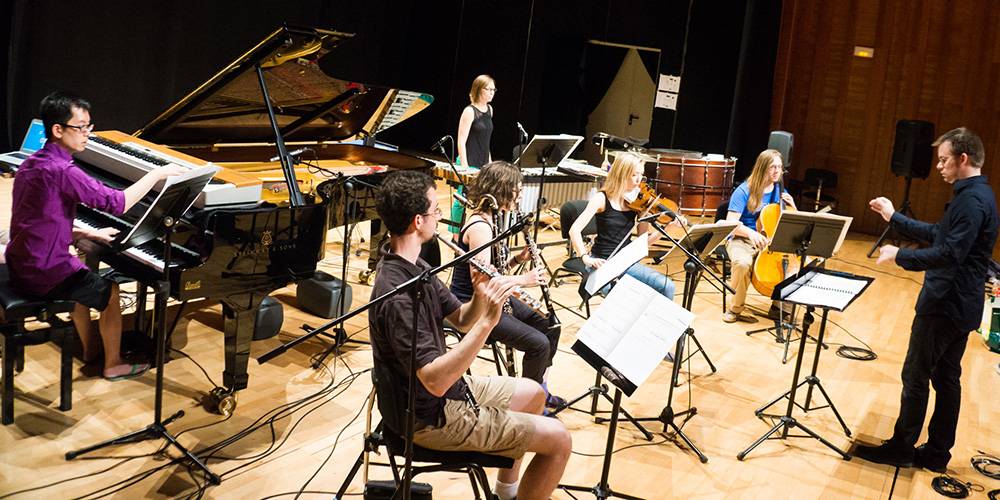
The internationally-renowned Talea Ensemble made their anticipated second trip to Buffalo and are preparing to premiere six works by UB graduate student composers Andres Bonilla-Garcia, Lihuen Sirvent, Jackson Roush, Francisco Corthey, Sohwa Lee, and Chi-Yen Huang. Each composer participated in a recorded workshop during the ensemble’s fall residency, and embarked on edits, revisions, and in a few cases complete rewrites of their drafted pieces. The pieces are extremely diverse in terms of instrumentation (from trio to full ensemble), use of electronics, use of contemporary or extended techniques, and they includes sonic material similar to that found during Beethoven’s time, Korean folk tunes, noise, and everything in between. This concert is FREE and open to the public.

Location: Lippes Concert Hall in Slee Hall
Date: March 14, 2025 
Time: 3:00PM
 

About Talea Ensemble

Heralded as “a crucial part of the New York cultural ecosphere” by the New York Times, the Talea Ensemble is comprised of nineteen of New York City’s finest classically-trained musicians, with a mission to champion musical creativity, cultivate curious listeners, and bring visionary new works to life with vibrant performances that remain in the audience’s imagination long after a concert.

Recipients of the 2014 Chamber Music America/ASCAP Award for Adventurous Programming, Talea has brought to life more than 30 commissions of major new works since it was founded in 2008. Partnering with institutions like the Austrian Cultural Forum or the French American Cultural Exchange, Talea has helped introduce NYC audiences to important works of such esteemed composers as Pierre Boulez, Georg Friedrich Haas, Beat Furrer, Pierluigi Billone, or Georges Aperghis.

Praised for their “verve and immaculate virtuosity” by the Washington Post, the Talea Ensemble is sought after both in the U.S. and Europe for its range, precision, risk-taking, and superior performance quality. Recent festival engagements include performances at Lincoln Center Festival, Internationales Musikinstitut Darmstadt, the Fromm Concerts at Harvard University, Warsaw Autumn Festival, Wien Modern, Chicago’s Contempo series, Royaumont Voix Nouvelles, Vancouver New Music, and many others. Talea’s recordings have been distributed worldwide on the Wergo, Gravina Musica, Tzadik, Innova, and New World Records labels, and been radio-broadcast on ORF (Austria), HRF (Germany), and WQXR’s Q2.

Talea assumes an ongoing role in supporting a new generation of composers, and has undertaken residencies in music departments at Columbia, Harvard, Stanford, Cornell, New York University, and many others.


Friday, March 7, 2025

James Falzone's Ricercar in Sixth Tone Harmony

Program Note

Falzone's piece searches for a new harmony by revisiting the sixth-tone system, developed over a hundred years ago in the first modernist efflorescence of microtonality, but worthy of a fresh reconsideration. It seeks to answer the question, "By expanding the gamut of available pitches," [that is, by "adding more notes,"] "can we both create interesting relationships of dissonance in addition to expanding the acoustic framework of harmony?"

Behind the Score:

Recently released on New World Records is a portrait album of Falzone's music, featuring performances by ensembles with a variety of instrumental forces, including the Arditti Quartet and ELISION Ensemble, as well as an orchestral work for the Ostrava New Orchestra. Taken together, these pieces investigate how unexpected but compelling results might emerge from seemingly euphonious and otherwise familiar materials.

About the album:

Falzone has a unique approach to music, and the result is multilayered. Recommended for the adventurous! —Fanfare

The music has a sensuous and imaginative quality that goes beyond the purely cerebral. —Fanfare


Brian Caswell's Arrow Through the Window


Program Note

This work is an answer to a question that I have long been asking: how can multiple meters happen at the
same time?

Arrow Through the Window has two groups of musicians. The two groups share a common pulse, or beat. But the larger groupings of that pulse – or in other words, the meter – differ.

What you are hearing tonight is an excerpt of the piece. It is the first major section of the piece. There are three more major sections to follow.


Behind the Score:

Brian Caswell has spent his time at UB exploring diverse musics such as Jazz and Latin drumming and pipe organ playing. He has written Minimalist process pieces, and Neoclassical pieces. Brian's approach was to use this time to continually search. This cycle of exploration has led back to where he started: Jazz composition and piano playing. However, his approach to this music is entirely different than where he was five years ago. It might be better categorized as "Third Stream," which describes a music in between Jazz and Classical. His piece Arrow Through the Window is an arrival point for the composer, which embraces the foundations of his musical practice.

Brian's music can be found on Bandcamp.

Thursday, March 6, 2025

William Brobston's SOJOURN

Program note:

SOJOURN is a meditation on a variety of musical gestures that are loosely based on the sounds emanating from a particular kinetic sculpture that I was fascinated with as a child in Birmingham, Alabama. The sounds become increasingly familiar as the tension of the piece unfolds, ultimately driving toward their impending cessation. 

Behind the Score:

Much of my compositional interest lies in the musical parameter of time. The way in which my work often explores this parameter is through the sequencing of repeated musical fragments. These fragments may act as interjections within a musical texture or they may occupy space harmoniously, depending on the nature of the piece. I am interested in the multitude of ways in which these small musical units can combine to create larger networks of sound, while also playing with the listener’s sense of time, memory, and expectation. Sojourn is an example of a piece that relies on a dense texture composed of several recurring fragments, but just as crucial to the composition is the sudden cessation of these sounds once they become familiar. 

Will supplied the following track as an example:

https://open.spotify.com/track/0LKWhvxKi0NH02F2XiNa2v?si=2e962c40689e472b

To explore more of his music, visit Will Brobston's website.

Thomas Little's Two Visions of the Prophet Ezekiel


First on the Sinfonietta's program is Thomas Little's Two Visions of the Prophet Ezekiel.


Program Note

This tone-poem is based on the first and thirty-seventh chapters of the Book of Ezekiel. The opening section sets Ezekiel (the oboe) against a foreign landscape of strings, before the heavens open to visions of the heavens, strange creatures with multiple faces, and wheels within wheels. The hymn tune “Helmsley” leads to the horn’s vox Dei, empowering Ezekiel on his mission. He soon encounters the second vision: the valley of dry bones, where God commands Ezekiel to prophesy and raise an army of skeletons from the earth. But as the second vision fades, will the people listen?

Behind the Score

The 21st-century composer comes on the heels of a vast and productive era of experimentation. Originality is no longer about generating a style sui generis; one can come up with a personal idiom by mixing and matching different things from different eras, depending on what the piece requires. To that end, Two Visions has the late-Romantic tone poem as a large-scale structure, and fill that mold with an Ivesian approach in textural layering (particularly between the oboe and strings, which bookend the piece), use of a hymn tune at a culmination point (the first vision), and the organ-esque orchestration at the beginning of the coda.

The second vision uses one of my own techniques. I call it “post-ergodic,” after James Tenney's term “ergodic form,” which describes static music of consistent parametric values. My post-ergodic music usually moves faster and consists of fragmentary material. This was taken to the limit in my percussion/electronics piece … as the sparks fly up [embedded below], where a digitized score re-composes itself for each performance, all based on an analysis of the starting motive. In the second vision of Two Visions, similar techniques control the relationships between different kinds of skittering, “bony” material across instruments. This allowed me to write fast music that never exactly repeats, and that can be as long or as short as the pacing of the music requires, and freed me to think more about how and when to tweak these parameters to shape the structure of that vision.

...as the sparks fly up 


 Premiered by UB faculty member Tom Kolor at Hallwalls Contemporary Arts Center

Thomas Little’s work can be explored on his website, lentovivace.com.

His educational video series about classical music, Classical Nerd, can be seen on YouTube.


Wednesday, March 5, 2025

Concert! Slee Sinfonietta, March 11, 2025

The Robert & Carol Morris Center for 21st Century Music, with the Slee Sinfonietta conducted by Matthew Chamberlain, will premiere four pieces by UB graduate student composers on March 11, 7:30pm in Lippes Concert Hall in Slee Hall.

Program:

Thomas Little, Two Visions of the Prophet Ezekiel

William Brobston, SOJOURN

Brian Caswell, Arrow Through Time

~~Intermission~~

James P.A. Falzone, Ricercar in Sixth-Tone Harmony

Falzone, in particular, takes the Sinfonietta to new places, as he utilizes his newly devised sixth-tone tuning system. The work features three separate pianos (tuned differently!) for the first time in the Sinfonietta’s history, and will show the ensemble in its largest formation in over a decade.

Brian Caswell’s work Arrow Through Time is also in an ‘absolute music’ vein and features polymeter, a technique in which different musical parts play at the same time but using different meters, or time signatures, for a richly complex rhythmic effect. 

William Brobston’s SOJOURN is a hefty revision of work presented at June in Buffalo 2024, and plays with time, memory, and expectation as fragments morph and return in unexpected ways.

Leading off the concert, and writing from specific extramusical inspiration, Thomas Little’s work Two Visions of the Prophet Ezekiel is a tone poem based on the first and 37th chapters of the Biblical book of Ezekiel.

Tickets may be purchased here ($10, or free with student ID).

Stay tuned for program notes, further details into the composers’ processes, and extra behind-the-score info this week!

Monday, March 14, 2022

Switch Ensemble Residency March 27-29, 2022

[Switch~ Ensemble]

A new music ensemble for the 21st century

The Center for 21st Century Music is excited to announce a residency by Switch~ Ensemble from March 27-29, during which they will workshop new works by UB student composers and perform in concert at (UPDATED) 7:30 pm on March 29, 2022. For more details and to purchase tickets ($10), click here. Follow on Facebook here.

Concert (Updated Program):

Heather Stebbins, Among Arrows (2021)
*David Felder, A Garland (for Bruce) (2012)
Santiago Diez Fischer, perpetual green switch (2022)
Anna-Louise Walton, Crossing (2022)
Forbes Graham, Inflection: Beacon Hill/Roxbury
 
*UB professor

About Switch~

A new music ensemble for the 21st Century, the [Switch~ Ensemble] is dedicated to the creation of new works for chamber ensemble: we bring bold new acoustic, electroacoustic, and multimedia projects to life. At the core of each performance is our commitment to the total integration of technology and live musicians. We strive for compelling artistry achieved through the seamless creation, production, and execution of new music, and believe that working directly with composers—in a medium where the score is a point of departure rather than a finish line—allows for new and thrilling musical possibilities.

[Switch~] contributes to the future of the genre by strongly advocating for and commissioning the music of a new generation of emerging young composers. We have enjoyed fruitful collaborations with both emerging and established composers, with commissions and premieres of works by composers including Anna-Louise Walton, Alican Çamci, Igor Santos, Katherine Young, Stefano Gervasoni, Stefan Prins, Wojtek Blecharz, Anthony Vine, Rand Steiger, Philippe Leroux, Timothy McCormack, Tonia Ko, James Bean, Matt Sargent, Marianthi Papalexandri-Alexandri, Esaias Järnegard, Sivan Eldar, Julio Zúñiga, Zeynep Toraman, Alexander Schubert, Adrien Trybucki, Elvira Garifzyanova, Santiago Diez-Fischer, Lisa Streich, Anthony Pateras, and many others.

Recent engagements include performances and residencies at Cornell, Bard College, University of Chicago, Ithaca College, Buffalo State, UC Berkeley,  the VIPA Festival (Spain), Eastman School of Music, and Avaloch Farms Music Institute, as well as concerts at the Image/Sound Festival, San Francisco Center for New Music, MATA Interval Series, NYCEMF, Vanguard New Music Series at Kent State University, the Queens New Music Festival, the CD release of Christopher Chandler’s Smoke and Mirrors on the SEAMUS label, and more.

https://www.switchensemble.com/assets/images/auto-add/featured/2016-santos_lamento_1000x500px.jpg

Student Works

Thomas Little, Signed Distance Field - Flute, clarinet (doubling bass), saxophone (alto + tenor), violin, violoncello, percussion, piano (doubling celesta)
Computer graphics use the “signed distance field” (or “signed distance function”) to efficiently render 2D images in 3D space, and blur said images at increasing distances. In a musical adaptation of this function, the “image” is a central E Major triad, and the function uses various musical “yardsticks”—including the circle of fifths, the harmonic series, and distance in quarter-tones―to determine seven discrete levels of “blurriness,” indicated by dynamic level. Signed Distance Field moves through a warped, funhouse-mirror version of tonality as it navigates and juxtaposes these dynamically-determined pitch fields to bring various sonorities into and out of focus.
Brian Caswell
Jonathan Rainous, Homeward - Flute, clarinet, saxophone (soprano + baritone), violin, violoncello, percussion, piano.
A fusion of non-classical styles using classically-enabled musical form and recombinant musical techniques to evoke a half-remembered roadtrip playlist.