Showing posts with label James PA Falzone. Show all posts

Friday, March 7, 2025

James Falzone's Ricercar in Sixth Tone Harmony

Program Note

Falzone's piece searches for a new harmony by revisiting the sixth-tone system, developed over a hundred years ago in the first modernist efflorescence of microtonality, but worthy of a fresh reconsideration. It seeks to answer the question, "By expanding the gamut of available pitches," [that is, by "adding more notes,"] "can we both create interesting relationships of dissonance in addition to expanding the acoustic framework of harmony?"

Behind the Score:

Recently released on New World Records is a portrait album of Falzone's music, featuring performances by ensembles with a variety of instrumental forces, including the Arditti Quartet and ELISION Ensemble, as well as an orchestral work for the Ostrava New Orchestra. Taken together, these pieces investigate how unexpected but compelling results might emerge from seemingly euphonious and otherwise familiar materials.

About the album:

Falzone has a unique approach to music, and the result is multilayered. Recommended for the adventurous! —Fanfare

The music has a sensuous and imaginative quality that goes beyond the purely cerebral. —Fanfare


Wednesday, March 5, 2025

Concert! Slee Sinfonietta, March 11, 2025

The Robert & Carol Morris Center for 21st Century Music, with the Slee Sinfonietta conducted by Matthew Chamberlain, will premiere four pieces by UB graduate student composers on March 11, 7:30pm in Lippes Concert Hall in Slee Hall.

Program:

Thomas Little, Two Visions of the Prophet Ezekiel

William Brobston, SOJOURN

Brian Caswell, Arrow Through Time

~~Intermission~~

James P.A. Falzone, Ricercar in Sixth-Tone Harmony

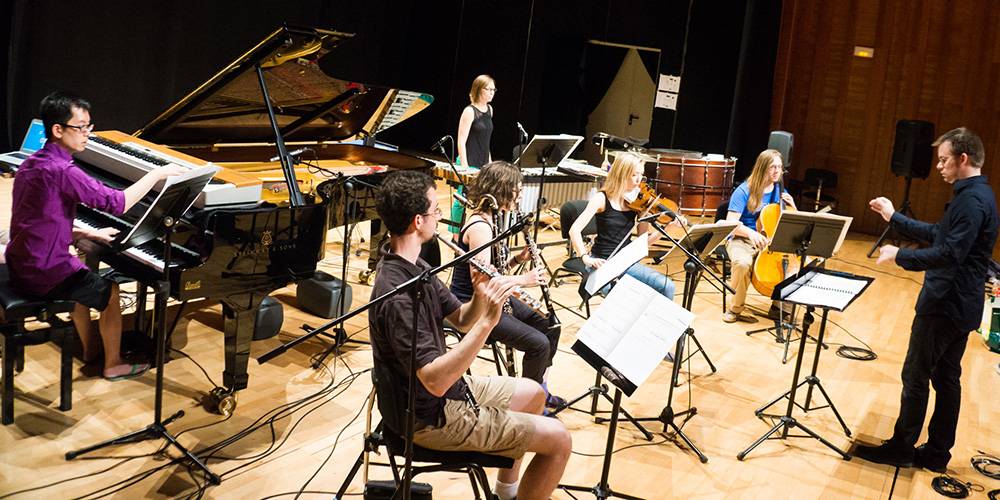
Falzone, in particular, takes the Sinfonietta to new places, as he utilizes his newly devised sixth-tone tuning system. The work features three separate pianos (tuned differently!) for the first time in the Sinfonietta’s history, and will show the ensemble in its largest formation in over a decade.

Brian Caswell’s work Arrow Through Time is also in an ‘absolute music’ vein and features polymeter, a technique in which different musical parts play at the same time but using different meters, or time signatures, for a richly complex rhythmic effect. 

William Brobston’s SOJOURN is a hefty revision of work presented at June in Buffalo 2024, and plays with time, memory, and expectation as fragments morph and return in unexpected ways.

Leading off the concert, and writing from specific extramusical inspiration, Thomas Little’s work Two Visions of the Prophet Ezekiel is a tone poem based on the first and 37th chapters of the Biblical book of Ezekiel.

Tickets may be purchased here ($10, or free with student ID).

Stay tuned for program notes, further details into the composers’ processes, and extra behind-the-score info this week!

Monday, March 14, 2022

Switch Ensemble Residency March 27-29, 2022

[Switch~ Ensemble]

A new music ensemble for the 21st century

The Center for 21st Century Music is excited to announce a residency by Switch~ Ensemble from March 27-29, during which they will workshop new works by UB student composers and perform in concert at (UPDATED) 7:30 pm on March 29, 2022. For more details and to purchase tickets ($10), click here. Follow on Facebook here.

Concert (Updated Program):

Heather Stebbins, Among Arrows (2021)
*David Felder, A Garland (for Bruce) (2012)
Santiago Diez Fischer, perpetual green switch (2022)
Anna-Louise Walton, Crossing (2022)
Forbes Graham, Inflection: Beacon Hill/Roxbury
 
*UB professor

About Switch~

A new music ensemble for the 21st Century, the [Switch~ Ensemble] is dedicated to the creation of new works for chamber ensemble: we bring bold new acoustic, electroacoustic, and multimedia projects to life. At the core of each performance is our commitment to the total integration of technology and live musicians. We strive for compelling artistry achieved through the seamless creation, production, and execution of new music, and believe that working directly with composers—in a medium where the score is a point of departure rather than a finish line—allows for new and thrilling musical possibilities.

[Switch~] contributes to the future of the genre by strongly advocating for and commissioning the music of a new generation of emerging young composers. We have enjoyed fruitful collaborations with both emerging and established composers, with commissions and premieres of works by composers including Anna-Louise Walton, Alican Çamci, Igor Santos, Katherine Young, Stefano Gervasoni, Stefan Prins, Wojtek Blecharz, Anthony Vine, Rand Steiger, Philippe Leroux, Timothy McCormack, Tonia Ko, James Bean, Matt Sargent, Marianthi Papalexandri-Alexandri, Esaias Järnegard, Sivan Eldar, Julio Zúñiga, Zeynep Toraman, Alexander Schubert, Adrien Trybucki, Elvira Garifzyanova, Santiago Diez-Fischer, Lisa Streich, Anthony Pateras, and many others.

Recent engagements include performances and residencies at Cornell, Bard College, University of Chicago, Ithaca College, Buffalo State, UC Berkeley,  the VIPA Festival (Spain), Eastman School of Music, and Avaloch Farms Music Institute, as well as concerts at the Image/Sound Festival, San Francisco Center for New Music, MATA Interval Series, NYCEMF, Vanguard New Music Series at Kent State University, the Queens New Music Festival, the CD release of Christopher Chandler’s Smoke and Mirrors on the SEAMUS label, and more.

https://www.switchensemble.com/assets/images/auto-add/featured/2016-santos_lamento_1000x500px.jpg

Student Works

Thomas Little, Signed Distance Field - Flute, clarinet (doubling bass), saxophone (alto + tenor), violin, violoncello, percussion, piano (doubling celesta)
Computer graphics use the “signed distance field” (or “signed distance function”) to efficiently render 2D images in 3D space, and blur said images at increasing distances. In a musical adaptation of this function, the “image” is a central E Major triad, and the function uses various musical “yardsticks”—including the circle of fifths, the harmonic series, and distance in quarter-tones―to determine seven discrete levels of “blurriness,” indicated by dynamic level. Signed Distance Field moves through a warped, funhouse-mirror version of tonality as it navigates and juxtaposes these dynamically-determined pitch fields to bring various sonorities into and out of focus.
Brian Caswell
Jonathan Rainous, Homeward - Flute, clarinet, saxophone (soprano + baritone), violin, violoncello, percussion, piano.
A fusion of non-classical styles using classically-enabled musical form and recombinant musical techniques to evoke a half-remembered roadtrip playlist.