
 |
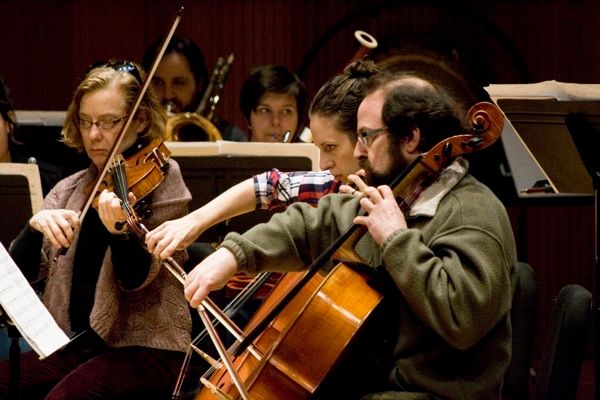
| The Slee Sinfonietta plays Ives's Three Places in New England |
The Center's 2014-15 season has been an incredibly exciting one with lots of exciting concerts, including numerous premieres of new works by intrepid composers. We saw several Slee Sinfonietta programs, including memorable performances of Elliott Carter's Triple Duo (with Ensemble SIGNAL), Charles Ives's Three Places in New England, and the production of Doug Fitch's magnificent "How Did We…?". We had two fruitful residencies with the Mivos String Quartet and the Deviant Septet, and several visiting composers, including Larry Groupé, Rand Steiger, and Daniel Asia.
Last month, we capped off the season with the 40/30 anniversary of the June in Buffalo Festival, a vibrant week of new music that featured 16 concerts with nearly 80 adventurous new works performed—half of those by the 30 emerging composers in attendance. The festival was a great success, a celebration of many years of great performances. In a recent Wall Street Journal Article, author Allan Kozinn points out that, "It would be hard to name more than a handful of major composers of the past 30 years who have not appeared on its faculty roster." Kozinn, impressed with the work of the festival's participant composers, elaborates:
[A] highlight of a Saturday afternoon program devoted to new student works was Mr. [Eric] Huebner's assured account of Music for a Mad Scientist—300+ Microvariations on a Bach Theme, an explosively virtuosic solo piano work by Texu Kim. Mr. Kim […] hid his Bach theme amid intensely chromatic Lisztian thunder, at first. But when the invigorating clatter briefly subsided, the score's internal joke became clear: The work's theme is the gently arpeggiated C major Prelude that opens The Well-Tempered Clavier, Book I. […] Ying-Ting Lin's The Journey began murkily, with repeated bass tones in the piano punctuated by chordal bursts for bass clarinet and violin, but quickly grew into an engagingly varied, lively piece. Liliya Ugay played the assertive, steely piano line in her own Third World Fable, but regularly ceded the spotlight, and some lovely, supple writing, to the violin and cello. The student program's most satisfying work was its opener, Ryan Jesperson's Souvenirs/Miniatures, a tightly focused piano trio that—like Ms. Ugay's work, but with a different accent—juxtaposed tense, sharp-edge keyboard angularity with luminous string writing rooted in 19th-century shapeliness.
 |
| SIGNAL and the Slee Sinfonietta perform David Felder's Les Quatre Temps Cardinaux |
Kozinn also took note of Saturday night's stunning performance of David Felder's Les Quatre Temps Cardinaux by SIGNAL and the Slee Sinfonietta, under Brad Lubman's direction. The chamber orchestra piece set poems by René Daumal, Pablo Neruda, Robert Creeley and Dana Gioia (read more about the work here), and featured vocal soloists Heather Buck and Ethan Herschenfeld, as well as video projections by Olivier Pasquet and 12 channels of electroacoustic sound:
The poems are heard not only in the spiky, emotionally intense vocal writing, but spoken on the recorded tracks, which also include percussion sounds and the sparkle, buzz and variegated growl of purely electronic timbres, all moving around a dozen speakers placed throughout the hall. Abstract video by Olivier Pasquet added atmosphere rather than commentary. All this could easily have become an exhibition of gimmickry, but Mr. Felder kept his grand audio-visual fabric focused, sober and often wrenching.
The festival saw not only great performances, but also seminars and masterclasses by its world-renowned faculty composers, which can be invaluable to emerging composers. As noted in a recent UB Reporter article by this author:
The works of these faculty composers were featured in JiB's evening concerts, while the composers themselves gave morning seminars and consulted with participant composers in master classes. "I am always eager to show my works to professors and peers, not to find confirmation but to collect 'data,'" says Chen. "Then, at the end of the day, I sit down and do some 'data mining' for my future projects. […] JiB is only a week long, but its impact on me will surely last for years to come. I cannot wait for JiB 2016."
For those interested in learning more about the festival, be sure to check out our series of profiles of JiB artists on Edge of the Center, and visit the UB Music Library for an exhibit commemorating the festival's 40/30 anniversary, which is still on display.
Onward…
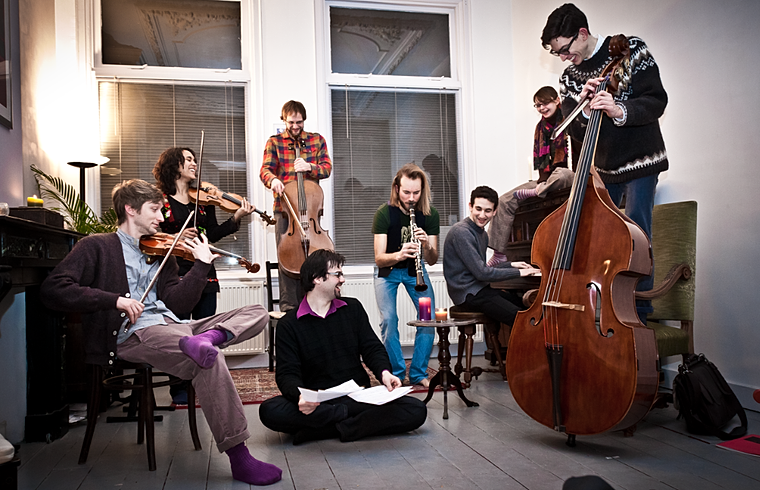 |
| The Oerknal Ensemble will visit the Center next year |
The gears are already in motion for next year's season. We are excited that next year's events will include visits from guest composers Kaija Saariaho and Hanna Eimermacher, as well as residencies with several prominent new music ensembles, including Load Bang, Voxnova Italia/Project Isherwood, Ensemble Linea, and the Oerknal Ensemble. We can also look forward to many spectacular Slee Sinfonietta concerts, and of course, June in Buffalo 2016, which will feature the following resident ensembles: Arditti Quartet, Buffalo Philharmonic Orchestra, Ensemble Dal Niente, Ensemble SIGNAL, Slee Sinfonietta, Uusinta Ensemble.
Edge of the Center will announce more details on all of these events in the coming months. It's already shaping up to be another incredible season featuring some of the most skilled performers in the city and from around the globe.
Robert and Carol Morris Center for 21st Century Music
2015-16 Schedule of Events
September 2015
Hanna Eimermacher
Visiting composer
October 5, 2015
Visiting composer
October 5, 2015
[Rescheduled concert]:
Program to include works by
Brook, Felder, Lachenmann, Stauning
November 2015
Visiting ensemble
Evening performance and composer workshop
December 4-6
Visiting ensembles
Two evenings of concerts and composer workshop
April 2016
Visiting ensemble
Evening performance and composer workshop
May 2-5, 2016
Visiting Ensemble
Evening performance and composer workshop
Program to include works by
Felder, Heidelberger, Nielson, Zorn
Slee Sinfonietta
October 6, 2015
Slee Sinfonietta Presents
Ensemble Signal
Brad Lubman, conductor
Camilla Hoitenga, flute
Featuring works by Kaija Saariaho and other Finnish Composers
Part of FinnFest in Buffalo, NY
April 21, 2016
Slee Sinfonietta
Program TBA
June in Buffalo 2016
June 6-13
David Felder, Artistic Director
Faculty Composers
Hanna Eimermacher
David Felder
Joshua Fineberg
Josh Levine
Resident Ensembles
Arditti Quartet
Buffalo Philharmonic Orchestra
Dal Niente
Ensemble Signal
Slee Sinfonietta
Uusinta Ensemble
Special Guests
Magnus Andersson
Brad Lubman
October 6, 2015
Slee Sinfonietta Presents
Ensemble Signal
Brad Lubman, conductor
Camilla Hoitenga, flute
Featuring works by Kaija Saariaho and other Finnish Composers
Part of FinnFest in Buffalo, NY
April 21, 2016
Slee Sinfonietta
Program TBA
June in Buffalo 2016
June 6-13
David Felder, Artistic Director
Faculty Composers
Hanna Eimermacher
David Felder
Joshua Fineberg
Josh Levine
Resident Ensembles
Arditti Quartet
Buffalo Philharmonic Orchestra
Dal Niente
Ensemble Signal
Slee Sinfonietta
Uusinta Ensemble
Special Guests
Magnus Andersson
Brad Lubman



 Posts
Posts


