Showing posts with label Les Quatre Temps Cardinaux. Show all posts

Wednesday, July 1, 2015

2014-15 Season Recap


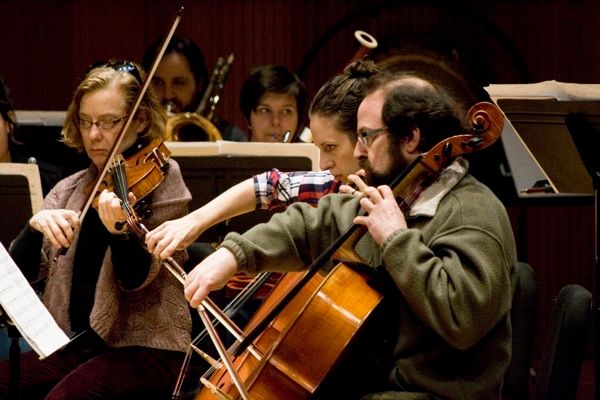
The Slee Sinfonietta plays Ives's Three Places in New England
The Center's 2014-15 season has been an incredibly exciting one with lots of exciting concerts, including numerous premieres of new works by intrepid composers.  We saw several Slee Sinfonietta programs, including memorable performances of Elliott Carter's Triple Duo (with Ensemble SIGNAL), Charles Ives's Three Places in New England, and the production of Doug Fitch's magnificent "How Did We…?".  We had two fruitful residencies with the Mivos String Quartet and the Deviant Septet, and several visiting composers, including Larry Groupé, Rand Steiger, and Daniel Asia.

Last month, we capped off the season with the 40/30 anniversary of the June in Buffalo Festival, a vibrant week of new music that featured 16 concerts with nearly 80 adventurous new works performed—half of those by the 30 emerging composers in attendance.  The festival was a great success, a celebration of many years of great performances.  In a recent Wall Street Journal Article, author Allan Kozinn points out that, "It would be hard to name more than a handful of major composers of the past 30 years who have not appeared on its faculty roster."  Kozinn, impressed with the work of the festival's participant composers, elaborates:
[A] highlight of a Saturday afternoon program devoted to new student works was Mr. [Eric] Huebner's assured account of Music for a Mad Scientist—300+ Microvariations on a Bach Theme, an explosively virtuosic solo piano work by Texu Kim.  Mr. Kim […] hid his Bach theme amid intensely chromatic Lisztian thunder, at first.  But when the invigorating clatter briefly subsided, the score's internal joke became clear:  The work's theme is the gently arpeggiated C major Prelude that opens The Well-Tempered Clavier, Book I.  […]  Ying-Ting Lin's The Journey began murkily, with repeated bass tones in the piano punctuated by chordal bursts for bass clarinet and violin, but quickly grew into an engagingly varied, lively piece.  Liliya Ugay played the assertive, steely piano line in her own Third World Fable, but regularly ceded the spotlight, and some lovely, supple writing, to the violin and cello.  The student program's most satisfying work was its opener, Ryan Jesperson's Souvenirs/Miniatures, a tightly focused piano trio that—like Ms. Ugay's work, but with a different accent—juxtaposed tense, sharp-edge keyboard angularity with luminous string writing rooted in 19th-century shapeliness.
SIGNAL and the Slee Sinfonietta perform
David Felder's Les Quatre Temps Cardinaux
Kozinn also took note of Saturday night's stunning performance of David Felder's Les Quatre Temps Cardinaux by SIGNAL and the Slee Sinfonietta, under Brad Lubman's direction.  The chamber orchestra piece set poems by René Daumal, Pablo Neruda, Robert Creeley and Dana Gioia (read more about the work here), and featured vocal soloists Heather Buck and Ethan Herschenfeld, as well as video projections by Olivier Pasquet and 12 channels of electroacoustic sound:
The poems are heard not only in the spiky, emotionally intense vocal writing, but spoken on the recorded tracks, which also include percussion sounds and the sparkle, buzz and variegated growl of purely electronic timbres, all moving around a dozen speakers placed throughout the hall.  Abstract video by Olivier Pasquet added atmosphere rather than commentary.  All this could easily have become an exhibition of gimmickry, but Mr. Felder kept his grand audio-visual fabric focused, sober and often wrenching.
The festival saw not only great performances, but also seminars and masterclasses by its world-renowned faculty composers, which can be invaluable to emerging composers.  As noted in a recent UB Reporter article by this author:
The works of these faculty composers were featured in JiB's evening concerts, while the composers themselves gave morning seminars and consulted with participant composers in master classes.  "I am always eager to show my works to professors and peers, not to find confirmation but to collect 'data,'" says Chen.  "Then, at the end of the day, I sit down and do some 'data mining' for my future projects.  […]  JiB is only a week long, but its impact on me will surely last for years to come. I cannot wait for JiB 2016."
For those interested in learning more about the festival, be sure to check out our series of profiles of JiB artists on Edge of the Center, and visit the UB Music Library for an exhibit commemorating the festival's 40/30 anniversary, which is still on display.

Onward…

The Oerknal Ensemble will visit the Center next year
The gears are already in motion for next year's season.  We are excited that next year's events will include visits from guest composers Kaija Saariaho and Hanna Eimermacher, as well as residencies with several prominent new music ensembles, including Load Bang, Voxnova Italia/Project Isherwood, Ensemble Linea, and the Oerknal Ensemble.  We can also look forward to many spectacular Slee Sinfonietta concerts, and of course, June in Buffalo 2016, which will feature the following resident ensembles:  Arditti Quartet, Buffalo Philharmonic Orchestra, Ensemble Dal Niente, Ensemble SIGNAL, Slee Sinfonietta, Uusinta Ensemble.

Edge of the Center will announce more details on all of these events in the coming months.  It's already shaping up to be another incredible season featuring some of the most skilled performers in the city and from around the globe.


Robert and Carol Morris Center for 21st Century Music

2015-16 Schedule of Events


September 2015
Hanna Eimermacher
Visiting composer

October 5, 2015
Visiting composer

October 5, 2015
[Rescheduled concert]:
Program to include works by 
Brook, Felder, Lachenmann, Stauning

November 2015
Visiting ensemble
Evening performance and composer workshop

December 4-6
Visiting ensembles
Two evenings of concerts and composer workshop

April 2016
Visiting ensemble
Evening performance and composer workshop

May 2-5, 2016
Visiting Ensemble
Evening performance and composer workshop
Program to include works by 
Felder, Heidelberger, Nielson, Zorn
Slee Sinfonietta

October 6, 2015
Slee Sinfonietta Presents
Ensemble Signal
Brad Lubman, conductor
Camilla Hoitenga, flute
Featuring works by Kaija Saariaho and other Finnish Composers
Part of FinnFest in Buffalo, NY

April 21, 2016
Slee Sinfonietta
Program TBA


June in Buffalo 2016
June 6-13
David Felder, Artistic Director

Faculty Composers
Hanna Eimermacher
David Felder
Joshua Fineberg
Josh Levine

Resident Ensembles
Arditti Quartet
Buffalo Philharmonic Orchestra
Dal Niente
Ensemble Signal
Slee Sinfonietta
Uusinta Ensemble

Special Guests
Magnus Andersson
Brad Lubman

Thursday, May 28, 2015

Unexplored Regions: An Interview with David Felder


This is a big year for June in Buffalo, marking both the 40th anniversary of the festival's founding and the 30th anniversary of David Felder's tenure as artistic director.  Under Felder's direction, the festival changed significantly, placing a greater emphasis on student works, and bringing in a wide range of skilled composers, performers, and ensembles.

David Felder
Felder, who serves as the Birge-Cary Chair in Composition at UB, has long been recognized as a leader among his generation of composers.  This year, JiB will see the performance of several of the composer's key works, including his brass quintet, Canzone XXXI (to be played by the Meridian Arts Ensemble), his set of orchestral variations, Six Poems from Neruda's "Alturas…" (to be played by the Buffalo Philharmonic), and his recent Les Quatre Temps Cardinaux, which will be performed by SIGNAL with members of the Slee Sinfonietta (see our post from its October performance).  The latter work, a fifty-minute song cycle for two voices, chamber orchestra, and 12 channels of electronics, sets poems by René Daumal, Robert Creeley, and Dana Gioia.  All three works, like most of Felder's output, are characterized by their energy, lyricism, and what Dansk Musiktidsskrift has called "an impressive ability to establish a sound universe, in which one is taken through every corner of experience."

I recently had a chance to interview Felder about the festival, and some of his recent work.


When you restarted the festival in 1986, what were some things you set out to do differently from the way it was run in the past?

It was a very big philosophical change, which was based on the way I assessed the field as a young composer myself at that time.

When I was in California, I was like a lot of other younger composers.  I didn't really feel that I'd had a good performance of my work until I was about 28 years old.  It was mostly student performers or conservatory faculty members who didn't care at all about playing a younger composer's work. Though I could understand why people didn't want to spend the time on a young composer's work, I thought it was really difficult for me and every other young composer I knew to evaluate what we were trying to do.  I took a look around, and I saw that there were only a few other opportunities for young composers to have strong performances of their work. Those were places like Aspen, Tanglewood, Davidovsky's summer program at Wellesley, and the summer program at Yale (the latter of which I was fortunate enough to attend).  But those programs were extremely selective and almost entirely Ivy League, so the majority of younger composers around the country were kind of stuck, particularly the composers on the West Coast.
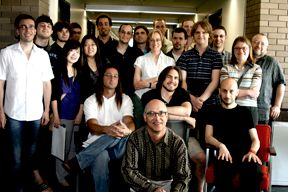
Felder with student composers at JiB 2010
So I began a series of concerts at the La Jolla Museum of Contemporary Art, which lasted two or three years.  I was given some venture capital and programmed some young composers and some senior composers that were friends of mine.  Then, when I moved to Cal State Long Beach, I formed the Summer Composers Institute, which was meant for West Coast composers to work with senior composers—the two who started it with me were Bernard Rands and Donald Erb—and we brought together this group of really great performers and ensembles to perform their works.

By the time I moved to Buffalo, the June in Buffalo festival had been dormant for a long time. So I proposed that I bring my vision and restart the festival, but under the terms I'm outlining here.  I considered Feldman a friend and had great respect for him, but we had differing views on what it meant to be a young composer.  He did not believe that young composers deserved to be presented in the way that I was presenting them.  He thought that they should sit at the feet of the geniuses and catch any pearl that might fall from their lips.  So the old June in Buffalo program did not feature performances of young composers' music, they just sat in seminars, and the concerts were portrait concerts of individual faculty composers.  It's a very different philosophy about how one teaches and how one helps young composers develop.

What were some of the difficulties restarting a festival which had been dormant for several years?

When I arrived, despite promises to the contrary when I interviewed, there was absolutely no money.  So I had to do everything with zero budget, and I had to raise the funds completely those first years.  I was able to find some interesting solutions, and the budgets started to stabilize after the third or fourth year, particularly when I became the Birge-Cary Chairholder and could dedicate resources.  I am proud that even from the beginning there was never one year in which there was a deficit.

Also, the first year we had to work hard to get  applicants, I had to call around a lot.  Very soon, though, we began to attract a large pool of applicants, allowing us to be very selective about who we decided to invite.  And the festival fairly quickly became an obvious success.  And now, there's  not a week that goes by where I don't see another new festival imitating JiB.  There are loads of them out there now—even some of our former student assistants for JiB are copying us.  It causes me to think about what the field might need next, since such events have proliferated now to the point of near-absurdity.

Are there any JiB performances that you have found particularly memorable?

There was a New York New Music Ensemble performance of an amazing work by Jacob Druckman called Come Round, which is really one of his great pieces.  I just remember that the performance [at JiB 2000, conducted by Harvey Sollberger] was absolutely hair-raising!  And a few years ago [2013], Charles Wuorinen conducted the Slee Sinfonietta in a performance of his chamber cantata, It Happens Like This.  That was a really great performance.  Having the composer here conducting the group was really very special.

But there are so many of them, it's really difficult.  So I'm singling out just a couple which were absolutely breath-taking.

The Performance Institute is doing the Druckman this year on their June 5 concert at Kleinhans.

Right, and that's being programmed because we really wanted to get that piece on the festival.  Jake Druckman was a big part of the early years of JiB, he came quite a bit and he was extremely supportive of me and also supportive of the festival.

It seems that there's always been a lot of variety amongst the faculty composers who have been here over the years.

One of the hallmarks of the way that I program the week is that I don't bring in people to be on the faculty with all the same viewpoints—in fact, I actually deliberately select people so that there will be some friction between ideas, so that students might get input that's 180º opposite from one master class to the next.  I mostly enjoy very diverse groups of composers working together because you can learn the most that way if you have a strong individual internal motivator and your own vision to follow.  If you're looking for consensus, JiB is not necessarily the place for you.

Were there any JiB performances of your own works that are especially significant to you?
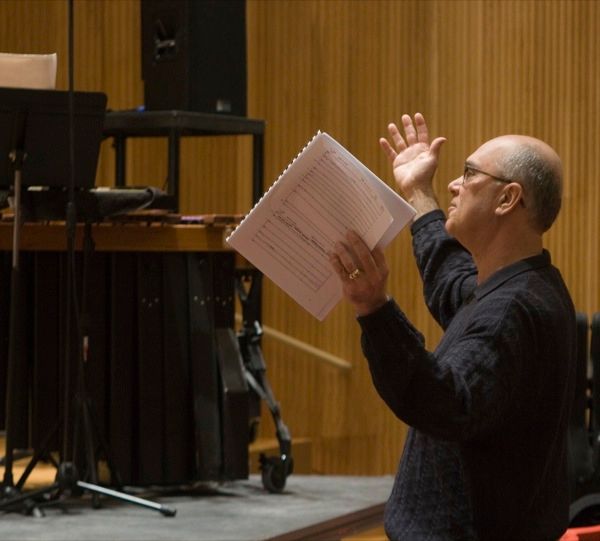
Felder coaches performers during a rehearsal of Tweener
In 1988, I wrote these solo pieces which are known as the Crossfire series, one of them is BoxMan for trombone, and another is a solo violin piece called Another Face.  Those were pieces that were supposed to be done with video walls.  We actually managed to do them here before they were done in Huddersfield and Vienna and some other places.  So we brought in the video walls and mounted the production of those pieces which was very difficult to do in those days.  Moving 24 television sets—which were extremely heavy—and setting them up as walls and then doing all the programming and the performances was really a trip.  But the pieces were great in that format, and they worked extremely well, so that was a big highlight for me.  The performances by trombonist Miles Anderson and violinist Karen Bentley were extraordinary!

Otherwise, any time that I hear my string quartets played is great.  For example, a few years ago [2013], JACK astonished me by playing the living hell out of my second quartet, Stuck-stücke, and that was really gratifying.  Of course, the Ardittis play it extremely well, but to then have a next generation quartet pick it up for the first time and play it absolutely brilliantly, that was wonderful!

One of the new things the festival has been doing in recent years is the Performance Institute.

There have been a lot of initiatives over the years, I've tried to do a lot of different kinds of things.  Years ago we had an emerging ensembles program, so groups that were just coming out of conservatory or had just formed in New York were invited to come and be resident ensembles at the festival.  For example, Brad Lubman had a group when he was at Stony Brook called the New Millenium Ensemble, which had just formed, so I invited them to come.  The Meridian Arts Ensemble was another one of the original groups that came under those programs, and there were lots of others.  We also tried a couple computer music initiatives.  And then we did some thematic programming for a number of years, where we looked at specific interactions between, for example, "Music and Text," and so forth.

The Performance Institute is another initiative, it's something that we're piloting right now to see how it might work, and it could be a nice broadening of the festival.

Is there anything in particular you're looking forward to about this year's festival?
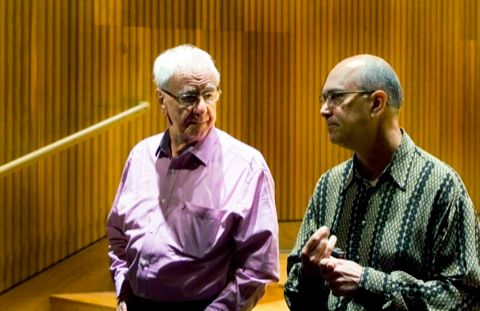
Felder and Bernard Rands at JiB 2014
First of all, I'm really looking forward to seeing so many of the faculty members.  The composers who are coming are people who have been really important to the festival over the years for a variety of reasons.  These are many of the people who have been here the most, who have been the most supportive and probably the most performed—with the exception of Martin Bresnick, who has only been to the festival once before.  I've known him a long time and he's an extremely important teacher and composer, so this is a great opportunity to bring him back to fulfill the mission.

What would you say is the most significant development in your music since the mid-1980s when you restarted the festival?

I see it all as one very connected line, so I don't think that there have been any giant changes.  I would say that the work has perhaps become less technically demanding in terms of what is asked of the players, and more demanding in terms of their ability to contribute just the right sound.  In some of the earlier work there's a lot of complexity on the page, which may not have yielded the same level of complexity in the sounding result (this is typical for younger composers).  So I'm happy now to allow the complexity to exist in the sounding event, and I take a lot of joy in getting out of the way more than I used to.

It seems like there's an increasingly present "spiritual" component—for lack of a better word—at work in your music (I think of Shamayim, Requiescat, and Les Quatre Temps Cardinaux), which seems to contrast with older pieces like Linebacker Music or Canzone XXXI.

It is there, and it's strongly there underneath.  Even if you look at the earlier pieces, the sources may appear less overtly "spiritual," but what's underneath the brass quintet, for example, is Dante.  What's behind that piece is an unfinished canzona from La Vita Nuova.  So it may be a little more on the sleeve now, but it's always been there.


That's interesting, because it seems like a lot of your works make direct reference to, or take inspiration from, poetic texts (e.g., Six Poems from Neruda's “Alturas...”, Les Quatre Temps Cardinaux).

I think the reason goes back to when I was coming of age as a composer.  The older fixed forms held no appeal for me at all.  I was not interested in writing multi-movement abstract suites, nor was I interested in following any of the existing fixed forms, instead I was looking to try and create my own formal vehicles and containers.

There are many ways to create those containers.  For example, if you go back and read Simple Composition, Wuorinen argues very convincingly that one can extrapolate from aspects of the time point and build the form purely from concrete musical abstraction.  But for me, I wanted to find something that could be an inspirational touchstone, either that I could constantly refer back to as a way of looking to see if I was actually doing what I thought I was, but more importantly, to give me the opportunity to create forms which were modeled on some kind of psychological or spiritual profile that could be extracted from texts—not so much literally, but more as a way of modeling a behavior.  

So, for example, the piece BoxMan refers to the novel by Kōbō Abe.  I was reading that at the same time I was reading Konrad Lorenz's book, On Aggression.  In that book, Lorenz is looking at the long relationships of Greylag geese:  they pair up, male and female, and stay together for virtually their entire lives.  And yet, they manifest these varying kinds of aggressive behavior, which he studied as a way of looking at aggressive behavior in people.  Somehow, that was assembled in my mind with the lead character called the "BoxMan" in Abe's novel, and the result was a form which was a pure musical abstraction—one that works like a long set of variations.  The controlling forces in the variations are some behaviors that I abstracted from those two books.  So that's why you see some performance directions in the score like, "threatening," or "manic." 


Your recent piece, Les Quatre Temps Cardinaux ["The Four Cardinal Hours"], is a much more large-scale form, which is based on the cycle of a single day.  It occurs to me that a lot of large-scale works seem to take these seemingly mundane cycles as stepping-stones to larger forms (e.g., the days of the week in Stockhausen's Licht, or Joyce's Ulysses, which is also based on a single day).  Were any of those earlier works reference points for you?

Not directly, but when I interviewed Stockhausen, he said something that was very powerful for me.  I had asked him about circular forms, and he said, "No, it's a spiral."  I hadn't ever considered that before, and that simple sentence changed a lot for me in my own thinking about form.

The idea is that these are ways that we measure temporal existence.  So that's why larger works have a tendency to use these as models in some way.  The very short Daumal poem, which is at the heart of LQTC—something he did very late in his life when he was close to death, after not writing poetry for years—was extremely powerful to me for its simplicity and clarity.  When he was a young man, he wrote extremely complicated automatic writing pieces, but through the course of his own creative life, and his contact with Hindu art-forms, he came back to something that was extremely simple but very powerful and direct, in that it works on an inner level with its imagery. 

The other poems, by Robert Creeley, Dana Gioia, and the reference to Pablo Neruda, are much more personal articulations of that larger transpersonal kind.  One of the great things about Creeley is that he can take a very simple moment that occurs in a day, and connect it, in a very subtle way, to much larger senses of time.  For example, there is one poem of his [“Kitchen” from Thirty Things, 1975] in which he's in a room, watching the light change as it comes through some lace curtains, but he's watching the light change indirectly on the floor, and that's a reference point.  It's very subtly done, he doesn't draw attention to it, but through that illustration the individual poet is connecting the passing of his own life to the larger life of man.  So that was the idea of the formal wheel in LQTC.
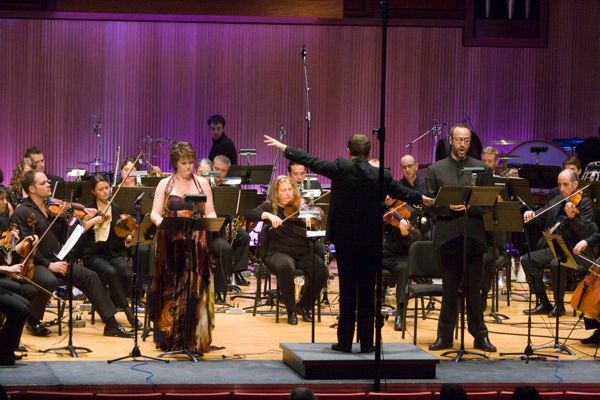
Brad Lubman conducts Felder's Les Quatre Temps Cardinaux
You also seem to have a predilection for lower voices in your music.  Contrabass clarinet, contrabass trombone, and bass flutes all figure prominently in some of your works, and the last movement of LQTC focuses almost entirely on the orchestra's lower range.  What attracts you to these lower pitch extremes?

I'd say I'm attracted to the unexplored regions, it's like Amundsen going to the South Pole or people who go down into the depths of the ocean in bathyspheres. I know there's a power in the low register that is very profound.  Much of contemporary music has been very focused on the attack point, but I'm interested in the movement of voices in the lower register which are not solely based on attack point or harmonic movement but are instead coloristic or resonance-reinforcing movements.  I'm also interested in the very highest registers.

There used to be three body types people talked about:  ectomorph, mesomorph, and endomorph.  I used to joke that I was mesomorphic (which is a body type that is wider at the hips), and so much of my music revolved around middle C and the octave below.  I think it's because of the tessitura of my voice:  I was a tenor-baritone and was a singer my whole life, so naturally, somehow, that's where my pieces originated.  And I noticed years later that many of my pieces work out from that register.

Even LQTC begins its unfolding from the F# in that octave.

Yes, it's meant to start there, due to the importance of B (the piece is very A/B centric).  The F# is also important because it's the 11th partial of a C fundamental.  And if you look at the piece, you'll see that there are certain pedal tones in the beginning, which essentially set out the work's major harmonic focal points.

I’m definitely looking forward to hearing that again at the festival this year.  Finally, when it comes to June in Buffalo, its legacy, and its longevity, what are you proudest of?

I don't know that I think in those terms.  If I had to answer that, I'd say that we've probably done performances of around 700 or more young composers' pieces, and those performances and the help that we've given to people over the years, I think has been really important to the profession.

I'm extremely grateful to the University at Buffalo, and Buffalo arts organizations, as well as our donors, university patrons, audiences, and composers—both student participants and faculty members—who have participated and supported this endeavor over the years.  Without that support, we certainly would never have gotten off the ground.  So it's very gratifying to continue to feel that Buffalo is a place that supports work that is innovative and hopes to advance the conversation about the ongoing developments in the field, whatever they may be.


June in Buffalo has certainly been a locus for the musical conversation to continue, with energetic and adventurous performers willing to dive into the uncharted territories being carved out by today's composers.  And the festival will surely continue for years to come, with hundreds more young composers hearing great performances of their work, further encouraging these emerging artists to keep surveying unexplored sonic regions.


—Ethan Hayden

Thursday, October 9, 2014

BMOP brings David Felder's Les Quatre Temps Cardinaux to Boston


Gil Rose conducting the Boston Modern Orchestra Project
This Sunday, the Boston Modern Orchestra Project will perform David Felder's massive song cycle, Les Quatre Temps Cardinaux, as part of its season-opening "Surround Sound" event.  Also featuring Ronald Bruce Smith's Constellation and the premiere of Anthony Paul De Ritis's Riflessioni, the evening centers itself on works that "merge orchestral and electronic sounds in profound and imaginative ways."  

BMOP Artistic Director and conductor, Gil Rose, describes the project:  "As you can probably imagine, a carefully choreographed balance of ensemble, soloist, and electronics is rarely found in works for orchestra these days.  We are pleased to share new works by leaders of the electro-acoustic vanguard that we believe best exemplify this highly sophisticated colloquy. Be prepared for some subsonic clangors and supersonic electronics!"

Indeed, those who were fortunate enough to attend the premiere of Felder's Les Quatre last year—an excerpt of which can be seen below—know the delicate choreography Rose is referring to.  The fifty-minute opus is composed for a chamber orchestra of forty musicians, two solo voices, and twelve channels of (surround-sound) electronics.  In addition, Felder has included specific cues for lighting, adding a visual dimension to the piece's narrative.  Coordinating all these elements is a substantial task for the performers, but one which yields transcendent results.


Les Quatre was composed specifically for the voices of Laura Aiken and Ethan Herschenfeld, who premiered the work and who will perform it with BMOP this weekend.  Vocal sound plays a huge role in the piece, which is centered on the eponymous poem by René Daumal, that, in Felder's words, "alludes to times of the day, the four elements, the four seasons and the four corresponding ages of life, emphasizing the trans-personal."  Felder was drawn to Daumal in part due to the poet's astute orchestration of vocal sound itself.  "His early career emphasized the conversion of poetry into a form of theater in which speech, gestures, breath, voice stops, and other elements of performance form a totality."  

Felder supplements Daumal with settings of Dana Gioia's "Insomnia" and Robert Creeley's "Buffalo Evening," both of which feature electronic samples of the poets reading their works.  "Bob Creeley was a very musical reader,” Felder explained to the Buffalo News last year, "There's a lot of things he does when he reads that are innately musical. Dana was trained as a musician also. When you hear them read, and listen to the sounds of the vowels, they're very musical rhythms."  

The seeds of Felder's setting of "Buffalo Evening" can be found in So Quiet Here, a short electroacoustic piece the composer prepared for the poet's 80th birthday celebration.  In So Quiet Here, the electronics emphasize the sonorous quality of the poet's voice, underlining and accentuating reoccurring phonemes.  In Les Quatres, however, the electronics are augmented with an elaborate percussion accompaniment, which mimics and resonates with the specific sounds of the poet's voice, before the other instruments join in and Herschenfeld begins intoning the evocative words.  In a way, the poem itself seems to have moved through four stages (written text, electronic recitation, percussive translation, orchestral setting), mirroring the "quatre temps" narrated by the large-scale work itself.


It's exciting that a work with such subtlety and richness will be performed by such a strong orchestra dedicated to contemporary music.  BMOP is widely recognized as one of the leading orchestras in the US specializing in new music.  Founded by Rose in 1996, the orchestra seeks to "illuminate the connections that exist naturally between contemporary music and contemporary society by reuniting composers and audiences in a shared concert experience."  In its first 18 seasons, BMOP has performed over a hundred world premieres in nearly as many concerts, including forty commissioned works.  Indeed, BMOP were co-commissioners of Les Quatres with SIGNAL ensemble and the Serge Koussevitzky Music Foundation, and in addition to performing the work, the orchestra will be recording it as well.

If you're in the Boston area, be sure to order a ticket to this exciting event!

Surround Sound
Boston Modern Orchestra Project
Gil Rose, conductor
Sunday, October 12, 2014, 3:00pm
Jordan Hall at New England Conservatory
Pre-concert talk one-hour prior to concert


BMOP Artistic Director Gil Rose has also conducted the Slee Sinfonietta, read about that performance here.


—Ethan Hayden


Updated October 21, 2014:

The BMOP performance has received several rave reviews.  Jeremy Eichler wrote in the Boston Globe:

David Felder’s Les Quatre Temps Cardinaux of 2013 was the symphonic-length conclusion to Sunday’s program. It’s a fiercely ambitious work, employing soprano and bass soloists (here, Laura Aikin and Ethan Herschenfeld), and weaving together poetic texts by René Daumal, Robert Creeley, and others, by turns sung, heard in recorded recitation, and abstracted into pure sound. At one point, for instance, we hear all the vowels of a poem strung together without any consonants. Felder deploys his vastly expanded palette of sounds artfully. In Sunday’s account, the human voice of the poetry introduced a kind of melancholy undercurrent beneath the whir of the orchestral machine.

He added that the performances "opened up as many questions as they answered about the possibilities for 21st-century technologies interacting with what we might describe as the cutting-edge sound technology of the 19th century."

David Wright of the Boston Classical Review wrote that "the composer’s use of the orchestra was resourceful and evocative throughout the work, and skillful execution by the players and conductor Rose made his musical imagery leap off the page." Wright was particularly taken with the piece's use of electronics:
All the pieces in Sunday’s concert […] might have inspired the title "Surround Sound," but it was the Felder work that made it literally true, bouncing electronic sounds and samples around an array of speakers located throughout the auditorium. To call Felder’s Les Quatre Temps Cardinaux "electronics-enhanced" would be like calling Brahms’s First Symphony "horn-enhanced."  The electronics were so integral to this ambitious, 50-minute-long meditation on time that they became a third soloist, taking over entirely from the orchestra at several points in extended solo cadenzas.

Thursday, May 16, 2013

Ensemble Signal returns for June in Buffalo 2013


Ensemble Signal 
We’re looking forward to Ensemble Signal joining us for June in Buffalo 2013 – we just recently enjoyed hosting them for the world premiere of David Felder’s recent Koussevitsky commission Les Quatre Temps Cardinaux, where they assembled an orchestra of 35 musicians and were joined by soprano Laura Aikin, bass-baritone Ethan Herschenfeld, and 12 channels of electronics. Check out more on the premiere from our friends at the Buffalo News, Artvoice, and Sequenza21.


More recently, Signal celebrated the release of their Helmut Lachenmann DVD on Mode Records, which features a performance of Zwei Gefühle with Lachenmann himself, which they performed here at Slee Hall back in 2010. Other recent projects of Signal’s include a staged production of the NY Premiere of Charles Wuorinen’s It Happens Like This at the Guggenheim Museum, performing the music of Brian Ferneyhough at The Tanglewood Festival of Comtemporary Music, and the recent premiere of Señales by Hilda Paredes, written for Signal and Irvine Arditti.


Signal will be rehearsing and performing the works of June in Buffalo composer participants on June 4th, and on June 8th they will offer a concert of June in Buffalo faculty composers, including Brian Ferneyhough’s Terrain (1992), Charles Wuorinen’s Big Spinoff (2011), Augusta Read Thomas’ Carillon Sky (2005), and Yehudi Wyner’s Passage (1983). Brad Lubman will be wielding the baton and will be joined by Irvine Arditti on violin and Kenneth Radnofsky on saxophone.


Enjoy the excerpt below of Signal’s recent Lachenmann release on Mode Records:


Link to this post here.


Monday, April 8, 2013

New UB Office of the President Signature Series kicks off with David Felder's Les Quatre Temps Cardinaux April 23!


Les Quatre Temps Cardinaux World Premiere
We're very excited to announce the World Premiere of David Felder's Les Quatre Temps Cardinaux, which will be part of a two day series of events presented by the University at Buffalo Office of the President. The events will inaugurate the Signature Series, a new university tradition, which President Satish K. Tripathi has introduced to "to celebrate UB's legacy of innovation and distinction in arts and letters." The premiere of the work, commissioned by the Koussevitsky Foundation, will take place on Tuesday, April 23rd, at 7:00 p.m. in Slee Hall, and feature a 30+ chamber orchestra of musicians including the Slee Sinfonietta, Ensemble SIGNAL, soprano Laura Aikin, bass-baritone Ethan Herschenfeld, and ten channels of electronics. Last month's full press release can be found here.

The two days worth of events include an open rehearsal, a luncheon dialogue, a panel discussion, a pre-concert reception, and concludes with the premiere. The complete two-day schedule follows below in the press release from The University at Buffalo Office of the President:


WORLD PREMIERE PRESENTED BY THE UB OFFICE OF THE PRESIDENT AND THE ROBERT AND CAROL MORRIS CENTER FOR 21ST CENTURY MUSIC
Tuesday, April 23, 2013 | 7 p.m.
University at Buffalo President
Satish K. Triparthi
LIPPES CONCERT HALL, SLEE HALL, NORTH CAMPUS

The premiere is the focal point of a two-day program that marks the start of a new university tradition called the Signature Series, which President Satish K. Tripathi has introduced to celebrate UB's legacy of innovation and distinction in arts and letters.

An internationally acclaimed composer of contemporary music, David Felder has long been recognized as a leader in his generation of American composers. His works are known for their highly energetic profile, lyrical qualities and for his use of technological extension and elaboration of musical materials. Felder is SUNY Distinguished Professor and Birge-Cary Chair in Composition at UB.

LES QUATRE TEMPS CARDINAUX

“Les Quatre Temps Cardinaux” is a complex song cycle for two solo voices, a 35-piece orchestra and twelve channels of electronics. Commissioned in 2011 for the Serge Koussevitzky Music Foundation in the Library of Congress, “Les Quatre” is dedicated to the memory of Serge and Natalie Koussevitzky. The work was composed from fall 2011 through spring 2013, and was written for Ensemble Signal, The Boston Modern Orchestra Project and the Slee Sinfonietta, and for singers Laura Aikin and Ethan Herschenfeld. Additional support was provided by the Robert and Carol Morris Center for 21st Century Music at UB, the Cameron Baird Foundation, the Birge-Cary Chair at UB, and the American Academy of Arts and Letters.
Ethan Herschenfeld

Schedule of Premiere and Related Events
MONDAY, APRIL 22

2—3:30 PM
Open rehearsal of "Les Quatre"
Open to the public, RSVP requested
Lippes Concert Hall

Join music enthusiasts from UB, other local colleges and schools, and the community as the composer, conductor, vocalists, and ensemble allow the public to observe one of the final rehearsals of "Les Quatre" prior to its world premiere.

Laura Aikin
TUESDAY, APRIL 23

1—2 PM
Luncheon Dialogue: “Inside the Making of ‘Les Quatre Temps Cardinaux’”
Open to the public, registration limited to 60, RSVP required
Slee Lobby

Composer David Felder and others involved in the premiere will hold a lunchtime discussion of the process of bringing "Les Quatre" from conception to fruition. A complimentary light lunch will be provided for all registered participants.
3:30—5 PM
"Textural Signatures": A Panel Discussion
Open to the public, RSVP requested
Baird 250

Slee Sinfonietta
photo by Irene Haupt
Faculty and students from the departments of English, Music, and Theatre and Dance, joined by the biographer of poet René Daumal (whose poetry is musically interpreted in "Les Quatre"), will explore the relationship between texts and the arts, with attention to the particular poems featured in Professor Felder's composition.
5:30—6:45 PM
Pre-concert reception, sponsored by University at Buffalo Alumni Association
Ticketed event limited to 100, RSVP required
Black Box Theater, Center for the Arts

Gather with others prior to the premiere for drinks and hors d'oeuvres, with remarks by E. Bruce Pitman, Dean of UB's College of Arts and Sciences, and composer David Felder (schedule permitting). Reception cost includes admission to the 7pm concert.
Brad Lubman and
 Ensemble SIGNAL

Single Ticket: $30; $25 for UBAA members.
Pair of Tickets: $55; $45 for UBAA members.

7—8:45 PM
Concert
Lippes Concert Hall, Slee Hall

The Slee Sinfonietta presents The Signal Ensemble:

   •  Brad Lubman, conductor
   •  Laura Aikin, soprano
   •  Ethan Herschenfeld, bass-baritone

Program features the world premiere of David Felder's “Les Quatre Temps Cardinaux,” preceded by a performance of Felder's percussion concerto "Tweener."

Advance tickets: $12/$9/$5
Door: $20/$15/$8
Admission is free for UB students with a student ID


Link to this post here.


Wednesday, March 20, 2013

David Felder's Les Quatre Temps Cardinaux premieres at Slee Hall April 23rd!


David Felder
photo by Irene Haupt
The Center for 21st Century Music is thrilled to announce to the world that the premiere of David Felder’s Les Quatre Temps Cardinaux, commissioned by the Koussevitzky Foundation, will be premiered at the University at Buffalo’s Slee Hall at 7:00 p.m. by a large assortment of musicians – not only the SIGNAL Ensemble with a variety of guests which total to a 35-piece orchestra, but also soprano Laura Aikin, bass baritone Ethan Herschenfeld, and 12 channels of electronics. We spoke to Felder about Les Quatre Temps Cardinaux last year, which is based on, among other texts, the writings of the esoteric French poet of René Dumaul. You can read our feature interview with him about his thoughts on the piece here. Also, please check out his new wikipedia page here.

The Buffalo News has issued a great press release, written by Patricia Donovan, featured below:

British music critic Hans-Theodor Wohlfahrt has written of composer David Felder that “he combines his deep knowledge of the past and the present with a constant searching on a philosophical, human and musical level – a Gustav Mahler for the 21st century."

Felder, PhD, SUNY Distinguished Professor and Birge-Cary Chair in Composition at the University at Buffalo, is an internationally acclaimed composer of contemporary music, with his works known for their highly energetic profile, lyrical qualities, and his use of technological extension for the elaboration of musical materials.  His work masterfully combines widely ranging materials in surprising way, achieving a new synthesis.

On April 23, the UB Office of the President and the Robert and Carol Morris Center for 21st Century Music at UB will present the world premiere of Felder’s “Les Quatres Temps Cardinaux,” a complex song cycle for two solo voices, a 35-piece orchestra and 12 channels of electronics.  It represents the pairing of the composer with two celebrated performers: dynamic soprano Laura Aikin, and bass baritone Ethan Herschenfeld.  Felder wrote the piece specifically for their voices.

Ensemble SIGNAL

The April 23 concert will begin at 7 p.m. in Lippes Concert Hall, Slee Hall, UB North Campus.

Advance tickets are available at the UB Center for the Arts box office 716-645-ARTS (716-645-2787). Prices are $12 (general public), $9 (alumni, faculty, staff and seniors), and $5 for students.

Tickets also may be purchased at the Slee Hall box office on the night of the performance and will be $20 (general public), $15 (alumni, faculty, staff and seniors) and $8 (students). The box office number is 716-645-2921.

The premiere will be the focal point of a two-day program that marks the start of a new university tradition, which President Tripathi is introducing as a way to celebrate the university community’s rich and thriving legacy of innovation and distinction in the arts and letters.  Other programming being held as part of this celebration include a rehearsal open to the campus and local community; a brown bag lunch discussion with the composer, conductor, and musicians; a panel discussion with faculty and students focusing on the interpretation of texts as works of art; and an alumni-sponsored reception and Q&A with the composer and performers.

“UB has a long and storied tradition of creative excellence and innovation at the vanguard of the arts,” said UB Satish K. Tripathi.

Laura Aikin
“This event is a wonderful opportunity to shine a spotlight on some of the outstanding individuals who embody this tradition, from David Felder’s visionary achievements in contemporary composition, to the expression of that vision by world-renowned alumni like Laura Aikin and the distinguished faculty performing in the Slee Sinfonietta, to poets like the late Robert Creeley, whose voices are woven into the performance in surprising and remarkable ways.  I am very much looking forward to what will surely be an evening to remember.”

The program will open with “Tweener,” a 2010 Felder composition for solo percussion, electronics and large chamber ensemble.  The soloist will be Thomas Kolor, assistant professor of music at UB and one of the country’s top young specialists in late 20 century American percussion music.

The orchestra for both compositions will comprise ensembles dedicated to the presentation of contemporary chamber orchestral music, the acclaimed Ensemble Signal, conducted by world-renowned Brad Lubman, and the Slee Sinfonietta, the flagship professional chamber orchestra of the Morris Center.

Both works employ electronics, with “Tweener” utilizing the KAT mallet controller as an addition to the wide variety of traditional percussion instruments that make up the battery of resources used in the solo part.

Ethan Herschenfeld
One of the most important elements of “Les Quatres…” is the poetry that Felder has incorporated into the piece.  It includes the eponymous “Les Quatres Temps Cardinaux,” a poem composed by French poet René Daumal near the end of his life.

Daumal’s early career emphasized the conversion of poetry into a form of theater in which speech, gestures, breath, voice stops and other elements of performance form a totality.

“Later,” says Felder, “after his contact with ancient Hindu texts that detail the aesthetic purposes of poetry and theater, Daumal reconsidered his purpose, and his late poetry is simple, profound and luminescent.  ‘Les Quatre Temps Cardinaux’ is one of his last two poems, and alludes to times of the day, the four elements, the four seasons and the four corresponding ages of life, emphasizing the trans-personal.


We’re excited that such a large, complex, and deeply thought-out work from an innovative American composer and commissioned by a highly respected commissioning foundation can be featured at our very own Slee Hall and feature such respected performers and musicians. Tickets will be limited and in high-demand, so please reserve yours in advance. Hope to see you there!


Les Quatre Temps Cardinaux
April 23, 2013, 7:00 p.m. in Lippes Concert Hall, Slee Hall, UB North Campus.

Advance tickets at the UB Center for the Arts box office: 716-645-2787
General Public: $12
Alumni, Faculty, Staff, Seniors: $9
Students: $5

Night of the performance:
General public: $20
Alumni, Faculty, Staff, Seniors: $15
Students: $8

Contact the Slee box office at 716-645-2921.


Link to this post here.