Wednesday, September 30, 2015

Saariaho, Fagerlund, and others celebrate FinnFest


Next week will see the beginning of FinnFest 2015 in Buffalo, an annual festival celebrating Finnish culture and heritage, which includes a variety of cultural and educational activities and events.  Due to Finland's rich musical history, the week-long festival will feature a variety of exciting musical performances, including a pair of concerts by the Buffalo Philharmonic in Kleinhans Music Hall (itself designed by Finnish architects Eliel and Eero Saarinen).  "Echoes of Sibelius" (October 9-10) will feature the first symphonies of Sibelius and Einojuhani Rautavaara, with the US premiere of Jaakko Kuusisto's Violin Concerto; "Northern Lights" (October 3-4), will feature Sibelius's Fifth Symphony and Grieg's famous Piano Concerto, alongside the US premiere of Isola, by Sebastian Fagerlund.  Both Fagerlund and Kuusisto will be present for their respective premieres, and will give preconcert talks.

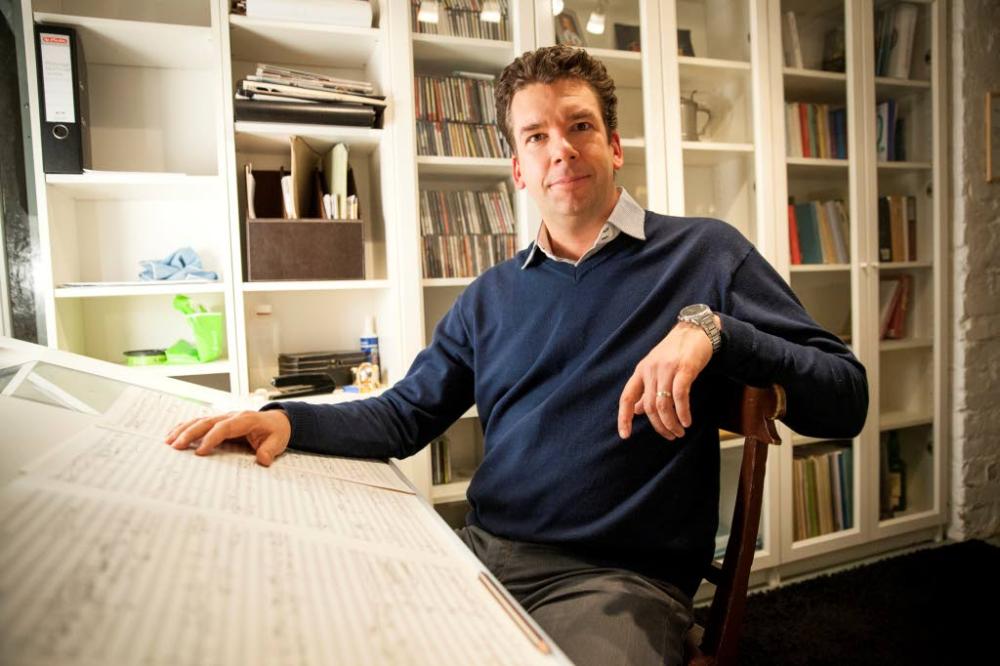
Sebastian Fagerlund
The Center is also excited to welcome Fagerlund as the first guest in this season's Visiting Lecture Series, with his presentation on October 2.  Fagerlund's rich, vibrant music often carries existential themes, and has been described as "post-modern impressionism depicting mental landscapes."  Combining elements from Eastern and Western musics, minimalist electronica and Scandinavian black metal, big band and Boulez, his diverse output—while oscillating between extremes—errs on the side of rhythmic drive and unceasing energy.  "A sort of primitivism is present in many of my works, [and] as a result, rhythm, in particular, has become very important [to me]" he explains.  Isola represents these ideas well, featuring an often violent approach to the orchestra which combines performative aggression with harmonic and textural sophistication.

Kuuisto will also present at the Visiting Lecture series, the following week.  The violinist-composer began studying at the Sibelius Academy at the age of 12 and quickly made a name for himself by winning several international competitions.  As a violinist, he has performed with the Sydney, Adelaide, and Melbourne Orchestras, the Hannover NDR Orchestra, and the Belgian Royal Philharmonic Orchestra, as well as most of the major Finnish orchestras.  As a composer, his output includes chamber and vocal music, orchestral works, film music, and operas—including his most well-known work, the "family opera," Koirien Kalevala, which was presented at the Savonlinna Opera Festival to a full house for three consecutive seasons.  We look forward to hearing his insights into his work.

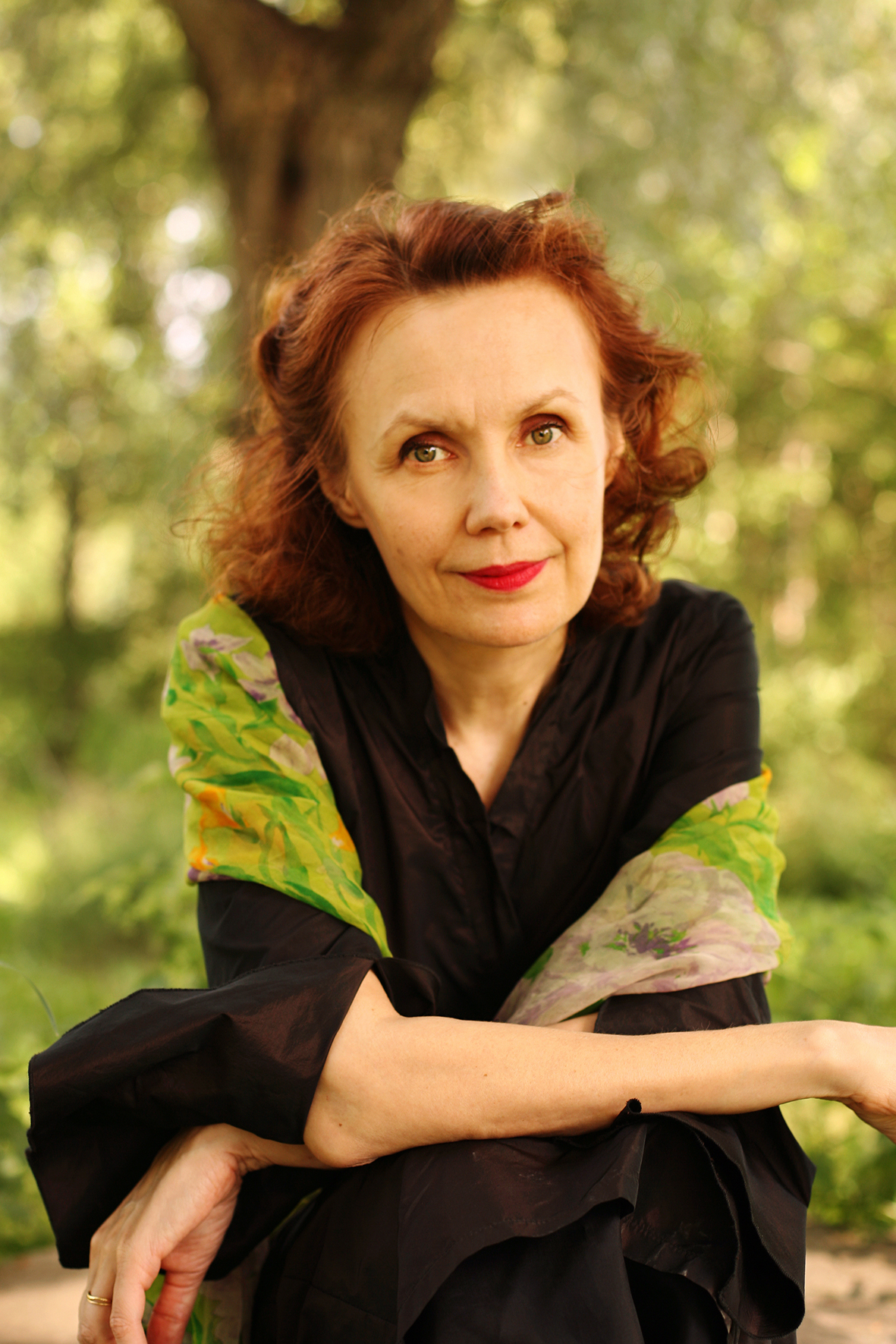
Kaija Saariaho
The Center's contributions to FinnFest do not end there.  We are excited to also host the residency of famed Finnish composer Kaija Saariaho, and to present a special Slee Sinfonietta / Ensemble SIGNAL concert  of some of the composer's most significant works on October 6.

Saariaho's music has always been marked by a fascination with color and texture, with timbre and harmony being the foundational elements.  While her earliest works showed the influence of late-modernist post-serialism—an idiom she eventually found to be constraining—her outlook shifted after being exposed to the music of Grisey and Murail while studying at Darmstadt.  As her aesthetic began to take shape during a period of research at IRCAM in Paris, Saariaho developed new expressive techniques based in analysis of the sonic spectra of instrumental sounds.  Her first computer-assisted composition was Lichtbogen, for 9 instruments and live electronics (1986), a piece whose point of departure lies in the spectrum of high harmonics which burst forth from a cello when bow pressure is increased (hence the title, which translates as "light-bow").

Paul Gauguin - NoaNoa
NoaNoa (1992), for flute and electronics, was composed in close collaboration with flautist Camilla Hoitenga, who will perform the work during next week's Sinfonietta concert.  The composer describes the work, which was inspired by the Paul Gauguin woodcut of the same title, as stemming from a desire to "write down, exaggerate, even abuse certain flute mannerisms that had been haunting me for some years."  The piece itself has become a key work in the contemporary flute repertoire and a signpost in the solo-instrument-plus-electronics genre.  Prés (1992), for solo 'cello and electronics, is also inspired by a Gauguin work (the painting, By the Sea), and pairs the string instrument with an electronic doppelgänger consisting of synthesized tones, manipulated 'cello sounds, and real-time processing of the live 'cello with resonant filters.  The piece will be played by SIGNAL executive director, Lauren Radnofsky.

The concert's most recent work is 2001's Aile du Songe, a concerto for flute, string orchestra, and percussion (also to be played by Hoitenga).  Like so much of the Saariaho's work, the piece is written in exquisitely detailed notations featuring harmonics, microtonal coloring, and a wealth of expressive markings.  Listeners will be privy to her slow timbral transformations as well as the sensitive lyricality which has been an increasingly present element in the composer's work since the late 1990s, when she began a series of operatic and vocal works.  Still marked by a sparsity characteristic of much of her earlier music, ("I don’t believe in austerity," the composer has said, "but I do [believe] in purity"), the work is sure to illustrate why the Denver Post has called "one of the most original compositional voices of our time."

The festival will include other intriguing musical events, including the Buffalo Chamber Music Society's hosting of the Carpe Diem String Quartet, who will perform a concert of Finnish works in Kleinhans' Mary Seaton room, including Sibelius's Andante Festivo, Rautavaara's first quartet, and Erkki Melartin's "The Sunflower."  In addition, Buffalo contemporary music ensemble Wooden Cities will present "A Kalevala Duo:  Playing Bones" a collaborative concert with performance artist Pia Lindman, which will feature the ancient Finnish technique of "bone-setting" set to music by recent UB-graduates Nathan Heidelberger and Brendan Fitzgerald.


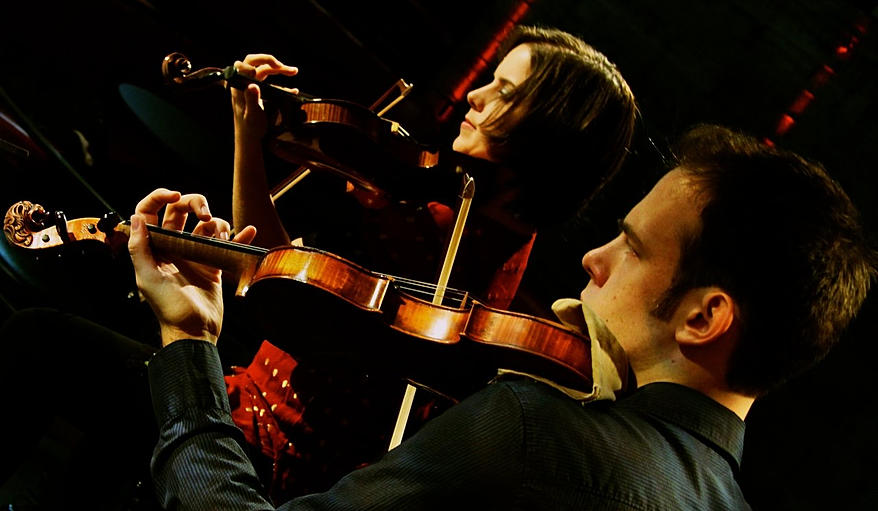
Mivos Quartet
If that's not enough music for you, next week the Center will host the Mivos Quartet for a concert of new works for string quartet (including works by Taylor Brook, David Felder, Martin Stauning, and Helmut Lachenmann).  This concert (October 5) was rescheduled from last season after a blaze of Buffalonian thundersnow (read more about the program here), so don't miss your second chance to see these amazing works played by the quartet the Chicago Reader has called "one of America's most daring and ferocious new-music ensembles."

Monday, September 21, 2015

A Busy Summer for UB Composers...


Summer is always a busy and exciting time for UB graduate composers, with many of them participating in conferences, festivals, and seminars in the US and abroad, and having their works performed by some of the most skilled performers in the field.  This past summer was no different, as you can see below:

Weijun Chen had two pieces which received multiple performances this summer.  First, his string quartet, Canoe, was performed by the Rhythm Method quartet at New York's Mise-En Music Festival in June.  As a student composer at this year's Aspen Music Festival and School, Weijun heard an orchestral adaptation of the piece performed twice (in July, and a few weeks later in August).  In addition, his Memos, for pierrot and percussion, was premiered at June in Buffalo by the New York New Music Ensemble, and was performed again at Aspen by the Aspen Contemporary Ensemble.


Matthew Chamberlain
Also at June in Buffalo, Matthew Chamberlain saw the premiere of his brass quintet, Three Family Photos, by the Meridian Arts Ensemble.  In addition, his string trio, Photo, was premiered by Chartreuse, with performances in Buffalo, Chicago, and New York.  Also a skilled conductor of new music, Matthew conducted at a JiB Performance Institute concert, leading a number of performers in Jacob Druckman's Come Round.  He also participated in a weeklong master course with world-renowned conductor Péter Eötvös in Budapest, where he performed Philippe Manoury’s piano concerto, Passacaille pour Tokyo.

Colin Tucker curated and produced Decay/Reverberate, a four-day festival of site-specific sound works created for presentation at Silo City, a group of historic vacant grain elevators in Buffalo.  The event included performances, installations, and guided listening activities, each of which engaged with the acoustic, social, and historical implications of the site.  Part of the Null Point series, a Buffalo-based platform for experimental arts founded by Colin, the festival featured performances by several artists associated with UB, including composers/sound artists Matt Sargent, Daniel Bassin, and Tom Stoll, and performers Zane Merritt, Crossfire Percussion (Bob Fullex and Jason Bauers), and John Bacon.  Read more about the event here, and check out Matt Sargent's Tide (10+1 Basses), a piece premiered at the event by bassist Zachary Rowden, below:


"I am grateful for the Center for 21st Century Music's financial support of the event," says Colin, who is currently planning a similar event at the same site for next spring.  Colin was also a fellow in the Summer Academy for Young Composers at Akademie Schloss Solitude in Stuttgart, Germany, where he studied with Chaya Czernowin, Ming Tsao, and Rebecca Saunders.  At Schloss, Colin presented a lecture on his work, and his engulfed, constrained in a widening gap was performed by friends of the Center, Ensemble SurPlus.

Colin also curated, organized, and performed on Null Point's Virtuosities, a concert program which toured the American midwest, playing eight cities in nine days.  The program featured two of Colin's pieces, distances swarming and encompassing, for prepared electric guitar and the audio installation, voice-dross, in addition to North American premieres of works by Joseph Kudirka, and Eva-Maria Houben.  While on tour, the ensemble was featured on Muddle Instead of Music, a weekly radio show directed by recent UB graduate, Jacob Gotlib.  A video summarizing the tour's stop at Cincinnati's Experimental Music at the Library series, can be seen below:


The two other composers featured on the Null Point tour were Zane Merritt and Ethan Hayden.  In addition to performing Colin's distances swarming and encompassing, Merritt performed his own solo electric guitar work, Double Etude Gizmo Mechanism Device Machine class alpha, set 1, number A, for guitar and fixed media electronics.  Ethan performed his "…ce dangereux supplément…", for voice and electronics, on the Null Point tour, and a version of the same piece with animated projections was performed by the composer at the international E-Poetry festival in Buenos Aires, Argentina.  This weekend, Ethan will perform the piece at the International Computer Music Conference in Denton, TX.

Dimitar Pentchev wrote, directed, and produced Gleams, an evening-length work featuring live piano, two singer-actors, dancer, and live video projection.  The piece saw three June performances at Toronto's Array Space.  "It is based on my own poetry," Dimitar explains, "and it was produced without any outside help."  An excerpt of the work can be seen below.


Esin Gündüz
ritüellerin yakınlığı (the proximity of rituals), Esin Gündüz's piece for two violas and recorded voice was premiered earlier this month by violists Yuri Gandelsman and Tuba Özkan.  The work was commissioned by the former's viola masterclass at Mersin State Conservatory in South Turkey.  She will soon see the premiere of cura, a new composition for violin, 'cello, and voice, which she will perform with UB's Yuki Numata and Jonathan Golove at the October 11th concert by Friends of Vienna—an organization at which Esin has been composer-in-residence for the past year.

Finally, Roberto Azaretto attended the 2015 MusicArte Festival in Panamá City, where Impasse, his 2011 duo for clarinet and 'cello was premiered by Gleb Kanasevich and Cody Green.

We should also congratulate the composers who, last spring, graduated with their PhDs:  Megan Grace Beugger, Jacob Gotlib, Clint Haycraft, Nathan Heidelberger, and Chun Ting Pang.  We couldn't be more thrilled for them and we know they're already up to new and exciting things!

As the Fall semester begins, each of these composers will begin composing new works and starting new projects, we can't wait to see what's next for them this year!

Wednesday, September 16, 2015

New Composers Join UB Composition Program


This year, UB's Composition program welcomes six extremely talented new composers.  We're excited to get to know them and their music, and we look forward to hearing what they come up with as they pursue their PhD's in Buffalo.

Jessie Downs is a composer, vocalist, and teaching artist who recently graduated from Oberlin (2013).  For Jessie, music is a medium for sharing personal experiences and entering into community with others.  "My work aims to capture things of delicate and wild beauty, from the sound of my mother's backyard, to the decrepit intonation of an antique folk instrument, to elements of the work of other artists […] that resonate deeply with my own practice and view of the world."  Her most recent large-scale work, a piece written during a residency with a middle school band called Dismal Harmony, is a "a surreal sonic expedition."  Each section of the piece strives to capture the experience of a particular point along New Jersey's Dismal Brook.  The musical material comes both from harmonies and textures that resulted from a composing workshop with the band, as well as from Jessie's own time spent with the sounds of the park.


Jessie Downs conducting students at
the NJPAC “Fiddle and Fa-la-la” Fest.
In writing for non-professional musicians, Jessie combines her love of music-making and education.  Since graduating Oberlin, she has worked primarily as a music educator in Orange, New Jersey, where she played a vital role in creating Sonic Explorations, an after-school music program for the elementary school students.  "As a way of creating a space in the program for each student to find their own musical persona, my partner Douglas Farrand and I developed the Creative Musicianship curriculum, in which students build an embodied understanding of key musical concepts through and for creative applications (composing, improvising, instrument building, etc)."  As a vocalist, Jessie practices what is often considered an "arcane strain" of the bel canto technique.  With an approach to vocalization that is much like a gym workout—complete with its grunts and squeals—she aims to build vocal musculature through the practice of a variety of 'raw sounds.'  "The element of struggle with one's voice—both physical and psychological—and the divine variety of timbres, registers, and dynamics that (sometimes) result from this struggle, is a subject of great interest and importance to me."

Alex Huddleston studied composition at Columbia College Chicago with Marcos Balter, Kenn Kumpf, and David Reminick, and recently completed his Masters degree at the Boston University School of Music, where he studied with Joshua Fineberg.  A recent piece of his for pianist and assistant, neglected Gardens; layers of rust, patina, and rock, treats the piano as a complex assembly of mechanical objects and vibrating entities.  In the piece, the pianist sits at the keyboard while the assistant reaches into the body of the instrument and plays directly on the strings.  "As a composer, my interests tend toward oblique criticism of structures of music making in various traditional forms."  The work treats the piano as a series of oscillators in a great "analogico-mechanical synthesizer."


Brien Henderson

Brien Henderson's recent compositional work examines the introspective power of medieval plainsong and the textured melodicism of Renaissance polyphony.  Strongly guided by architect Antoni Gaudí's claim that "originality means returning to our origins," Brien reimagines these timeworn elements in a pitch organization system of his own invention that "embraces the full chromatic spectrum while maintaining a decidedly modal character."  Brien's work also treats noise elements, timbre, and musical fragments as essential material.  A June in Buffalo alum, his piece Fragments of Lost Words was performed by Ensemble SIGNAL at the festival in 2013.

Brien has studied composition with Richard Festinger, Christopher Jones, and Ben Sabey at San Francisco State University, where he earned both Bachelor of Music and a Master of Arts degrees.  Also a singer, for the past two years he sang with Ut Re Mi, a San Francisco-based choir specializing in Renaissance music, and for whom he composed Noli esse vana, a setting of a text from The Confessions of St. Augustine.

Igor Coelho Marques hails from Curitiba, a large Brazilian city 500 miles southwest of Rio de Janeiro.  Beginning his musical education at the city's public conservatory, he soon transferred to Brigham Young University, where he received his undergraduate degree in composition.  He later pursued a Master's degree at the University of Utah before arriving in Buffalo for his PhD.


Igor's style and skill is on display in his 2014 piece, I Win, for pierrot ensemble.  "At the time, I was taken by the idea that even when people discredit you, if you trust your choices and cherish meaningful relationships, you 'win' in the end."  Each of the five instruments is highlighted in a different section of the piece; the composer giving unique material and a characteristic affect to each part, with a conclusion that brings together all the disparate elements.

Nathan Kelly is a composer interested composing for large ensemble forces and in post-minimal music.

Derick Evans is a New York native who grew up just outside of Utica.  Spending his youth performing as an electric bassist in various bands—including his own instrumental jazz-rock trio—he went on to earn his Bachelor of Music degree from the College of Wooster.  He later earned his Master of Music degree from The University of Arizona, where he studied with Daniel Asia.  While in Arizona, Derick served as instructor of a self-designed undergraduate music course focused on improvisation and composition, and earlier this year he founded ensemble D.E.R.F., the school’s first ensemble dedicated solely to performing student works.  D.E.R.F. has performed a variety of works, including Derick's own GILA, a "quirky and playfully irreverent" piece composed for the ensemble.


Derick's academic interests center on American composers, rock music theory, and the assimilation of popular styles in Western concert music.  Derick is excited to leave the Southwest for a cooler northern state.  "Having spent the last two winters in Arizona, I’m excited about the changing seasons and experiencing a snow-filled winter this year in Buffalo.  Although I admit that, having been away for so long, I may have a nostalgic and romanticized recollection of what the snow is like.  My boots and I will find out soon enough."

Monday, September 7, 2015

2015-2016 Calendar of Events


The Robert and Carol Morris Center for 21st Century Music is excited to announce its 2015-2016 Calendar of Events.  The season is sure to be one full of exciting music for adventurous listeners, with performances by the Slee Sinfonietta, Mivos Quartet, Ensemble Linea, and Project Isherwood among other stellar ensembles.

Brad Lubman will direct the Slee Sinfonietta and Ensemble SIGNAL
in works by Kaija Saariaho next month!
The Center is thrilled to host the residencies of several renowned artists this year, including LoadBang, VoxNova Italia, JACK Quartet, and Oerknal Ensemble, all of whom will present concerts of cutting-edge contemporary music and work directly with Buffalo composers at student workshops.  Our Visiting Lecture Series will feature world-renowned composer Kaija Saariaho, whose time in Buffalo will coincide with the events of FinnFest 2015, including a special Slee Sinfonietta program featuring some of her most significant works.  The Lecture Series will also welcome Sebastian Fagerlund, another Finnish composer whose works have received wide acclaim, and who will be featured on an October Buffalo Philharmonic concert as part of FinnFest.

The year will culminate in June in Buffalo 2016, the Center's annual festival and conference dedicated to composers, which will welcome a number of exciting artists including the composers Hans Abrahamson, Hanna Eimermacher, Joshua Fineberg, and Josh Levine, in addition to the festival's artistic director, David Felder.  A number of spectacular resident ensembles will be in attendance, including the Arditti Quartet, the Buffalo Philharmonic Orchestra, Ensemble SIGNAL, the Slee Sinfonietta, and—in their first visits to the festival—Dal Niente and Uusinta Ensemble.   The JiB call for works will be released within the coming months…

See below for our full calendar of events, or visit the Center's website.


Robert and Carol Morris Center for 21st Century Music

2015-16 Schedule of Events


October 2, 2015
Sebastian Fagerlund
Visiting composer

October 5, 2015
[Rescheduled concert]:
Program to include works by 
Brook, Felder, Lachenmann, Stauning

October 6, 2015
Visiting composer

November 12-13, 2015
Visiting ensemble
Evening performance and composer workshop

December 4-6
Visiting ensembles
Two evenings of concerts and composer workshop

April 5, 2016
Visiting ensemble
Evening performance

April 30 - May 2, 2016
Visiting ensemble
Evening performance and composer workshop

May 2-5, 2016
Visiting Ensemble
Evening performance and composer workshop
Program to include works by 
Felder, Heidelberger, Nielson, Zorn


Slee Sinfonietta

October 6, 2015
Slee Sinfonietta Presents
Ensemble Signal
Brad Lubman, conductor
Camilla Hoitenga, flute
Lauren Radnofsky, 'cello
Featuring works by Kaija Saariaho
Part of FinnFest in Buffalo, NY

April 21, 2016
Slee Sinfonietta
Program TBA


June in Buffalo 2016
June 6-13
David Felder, Artistic Director

Faculty Composers
Hans Abrahamson
Hanna Eimermacher
David Felder
Joshua Fineberg
Josh Levine

Resident Ensembles
Arditti Quartet
Buffalo Philharmonic Orchestra
Dal Niente
Ensemble Signal
Slee Sinfonietta
Uusinta Ensemble

Special Guests
Magnus Andersson
Brad Lubman

Wednesday, July 1, 2015

2014-15 Season Recap


The Slee Sinfonietta plays Ives's Three Places in New England
The Center's 2014-15 season has been an incredibly exciting one with lots of exciting concerts, including numerous premieres of new works by intrepid composers.  We saw several Slee Sinfonietta programs, including memorable performances of Elliott Carter's Triple Duo (with Ensemble SIGNAL), Charles Ives's Three Places in New England, and the production of Doug Fitch's magnificent "How Did We…?".  We had two fruitful residencies with the Mivos String Quartet and the Deviant Septet, and several visiting composers, including Larry Groupé, Rand Steiger, and Daniel Asia.

Last month, we capped off the season with the 40/30 anniversary of the June in Buffalo Festival, a vibrant week of new music that featured 16 concerts with nearly 80 adventurous new works performed—half of those by the 30 emerging composers in attendance.  The festival was a great success, a celebration of many years of great performances.  In a recent Wall Street Journal Article, author Allan Kozinn points out that, "It would be hard to name more than a handful of major composers of the past 30 years who have not appeared on its faculty roster."  Kozinn, impressed with the work of the festival's participant composers, elaborates:
[A] highlight of a Saturday afternoon program devoted to new student works was Mr. [Eric] Huebner's assured account of Music for a Mad Scientist—300+ Microvariations on a Bach Theme, an explosively virtuosic solo piano work by Texu Kim.  Mr. Kim […] hid his Bach theme amid intensely chromatic Lisztian thunder, at first.  But when the invigorating clatter briefly subsided, the score's internal joke became clear:  The work's theme is the gently arpeggiated C major Prelude that opens The Well-Tempered Clavier, Book I.  […]  Ying-Ting Lin's The Journey began murkily, with repeated bass tones in the piano punctuated by chordal bursts for bass clarinet and violin, but quickly grew into an engagingly varied, lively piece.  Liliya Ugay played the assertive, steely piano line in her own Third World Fable, but regularly ceded the spotlight, and some lovely, supple writing, to the violin and cello.  The student program's most satisfying work was its opener, Ryan Jesperson's Souvenirs/Miniatures, a tightly focused piano trio that—like Ms. Ugay's work, but with a different accent—juxtaposed tense, sharp-edge keyboard angularity with luminous string writing rooted in 19th-century shapeliness.
SIGNAL and the Slee Sinfonietta perform
David Felder's Les Quatre Temps Cardinaux
Kozinn also took note of Saturday night's stunning performance of David Felder's Les Quatre Temps Cardinaux by SIGNAL and the Slee Sinfonietta, under Brad Lubman's direction.  The chamber orchestra piece set poems by René Daumal, Pablo Neruda, Robert Creeley and Dana Gioia (read more about the work here), and featured vocal soloists Heather Buck and Ethan Herschenfeld, as well as video projections by Olivier Pasquet and 12 channels of electroacoustic sound:
The poems are heard not only in the spiky, emotionally intense vocal writing, but spoken on the recorded tracks, which also include percussion sounds and the sparkle, buzz and variegated growl of purely electronic timbres, all moving around a dozen speakers placed throughout the hall.  Abstract video by Olivier Pasquet added atmosphere rather than commentary.  All this could easily have become an exhibition of gimmickry, but Mr. Felder kept his grand audio-visual fabric focused, sober and often wrenching.
The festival saw not only great performances, but also seminars and masterclasses by its world-renowned faculty composers, which can be invaluable to emerging composers.  As noted in a recent UB Reporter article by this author:
The works of these faculty composers were featured in JiB's evening concerts, while the composers themselves gave morning seminars and consulted with participant composers in master classes.  "I am always eager to show my works to professors and peers, not to find confirmation but to collect 'data,'" says Chen.  "Then, at the end of the day, I sit down and do some 'data mining' for my future projects.  […]  JiB is only a week long, but its impact on me will surely last for years to come. I cannot wait for JiB 2016."
For those interested in learning more about the festival, be sure to check out our series of profiles of JiB artists on Edge of the Center, and visit the UB Music Library for an exhibit commemorating the festival's 40/30 anniversary, which is still on display.

Onward…

The Oerknal Ensemble will visit the Center next year
The gears are already in motion for next year's season.  We are excited that next year's events will include visits from guest composers Kaija Saariaho and Hanna Eimermacher, as well as residencies with several prominent new music ensembles, including Load Bang, Voxnova Italia/Project Isherwood, Ensemble Linea, and the Oerknal Ensemble.  We can also look forward to many spectacular Slee Sinfonietta concerts, and of course, June in Buffalo 2016, which will feature the following resident ensembles:  Arditti Quartet, Buffalo Philharmonic Orchestra, Ensemble Dal Niente, Ensemble SIGNAL, Slee Sinfonietta, Uusinta Ensemble.

Edge of the Center will announce more details on all of these events in the coming months.  It's already shaping up to be another incredible season featuring some of the most skilled performers in the city and from around the globe.


Robert and Carol Morris Center for 21st Century Music

2015-16 Schedule of Events


September 2015
Hanna Eimermacher
Visiting composer

October 5, 2015
Visiting composer

October 5, 2015
[Rescheduled concert]:
Program to include works by 
Brook, Felder, Lachenmann, Stauning

November 2015
Visiting ensemble
Evening performance and composer workshop

December 4-6
Visiting ensembles
Two evenings of concerts and composer workshop

April 2016
Visiting ensemble
Evening performance and composer workshop

May 2-5, 2016
Visiting Ensemble
Evening performance and composer workshop
Program to include works by 
Felder, Heidelberger, Nielson, Zorn
Slee Sinfonietta

October 6, 2015
Slee Sinfonietta Presents
Ensemble Signal
Brad Lubman, conductor
Camilla Hoitenga, flute
Featuring works by Kaija Saariaho and other Finnish Composers
Part of FinnFest in Buffalo, NY

April 21, 2016
Slee Sinfonietta
Program TBA


June in Buffalo 2016
June 6-13
David Felder, Artistic Director

Faculty Composers
Hanna Eimermacher
David Felder
Joshua Fineberg
Josh Levine

Resident Ensembles
Arditti Quartet
Buffalo Philharmonic Orchestra
Dal Niente
Ensemble Signal
Slee Sinfonietta
Uusinta Ensemble

Special Guests
Magnus Andersson
Brad Lubman

Wednesday, June 24, 2015

Null Point: Singing Silos, Decay/Reverberate


Silo City, site of Null Point's Decay/Reverberate
The grain silos in Buffalo's Old First Ward have been an attractive location for the city's experimental artists for many years.  These vast, now empty structures are the site of several well-known events, including the Silo City Reading Series, the City of Night festival, and the Silo Sessions video series.  Most of these events take advantage of the resonant acoustics of the large grain elevators, using the silos' natural reverberation to extend and transform a wide variety of sonic art forms, from folk music to literary readings.

Last week's Decay/Reverberate, however, took a different approach.  Sponsored by the Robert and Carol Morris Center for 21st Century Music's co-sponsorship program, and presented by Null Point, a Buffalo-based platform for experimental music and sound art, the four-day event (June 11-14) centered around site-specific works that recognized not only the silos' acoustic features, but also their architecture and history—a history that is entangled with often-troubling subjects like habitat destruction and labor exploitation.  Event curator (and UB composer) Colin Tucker sought out works that "build new musical and sonic syntaxes from the ground up in dialogue with the site, revealing Silo City in new and unexpected ways."  Null Point's call for works attracted a surprising number of artists—with submissions coming from 18 countries on 5 continents—all eager to engage with the site in this way.

Tucker developed a curatorial strategy he called 'double negation':  "[The] site and aesthetic negate each other, creating a third space which is not reducible to either, and yet which opens up unnoticed aspects of both.  The site provides resistance to aesthetic business-as-usual, while the artwork brings into focus aspects of the site that might not be apparent in its everyday existence."  This resulted in a program of works that were site-specific not only in their dependence on the physical and acoustic properties of the silos, but also in their reckoning with and consideration of their social and ecological history.

Materials from Christof Migone's Record Release 7-inch
which uses surface-resonating speakers, contact microphones, 
and small pellets used to make vinyl records in an interactive 
installation.
For some artists, this entailed turning the silos themselves into a kind of large-scale musical instrument.  One such work was Lena Nietfeld's "…some workers it casts into barbarous types of labor, and others it turns into machines", in which "the floor, walls, and the remains of metal grain hoppers are scraped and struck with a variety of objects of historical significance."  These include shovels and brooms (used to move loose grain from ship hulls to the grain elevator) and beer bottles (representing the grain scoopers' dependence on saloon bosses).  In Nietfeld's work, five musicians perform a repertoire of actions that reflect the kinds of work done when the grain elevators were fully operational.  "In some cases this can be very visceral," Nietfeld explains, "but in other cases it is more subtle."  Noting that the introduction of grain elevators to the waterfront produced a significant change in the First Ward's soundscape, the performers of "…some workers" do not read from a traditional score, but instead rely on cues from each other and/or unpredictable environmental sounds (bird calls, ships, machines, etc.).

For the collaborative work, Slow Drip, media artists Tom Stoll and Ezra Teboul took the simple sound of dripping water—ubiquitous to abandoned industrial sites—and developed it into an expansive sonic sculpture.  Based around a set of hanging bowls which slowly drip water into each other—mimicking the funnel structures of grain silos—the piece used opto-interrupter sensors to measure the dripping, and relayed this information to a computer, which spontaneously created real-time sonic responses from a repertoire of drop-like sounds pre-recorded by clarinetist, Krista Martynes.

Shannon Werle, a Dartmouth-based artist specializing in the intersections between architecture, sound, and urban research, offered Filter Index.  A culmination of months of research into the relationship between impulse-location and tone-color, the piece consisted of several dozen balloons positioned throughout the silos popping in succession.  This activated "the reverberant interior of the Marine A elevator, making manifest the unique acoustic architecture of the silo."  Werle has created a preliminary fixed media version of this piece—with an accompanying video diagramming each point's location—which can be seen below (additional documentation from Decay/Reverberate will be released on Null Point's website over the coming months).


Other pieces included works by frequent Center collaborators Daniel Bassin and Matt Sargent.  Bassin performed his Typographies II:  Opera, a series of 35 improvisational modules for trumpet (Bassin) and drum set (UB percussionist John Bacon).  The piece—based on a compositional germ Bassin first cultivated in a string quartet composed for the Ardittis at June in Buffalo 2010—utilized the silos' reverberations as a "virutal third player" and was subtitled "sempre pianissimo":  referring to the 'intensity of listening' demanded by the piece as well as the "potential violence that comes as soft sounds give way to silences."  Sargent's Tide (10+1 basses) was a collaboration with bassist Zachary Rowden.  The work's eleven lines (10 recorded + live performer) consisted of an interaction between software and improvisor, just as its realization depended on an interaction between sound, space, and audience.

Daniel Bassin & John Bacon
perform Typographies II: Opera
Nearly all of the nearly twenty pieces featured at Decay/Reverberate were world premieres, composed especially for this site and this event.  One of the few exceptions was a performance of James Tenney's classic having never written a note for percussion, a frequently-performed open work for percussion, consisting simply of a crescendo from pianissississimo to fortissississimo and back again.  During last week's realization, percussionist Brandon Bell performed the work as an extended roll on a simple gong.  "However," Tucker notes, "the real instrument was not the gong but the silo itself—as the gong's volume rises, the silo begins to 'sing' as its resonant frequencies become activated."

The singing of the silos was a integral—if not deliberately understated—component of Tucker's own work, surplus, an electroacoustic installation whose specific location was unannounced.  In surplus, two unmarked speakers played back a large number of field recordings taken at Silo City, which had been overdubbed and filtered in order to reinforce low frequency broadband noise emanating from nearby industrial fans and distant traffic.  As a result, the sonic environment near the concealed speakers became something of an acoustic black hole, as the speakers strongly emphasized certain ambient sounds while masking others.  "[I] liked the idea of just strolling around the site and [wondering] 'What's that going on over there?" Tucker told WBFOsurplus aligns closely with Tucker's original curatorial project, as the piece, in his words, "materializes a socio-ecological contradiction in sound, denaturing the site's present day scene with faint traces of the unresolved antagonisms constitutive of its past."


—Ethan Hayden

Monday, June 1, 2015

Buffalo's Third Wave: Thirty Years of June in Buffalo Under David Felder


April in Paris is a well-known song by Vladimir Dukelsky (aka Vernon Duke) and May in Miami refers to a month of cultural and community activities in its eponymous city.  But June in Buffalo? Here our seasonal conceit might founder except among those of the musical cognescenti who are aware of Buffalo's unique reputation as a North American center for contemporary music.  Buffalo, at the eastern end of Lake Erie, is one of those American "rust belt" cities—like Cleveland, Akron, Youngstown, and Pittsburgh—that had a solid cultural foundation laid by its nineteenth-century German and Slavic settlers, and then in the late 20th came upon both hard times and population loss as the muscle of American industry was outsourced abroad.  Yet, for anyone who chooses to look closely, the city has maintained its vivid cultural and architectural life into the present, whether in its blocks of nineteenth-century row houses and Frank Lloyd Wright designed dwellings, the Albright-Knox Museum of Art with its renowned collection of twentieth-century American paintings, the excellent Buffalo Philharmonic or the University at Buffalo with its tradition as a vital contemporary music hub going back to the 1960s.


It was the latter, in fact, that in 1964 became host to the Center for the Creative and Performing Arts—and a home to the composers and performers who constituted it—during a period that saw the proliferation across the United States of that strange new beast called the "new music ensemble".  Buffalo's was one of the best-funded and supported and, under Lukas Foss and Lejaren Hiller, continued to function until 1980.  Meanwhile, Morton Feldman had joined the UB faculty and founded and directed the June in Buffalo Festival from 1975 to 1980, after which point it became dormant for several years.  The next stage of the story—and the real point of departure for this article—commences with the arrival of David Felder as a new UB faculty composer-colleague of Feldman's in 1985.

I first met David on a 1983 trip to San Diego where I'd gone to collaborate with Roger Reynolds on a project that became his Transfigured Wind series of flute pieces.   At some point Roger indicated that he had a graduating student of whom he thought highly and who he thought I'd enjoy meeting, and thus it came to pass that David and I shook hands on a May afternoon at Roger and Karen's house overlooking the Pacific.  Hindsight makes liars of us all, of course, but what I  remember is meeting a dark, intense young man who introduced me to the score of his recently-completed Coleccion Nocturna, a work which caught my attention by virtue of its balance between a gently-enfolding, almost amniotic, nocturnal stasis and sharp, pointed outbursts.  It represented in ovo if not in the flesh what I've come to call the Felder Style.

A couple of years later Roger mentioned that David had taken a position at the University at Buffalo, and we both speculated as to how he would adapt to being a colleague of Morty's (and vice versa) and  what effect he would have on Buffalo.  We didn't have to wait long.  In early 1986 I received a call from him re-establishing our connection and asking if I'd like to participate in a reborn June in Buffalo Festival now under his direction that would take place… well, in June and in Buffalo.  I came aboard, though at the time with very little idea of what David planned or intended, just as I had little sense of the dimensions the festival would assume over time.  Nor could I have predicted that I'd frequently be beating a path to Buffalo over the upcoming thirty years.   


The 1986 Festival brochure described it as "A Composer's Seminar" with a faculty of seven senior composers and a performance faculty of about fifty plus the Buffalo Philharmonic Orchestra.  Given the university setting and the fact that the twenty-or-so younger composer participants were mostly of graduate student age and status, the academically-slanted designations were quite understandable.  Most unacademic, though, was the first gathering of the faculty at Buffalo's legendary Anchor Bar the night before the festival began.  Present were Felder, Feldman and Jerry Hiller of the UB faculty plus Jacob Druckman, Donald Erb, Bernard Rands and myself.  Over drinks (potent) and chicken wings (hot and lots of them) and with live jazz in the background, David outlined his vision for JiB:  each senior composer would give a two-hour morning lecture on his work and meet with small groups of the younger composers in scheduled master classes (or "mahsteh clahsses" as Charles Wuorinen later characterized them in his most plummy BBC accent).  We would, as well, have a couple of our pieces performed, with time set aside for us to conduct or supervise rehearsals.  In the meantime, the performance faulty was hard at work rehearsing not just faculty works but one work for concert performance by each of the younger seminar participants.  Thus, the week-long festival featured a headliner concert every night along with two smaller concerts during the afternoon and master classes scheduled to fill the interstices between concerts.  At the same time rehearsals for upcoming concerts would be going on all day and part of each night.

Over the years, this has remained the basic template for the festival.  What, of course, has varied have been the diverse and various musical contents that have been enclosed within it.  As for the basic ingredients—composer participants, senior composers, and professional performers—there has been continuity embedded within slow change.  The young composer participants must, even with a few repeaters, sum to close to 700 by now.  They have come from all parts of the world, and from graduate music programs both renowned and little-known.  The festival has given them a chance to try their wings, often for the first time, in a professional setting, affording them the opportunity to engage peers, senior colleagues, and professional performers in an intense and supportive atmosphere where music was the only item on the agenda.  Many of their contacts with staff performers have spawned commissions and collaborations that have extended far beyond the week-long confines of the event, and numerous careers have been launched or received a boost there.

Nils Vigeland, Harvey Sollberger,
David Felder, and Stephen Manes at JiB 1986
The line-up of senior composers, too, has seen both stability and change, and has reflected a broad range of musical approaches and viewpoints.  While I know that lists are not terribly exciting, I think that even a partial grasp of the festival's breadth and extent needs to take into account its roster of senior professionals over the years.  That list's regulars and repeaters have included Jacob Druckman,  Donald Erb, Brian Ferneyhough, Lukas Foss, Philip Glass, John Harbison, Philippe Manoury, Bernard Rands, Steve Reich, Roger Reynolds, Augusta Read Thomas (who became the first of the former students to advance to the ranks of the "seniors") and Charles Wuorinen.   Other distinguished American composers who have participated over the years have included Martin Bresnick, Earle Brown, John Corigliano, George Crumb, Charles Dodge, John Eaton, Aaron Jay Kernis, Alvin Lucier, Mathew Rosenblum, Christopher Rouse, Gunther Schuller, Steven Stucky, and Nils Vigeland, as well as Jonathan Golove, Cort Lippe, and Jeffrey Stadelman of the UB faculty.  There has been a strong international component, too, with visits from Jukka Tiensuu (Finland), Vinko Globokar (Slovenia), Jonathan Harvey and Simon Bainbridge (UK), Gerhard Stabler (Germany), Bent Sorensen (Denmark), Tristan Murail (France) and Joji Yuasa (Japan).  The 2004 edition of the festival was focused on "Music and Computers" and listed nineteen Resident Composers including such notables in the field as Rand Steiger, Edmund Campion, Tod Machover, and Miller Puckette.  In total, it's hard to imagine another city the size of Buffalo with so many distinguished musical visitors over the same time period.  The "Buffalo Tradition," begun with Lukas Foss and then passed-on to Morton Feldman, has clearly had an exuberant third wave worthy of or surpassing the first two.

New York New Music Ensemble at JiB 2003
JiB's performers, too, have represented a who's-who of leading new music ensembles and soloists.  There being far too many to list in full, I'll mention as representative the ensembles assembled for the festival's two anniversary editions—2000 (25th anniversary of founding by Feldman) and 2010 (Felder's 25th anniversary).  Thus, in 2000 resident ensembles included UB's Slee Sinfonietta, the New York New Music Ensemble, the New York Virtuoso Singers, and Steven Schick's red fish blue fish percussion ensemble.  2010 saw the participation of the Buffalo Philharmonic Orchestra, the Slee Sinfonietta, the Arditti String Quartet, Brad Lubman's Signal Ensemble from New York City and two European groups, Ensemble SurPlus and Ensemble Labortorium.  The New York New Music Ensemble has, in fact, participated in almost all of the festivals since the mid-1990s, and Ensemble SurPlus, the Arditti Quartet, and JACK Quartet have been in residence several times as well.

With the longevity of the festival has come growth, as well.  In 1997 David Felder founded the Slee Sinfonietta, a resident professional chamber orchestra with a year-round season.  The Sinfonietta has been a participating ensemble in every edition of the festival since 2000.  In 2006 Felder founded the Robert and Carol Morris Center for 21st Century Music to help support and coordinate the festival as well as the rich menu of concerts, lectures, visitors and other new music events that proliferate on campus during the academic year.  The most recent addition to the "family" (2013) has been the June in Buffalo Performers Institute, an intensive course in contemporary music performance practice and skills, offered every other year, led and staffed by Music Department faculty.  It functions as a kind of performers' equivalent to the Festival's offerings for composers.   

In overview, it seems to me that the only American summer music festivals to which JiB can be compared are Tanglewood and Aspen, and here the differences are manifest.  Tanglewood and Aspen both run courses for young composers over an eight-week period, whereas JiB by comparison is a kind of "flash" festival lasting a week or at most ten days.  Whereas T & A  feature performances by excellent young student performers, JiB draws on professional specialist performers and ensembles, and in a week JiB's composer participants—20-25 each year (more than either T or A invite)—meet and interact with a range of composers, performers, and ensembles more extensive than the other festivals provide over their two months' span.  Finally, there is a considerable difference between a festival centered entirely around new music and one which, whatever its virtues, is a kind of sideshow to a larger festival geared to more conventional musical tastes.  Perhaps the nearest thing to JiB is Germany's Darmstadt summer music course, which packs a comparably intense schedule into a similarly short period of time.

David Felder, JiB 2003
Behind all of this has been the imagination and guiding hand of JiB's Artistic Director, David Felder.  For make no mistake about it, since he took it on, the festival has been David's baby, just as it was Feldman's before him.  Along with its artistic direction, he has shouldered the burden of finding external and internal funding for it and maintaining support within the University through the usual cycles of economic boom, bust, and academic regime change.  And inextricably related to the rise and growth of the festival has been Felder's role in helping lead the University at Buffalo's Department of Music to an enviable position among American musical-training institutions.  With its prime focus on composition, and the performance of new music, the Buffalo Department of Music represents a welcome departure from the cookie-cutter sameness and seamless flatness of so many American musical incubators.  While it's not for everyone, it is vital and necessary for those who desire a more comprehensive and intensive engagement with new music than most academic units afford.  Complementing his stirring compositions, June in Buffalo, The Center for 21st Century Music, the Slee Sinfonietta, and the UB Music Department have become important aspects of what I would call David Felder's creative life's-work.  Thanks to his vision, hard work and energy, the Buffalo Tradition has been both fostered and furthered, and the Third Wave has become a tsunami.

Especially intriguing to me has been David's ability to keep the festival on target as a place of meeting and exchange between composers of all ages while still "making it new" in response to the various changes our field has undergone.  Within its basic template, the festival has shed its skin and re-made itself numerous times over the years, whether in the form of new faces among the senior composers and performers or in the form of "project" years which have targeted particular musical topics.  Thus, in 2001 the focus was local, as JiB celebrated the 100th anniversary of Buffalo's hosting of the 1901 Pan-American Exposition with programs featuring "A New Generation of Buffalo Composers."  2002 saw a focus on "Music and Text," 2003 on "Music and the Visual Image," 2004 on "Music and Computers," while 2005 took on the more general topic of "Sonic Virtuosity."  2008's edition returned again to "Music and Computers," this time engaging the full range of "algorithmic, interactive, multimedia, acousmatic, and electroacoustic computer music" in its description.   The quality and relevance of these events is attested to over time by the presence at the festival of  numerous European and American music critics and scholars, as well as by the visits of publishers and representatives of performing rights organizations which have become commonplace.

Harvey Sollberger conducting the
June in Buffalo Chamber Orchestra, 2000
Through all these years and changes my experiences as a participating composer, flutist, and conductor have come to constitute an important part of my life.  By my count I've participated in 18 of JiB's past 30 editions, during which time I've enjoyed renewing old acquaintances and deepening friendships with various composer and performer colleagues as well as with many of the staff and production support crew.  Concurrently, I've met scores of younger composers and become aware each year of music, composers, performers, and ensembles that were new to me and that have helped keep me abreast of music's new and breaking developments.  Many of these interactions and discoveries occurred onstage or in lecture and rehearsal halls.  Others were over meals or at the late-night watering-holes where we all, composers and performers united by thirst and post-concert excitement, met to shoot the bull and drink and eat into the wee hours.  Alas, my tolerance for those wee hours has declined over the years, but these and other memories retain a vividness that attests to their intensity and staying power.    

While on the subject of food I dare not forget Duff's Wings, that sterling purveyor of Buffalo's great and unique gift to global cuisine, the Buffalo chicken wing.  It's just down the road from campus, and I'm still drawn there at least once each time I visit.  Fancy it's not, but ten hot wings ("medium is hot, hot is very hot; very hot is very very hot") garnished with celery, fries, and ranch dressing taken with a couple of beers qualify as near sublime in my book.  Having bitten, now, with my mind's tooth into Buffalo's equivalent of Proust's madeleine, a host of other memories come flooding in.  For instance, as an impecunious younger faculty composer who chose not to bear the expense of a motel, I recall the curious sense of relief and liberation I felt as I relaxed or studied scores in my spartan UB dorm room.  Within those narrow walls, with my straitened bed and state-issue desk as my only possessions, I avidly gulped down my freedom from phone calls, bills, taxes, mortgage, traffic jams, and committee meetings.  Having nothing to do all week but to lecture, perform, and listen with no external distractions, I understood—and felt the call of—the simple monastic life, for wasn't our love of and devotion to music equal and equivalent to a monk's higher purpose?  Memories of outstanding and revelatory performances abound, as well, and if I were to choose one, Jesse Levine's performance (from memory) of the orchestral version of Morton Feldman's The Viola in my Life, with Jan Williams conducting the Slee Sinfonietta, stands out.  Yet another high point was attained in performing the solo flute part of my Riding the Wind I in 2006 with James Avery and his Ensemble 
Ensemble Sur Plus at JiB 2010
SurPlus colleagues.  It wasn't just the stunning quality of the musicians or the quiet guru-like certitude with which James led them, but the fact that both James and I saw it as the closing of a circle which we had opened twenty-eight years before when he at the piano and I with my flute had first played the piece together.  This was made all the more poignant by Ensemble SurPlus's return to JiB in 2010, this time without James, who had died in the interim.  He was a great musician and a wonderful person who all who knew him will miss and long remember.

Lest I convey the wrong impression, though, all was not always sweetness and light at JiB.  I recall being told after I'd conducted a piece of mine, that a senior composer—okay, it was Morty Feldman—and his entourage of students (1986) had very publicly walked-out after the first couple of minutes.  Too bad.  I wish I'd known Morty better, since I admire his music.  And then there was the stuffed-shirt critic from the West Coast some years later, who, while on a panel, commenced to re-write the history of music in the 1960s in the most simplistic and neo-Stalinist terms ("heartless serialists, musical expressiveness crushed everywhere, blah-blah-blah").  As someone who'd participated in a small bit of that history, who'd been there, for God's sake!, I felt offended to the point where I couldn't refrain from abruptly cutting-in from the audience to set him straight.  Rude?  No question.  The result?  The next piece I had performed in Los Angeles received a totally excoriating review from this gent.  I wore it as a badge of honor, and in fact included it in my next University of California review file (and got the raise).  Then there was the young  woman who I unwittingly drove in tears from my master class (sorry!), and the soloist in a Wuorinen piece I was conducting, who grabbed several pages instead of the right one, causing a train wreck, and so on and so much more.

But enough of stories told by the elders around the campfire!  It's 2015 and David Felder is completing his thirtieth year at the helm of June in Buffalo.  While the template for the Festival may have changed little from 1986 to 2015, the people and to some degree the musical content it encloses have and will continue to change.  Thirty years have taken their toll, too, and several of the original 1986 faculty including Jacob Druckman, Donald Erb, Morton Feldman, and Lejaren Hiller are no longer with us.  Others from those early years will be back, joined as well by younger colleagues.  And this year, as always, the invited ensembles and performers will be among the best of those currently active here and abroad, and the young composers—our hope for the future, who always, of course, seem to get younger each year—will be out in force.  Is it too much to hope for another thirty years under Felder's direction?  A Fourth Wave?  Time will tell, but in what counts—the here and now—anyone seeking a musical setting where near-utopian idealism is balanced and blended with the down-to-earth practicality of superb music making would be well-advised to set her sights on Buffalo this June.

Harvey Sollberger
May 5, 2015