Showing posts with label Bernard Rands. Show all posts

Monday, March 21, 2016

Visiting Composers: Marc Satterwhite & Bernard Rands


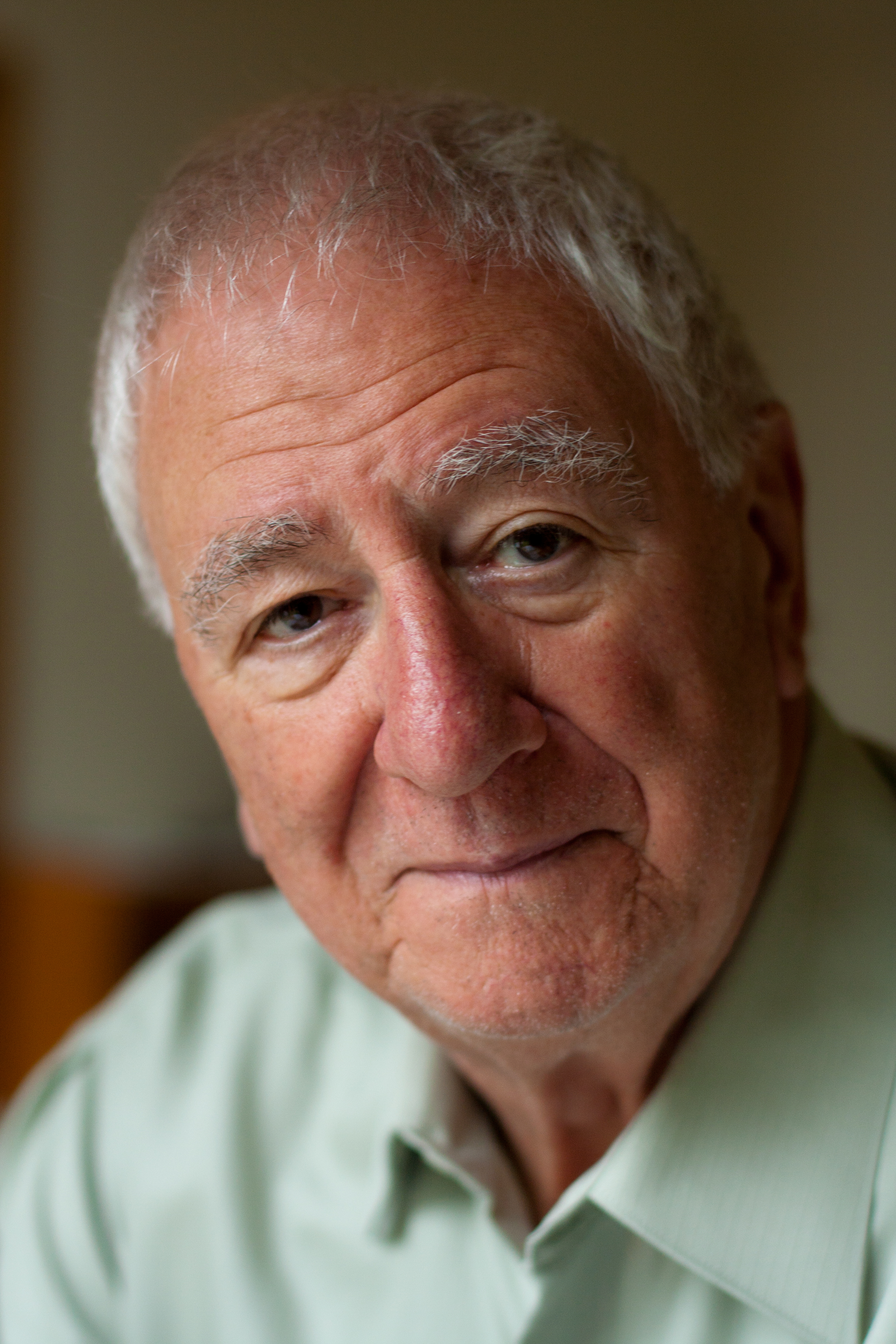
Bernard Rands
Over the next two weeks, the Center is excited to host two visiting composers for our Guest Artist Series. Marc Satterwhite and Bernard Rands will present in the Composer Seminar series on Friday March 25, and April 1, respectively.

Marc Satterwhite has taught in Texas, Indiana, and Michigan, and is currently Professor of Composition and Music Theory at the University of Louisville School of Music.  His music has been heard around the world, from Japan and South Korea to England and Latin America, and has been performed and recorded by several notable ensembles, including the Boston Symphony, Utah Symphony, Eighth Blackbird, Pittsburgh New Music Ensemble, Verdehr Trio, the London Composers Ensemble, and Percussion Group Falsa.  

Marc Satterwhite
Satterwhite was a member of the Grawemeyer Award Committee for a number of years, and currently serves as its director.  Named for the famous industrialist, entrepreneur, and philanthropist H. Charles Grawemeyer, the Grawemeyer Awards are five annual prizes given in the fields of music, political science, psychology, education, and religion.  The oldest of the five, the first award for Music Composition was presented in 1985 to Witold Lutosławski for this Third Symphony.  Other winners include György Ligeti, Harrison Birtwistle, Toru Takemitsu, Thomas Ades, and Louis Andriessen.  Recent Guest Artist to the Center Kaija Saariaho won the award in 2003 for her first opera, L'Amour de loin, and this year's award has gone to Hans Abrahamsen, a member of the 2016 June in Buffalo faculty, for his song cycle, let me tell you.  "I have one of the best jobs in the world," says Satterwhite.  "I have great students, terrific colleagues, and I get to direct the most prestigious award for composers in the world.  This puts me into constant contact with great musicians in the wider world, some of whom have become good friends as a result."

Satterwhite began his musical career as a bassist, studying the instrument at Michigan State University and playing full-time in the Orquesta Filarmónica de la Ciudad de México.  After deciding to pursue composition, he enrolled at Indiana University, where he studied with John Eaton and served as a research assistant to George List, one of the pioneers of the field of ethnomusicology.

As a composer, Satterwhite emphasizes adept instrumental writing, his music featuring elaborate gestures and fine textural subtleties which often outline familiar teleological narratives.  "I am most interested in music which has an immediate emotional appeal, but which is also intellectually stimulating enough to bear up to repeated hearings.  I tend to prefer music which is goal-directed, with clear buildups, climaxes, and dénouements."  His output is quite varied, ranging from large-scale works for orchestra or wind ensemble (including a 3-hour opera, Akhmatova, composed in 2000), to more compact chamber pieces and solos, like his Spiky Epiphanies for piano trio, or the dramatic solo 'cello work, Witnesses of Time:


Despite this varied oeuvre, Satterwhite's compositional voice is fairly consistent.   "Although I love a great deal of music which is on the lighter side, my own music is, with some notable exceptions, usually pretty serious.  This has always been true, and is generally true of my tastes in the other arts as well.  I usually prefer Shakespeare's tragedies to his comedies, I like sad songs more than happy ones-and so on."  Satterwhite's solemn, often elegiac approach can be heard clearly in his recent orchestral composition, Icons, which was partly inspired by Roman Catholic reliquaries—containers made to house relics of saints.  "The incongruousness of a few bone fragments housed in such a splendid piece of art struck a deep chord in me.  Despite its beauty, it still had a definite aura of the macabre and bizarre for me.  […]  I have attempted to recreate some of the beauty and mystery of such objects, but I will confess that it's really more about the darker images these creations conjure up for me."


The week after Satterwhite's visit, the Center is excited to once again host world-renowned composer Bernard Rands.  A member of the JiB 2015 faculty, and long-time friend of the Center, Rands will present some of his recent work, part of a vast and continually-expanding repertoire that includes numerous orchestral works, several celebrated vocal pieces, and a successful opera, Vincent, on the life of Vincent van Gogh.  Click here to read our full profile of Rands, written as part of last year's series on 2015 JiB composers.

Be sure to catch both of these skilled and highly-reputed composers during their visits in the coming weeks!

Tuesday, May 19, 2015

Bernard Rands: An Inexhaustible Phenomenon


Bernard Rands during a rehearsal at JiB 2014
Last year, the Chicago-based, English-born composer Bernard Rands celebrated his 80th birthday.  To honor this milestone, the Boston Symphony Orchestra commissioned a new work, Concerto for Piano and Orchestra, which featured pianist Jonathan Biss.  Rands shows no signs of slowing down—the concerto is just one of over a hundred of his published works, and later this year, he'll see the premiere of another new concerto, for English Horn and orchestra, which is being written for Robert Walters and the Cleveland Orchestra.

Rands is no stranger to orchestral composition—he was the composer-in-residence at the Philadelphia Orchestra for seven years (1989-1995), and before that, he became widely known for his two Le Tambourin suites (1984), composed for the same organization.  This work, eventually awarded first place in the Kennedy Center Friedheim Awards, took inspiration from six paintings and drawings by Vincent van Gogh.  For its six movements, the composer tried to translate the visual elements of six of the Dutch artist's works, without creating any direct narrative allusions.  "I didn’t want to do another Pictures at an Exhibition.  That’s not the intention.  I analyzed those paintings and drawings to the nth degree in terms of everything that constitutes a visual art activity.  That is:  form, color, density, harmony of colors, counterpoint of movements—the same terminology we use in music."  Elaborating on what he found so stimulating about van Gogh's work, the composer enthusiastically explained to New Music Box,
You don’t see sunflowers like that!  […He] painted to see the world in his mind, not the world as it is, or in the reality of normal observation.  The world in his mind made him so different, and made the paintings so different from anybody else’s.  When you think of that in terms of the sonic domain in which we work:  what is the sound in my mind, not what it ought to be but what is in my mind.  […It] has to leap off the page and be something other than what’s technically possible.
Rands's preoccupation with van Gogh did not end with the Le Tambourin suites, but continued into what is perhaps his most large-scale work, the two-act opera, Vincent (1999).  With a libretto based on Van Gogh's letters by J.D. McClatchy, the opera aims to place the artist "in contexts which were his real experiences, thus revealing his complex character—that of genius artist, religious fanatic, alcoholic, epileptic, unstable of temperament, resulting in behavior ranging unpredictably between kindly affability and violent aggression."  Premiered by the Indiana University Opera School in 2012, the work displays Rands's characteristically colorful orchestral writing alongside his keen knowledge and skill in composing for voice.


It is perhaps Rands's vocal works that have become the most widely celebrated.  His 1991 choral cycle, Canti d'Amor, which sets texts from James Joyce's "Chamber Music," was recorded on the Grammy-winning Chanticleer album Colors of Love.  His trilogy of works for solo voice and orchestra, Canti Lunatici (1980), Canti del Sole (1983), and Canti dell'Eclisse (1988), have been widely performed, with the middle work winning the 1984 Pulitzer Prize.  In a unique act of compositional imagination, each of these three works exist in two different forms, a chamber and orchestral version.  However, the chamber versions are not merely reductions, as the composer explains,
The vocal line remains absolutely the same in the chamber and orchestra versions, but they’re not the same pieces. […]  Let’s say in the chamber version, before there’s any intention to make an orchestra version, you have a five-note chord, which is perfectly fine for an orchestra.  But what if you add one more note to that chord?  Where does it go?  Does it go here?  There?  […]  If you add two, where do they go?  And, if you add more, and you start to change the harmonic implication, you’ve got a very different environment for the voice to perform exactly as it would in the other version, but now we have an extension of the juxtaposition of differences that are very important.
van Gogh's Agostina Segatori Sitting
in the Café du Tambourin
, the namesake for Rands's 
Le Tambourin suites
Rands's history with June in Buffalo stretches back to before David Felder restarted the festival in the mid-1980s.  Before reigniting the festival, when Felder was teaching at Cal State Long Beach, he started a summer program for West Coast artists called the Summer Composers Institute, which brought together young composers with emerging performers and ensembles and gave them a chance to work with faculty composers, one of the first of which was Bernard Rands.  Rands was quick to offer Felder his support when the latter restarted June in Buffalo, and since then, Rands has been an important figure in the festival's history, being a faculty composer more than ten times, and seeing nearly thirty performances of his works at the festival.  These include the world premiere of Rands's Interlude, which was commissioned for the festival's 25th anniversary in 2000, and three performances of Canti Lunatici (in 1991, 2002, and 2014—the latter at a portrait concert which also featured Steven Beck playing Rands's Piano Preludes).  Several of the composer's "Memo" series of solo works have been heard at the festival, including Memo 1 for contrabass in 2000, Memo 7 for soprano in 2002, and Memo 4 for flute in 2006.  Rands's virtuosic orchestral compositions have been featured many times at the Buffalo Philharmonic's festival-concluding concerts, including a 2010 performance of the second La Tambourin suite, and last year's presentation of "…where the murmurs die…" (both conducted by JoAnn Falletta).  This year, the festival's mid-week Performance Institute concert at Kleinhans Music Hall will feature two of the composer's works, Memo 4 and Walcott Songs, played by Performance Institute students and faculty.

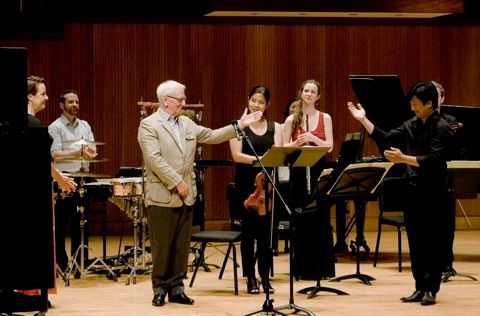
Rands with the Slee Sinfonietta and Jerry Hou
after the JiB 2014 performance of Canti Lunatici
Thinking back to the aforementioned Concerto for Piano and Orchestra, the Boston Globe writes that Rands's music brings "tonal and non-tonal elements into a fusion that is firmly enough based in musical tradition to be inviting, yet unpredictable enough in the deployment of those tools to convey a sense of modernity."  This dichotomy between tradition and innovation, singable and spiky, lyrical and dramatic, is key to Rands's work, as he explains:
It so happens that one of the fundamental principles of my own aesthetic position is the juxtaposition of opposites.  […]  These two [the non-tonal and the tonal] are interacting all the time, whether it’s a harmony or a rhythmic cell, a timbre or a gesture.  Music has always been that way.  Otherwise, we would have used up its resources a long time ago.  But it seems to be an inexhaustible phenomenon.
As a composer, Rands seems yet to use up his musical resources, and is himself an inexhaustible phenomenon, still creating new, intriguing music into his eighth decade.


—Ethan Hayden

Tuesday, May 25, 2010

Slee Glee

As is customary for June in Buffalo, UB's own Slee Sinfonietta plays a key role in the concert schedule this year, serving up two programs of music by JiB master composers. On June 2, James Baker leads the ensemble in David Felder's Tweener, Olivier Pasquet's Kasper, 6 Piano Etudes by Augusta Read Thomas, and Roger Reynolds's Aspiration.  

On June 4, Brad Lubman conducts the Slee Sinfonietta in works by Harvey Sollberger (New Millennium Memo), Felder (Partial [Dist]res[s]toration and Canzone XXXI), Thomas (Carillon Sky), and Bernard Rands (Now again - fragments from Sappho). Julia Bentley is the mezzo-soprano soloist in the Rands, and violinist Yuki Numata takes the solo role in Thomas's piece.  You can hear excerpts from Carillon Sky here and here.  

In case you're unfamiliar with the group, the Slee Sinfonietta is the professional chamber orchestra in residence at the University at Buffalo and the flagship ensemble of the Center for 21st Century Music. Founded in 1997 by David Felder, it is comprised of UB faculty artists, visiting artists, regional professionals and advanced performance students. Others activities include tours, professionally produced recordings, and unique concert experiences for regional and international audiences alike.  

Thursday, March 4, 2010

New honor for David Felder


The Center's Director, David Felder, has just been recognized by the American Academy of Arts and Letters. He is one of sixteen recipients of this year's awards in music, which total $170,000. The winners were selected by a committee of Academy members:  Robert Beaser (chairman), Bernard Rands, Gunther Schuller, Steven Stucky, and Yehudi Wyner. Candidates for music awards are nominated by the 250 members of the Academy.

Felder is one of four composers to receive a $7500 Academy Award in Music, which honors outstanding artistic achievement. Each composer will receive an additional $7500 toward the recording of one work. The other winners were Daniel Asia, Pierre Jalbert, and James Primosch; the awards will be presented at the Academy's annual Ceremonial in May.

Friday, June 26, 2009

more from June in Buffalo


We interrupt our look back at the 2008-09 season for a few words from Sequenza21 regular (and SUNY Fredonia composition prof) Rob Deemer. After Deemer posted his first JiB review, he agreed to submit a report for our own blog, focusing on the Friday, June 5 evening performance that featured the Slee Sinfonietta along with soloists flutist Mario Caroli and mezzo-soprano Julia Bentley as well as a solo performance by flutist Lindsey Goodman. Deemer writes, "While the audiences' necessary proximity to the stage caused occasional challenges to holistically experience the combination of acoustic and electro-acoustic, the overall concert was a huge success and quite thought-provoking.

"Commencing with the largest ensemble first, Brad Lubman calmly and expertly directed the Slee Sinfonietta strings, piano & percussion through David Felder's Inner Sky, a tour-de-force for master flutist Caroli that pitted the soloist (on piccolo, flute, alto flute and bass flute) against both the chamber orchestra and electronics, creating a richly dense texture. Beginning what would become a graduate thinning of textures throughout the concert, Bernard Rand's Now again - fragments from Sappho allowed the audience to experience each line within the chamber ensemble supporting Bentley, who wrung every drop of emotion from the ancient text, while creating a wonderfully unique sound of two female singers acting as a small chorus within the ensemble.

"After two intensely challenging works, one did not expect to see flutist Lindsey Goodman to take the stage by herself...and a toy dog in a basket! Such an introduction, however, was just what was needed for Matthew Rosenblum's tongue-in-cheek work for solo flute and electronics, Under the Rainbow. Incorporating the intricate flute part into the schizophrenic kaleidoscope that emanated from the speakers seemed to be a walk in the park for Goodman, who was into the character enough to slyly gesture to her ruby slippers at the appropriate time without seeming like a performer trying to act. I'm not sure what was more satisfying: the work itself or Goodman's performance, but nevertheless the performance encapsulated the entire concert - so much to enjoy that you'd have to see it again to catch what you missed the first time."

In addition to his activities as a journalist and composer, Deemer directs the Fredonia-based Ethos New Music Society. If you're a reader of this blog living in western NY, you'll definitely want to check out the group's upcoming season.