Showing posts with label Augusta Read Thomas. Show all posts

Saturday, April 4, 2015

Augusta Read Thomas: The Whole is Other


The German psychologist Kurt Koffka famously summarized Gestalt theory with the phrase, "the whole is other than the sum of its parts."  Koffka emphasized that in Gestalt psychology, the whole has an existence which is unique, independent of its component elements.  While we can recognize the various parts of, say, the sound of a bell (quick attack, long sustain, inharmonic timbre), our experience of the whole bell sound is entirely separate from our awareness of its individual features.  The whole is other than the sum of its parts.
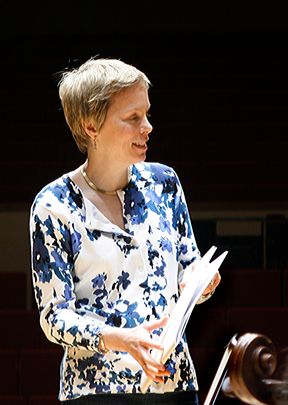
Augusta Read Thomas at Jib 2010
This concept is key to Augusta Read Thomas's music, because throughout her oeuvre, the composer is attempting—and succeeding—at something impossibly contradictory:  a music which is at once intricately crafted with meticulous precision, but which sounds spontaneous and improvisational.  Thomas's music is incredibly detailed, constructed from a keen awareness of instrumental technique, tonal and timbral nuance, and a harmonic sophistication matched by only a small handful of contemporaries.  These are the "parts" of her music, manifested through explicit notation and attention to detail.  "One of the things that interests me a great deal is for the music to be very nuanced.  So the notations are extremely specific, and I think that lends itself to a clear and crisp execution of the piece," Thomas says in an interview with New Music Box.  "Yet on the other hand, I want the pieces to sound really spontaneous—'There it goes!  The orchestra’s playing, and the train has left the station!' [It] almost sounds as if they’re improvising."  Herein lies the contradictory "whole" of Thomas's music—the effect of unplanned animation, whimsical energy, vibrant organicism.  While a listener may be aware of the careful, deliberate construction of Thomas's music, the experience is one of flowing caprice, a music of sudden shifts that are both unexpected and inevitable.  The whole is other than the sum of its parts.

Few composers have managed to successfully achieve this tightrope-walk of carefully-composed spontaneity.  Debussy comes to mind, and Thomas's music certainly maintains a Debussian finesse, heard in the intricate diaphanousness of 2010's Jubilee for orchestra or the refined lyricism of 2005's violin concerto, Carillon Sky.  But her music also often features a ferocious dynamism, as colors and shapes collide with one another with a forcefulness that calls to mind Varèse's sinewy harmonic intersections (see for example, her early orchestral piece, Words of the Sea).  Throughout her work, however, remains this ("Koffka-esque"?) distinction between whole and part that the composer herself is well aware of:  "If I could try to describe the way I think of music, I would draw a big circle.  Then inside of it, I would put a lot of words, such as counterpoint, harmony, rhythm, harmonic rhythm, pitch, flow, flux, density, tessitura, balance, and so on and so forth. For me, it’s a big huge gestalt.  […]  They’re all connected with this beautiful web, and so while I could talk about rhythm independently, or I could talk about harmony independently, for me, they instantly plug back into that gestalt."


Augusta Read Thomas is one of the hardest working composers active today.  Just this year, she has already had four pieces premiered (including Selene, premiered last month by friends of the Center JACK Quartet and Third Coast Percussion, and the orchestral ballet EOS: Goddess of the Dawn premiered by the Utah Symphony in February) with two more upcoming this month (including the Parker Quartet's premiere of Helix Spirals next week at Harvard).  She spends eight to ten hours a day composing—an activity she typically does on her feet, standing at large draft tables, as she describes in the video below.  Her prolific work schedule has resulted in an impressively expansive catalog of works, and has made Thomas one of the most frequently-performed living composers.  She has been recognized by both the American Academy of Arts and Letters (inducted in 2009) and the American Academy of Arts and Sciences (inducted in 2012), and, most recently, she won the Lancaster Symphony Orchestra's Composer Award for 2015-16, the oldest award of its kind in the nation (previous winners have included William Schuman, Walter Piston, and Morton Gould).  It would be entirely forgivable if such an active composer had no time or interest in teaching, but Thomas is very passionate about teaching, an activity she sees as a "natural extension of [her] creative process."  She currently teaches at the University of Chicago, where she is one of seven University Professors, and regularly teaches at the Tanglewood Music Center during the summer.  Next year, she will be spearheading the Ear Taxi Festival, which celebrates Chicago's strong new music scene.


We are thrilled that Augusta Read Thomas will be joining us during this anniversary year at June in Buffalo.  The composer has been an invaluable member of the JiB faculty over the years, regularly presenting new and exciting works, and providing sharp insights and guidance to young composers.  Perhaps the most affecting aspect of Thomas's relationship with the festival is that she was once herself one of those emerging composers who came through the festival as a student, before returning years later as a member of the faculty.  "I first came to June in Buffalo in 1988, while I was a student of Jacob Druckman at Yale.  I had a great time.  It was enriching in terms of learning the music of others, hearing beautiful concerts, and having lots of time for informal discussions about music.  I loved it!  I went back at least once more as a student in the early 1990s."

Thomas has high praise for the festival, pointing out how beneficial it's been to so many emerging composers over the years:  "I think the festival has boosted the careers of lots of students—and there have been many over the years (30 years times 25-30 students each year).  It's really been something that's helped a lot of composers, even if it's just one recording or one connection made—a composer can meet someone they'll know as a colleague for the rest of their career.  There are all kinds of things like that which are difficult to put a finger on, but which are part of the culture of the festival."
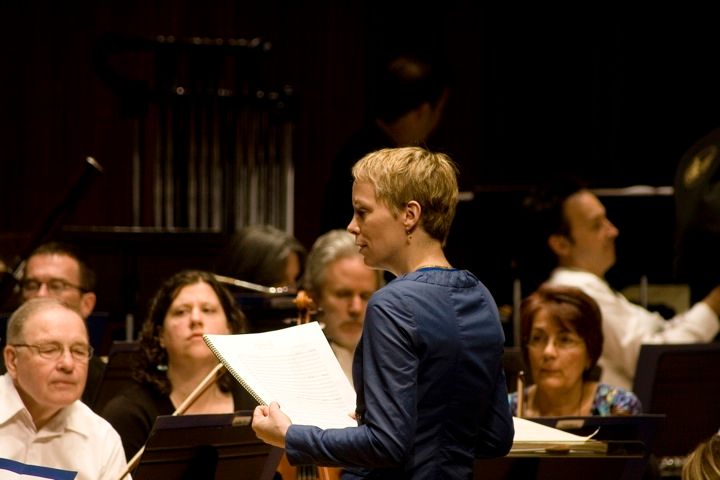
Augusta Read Thomas rehearses Aureole with
the Buffalo Philharmonic Orchestra at JiB 2013
June in Buffalo has seen some great performances of Thomas's works over the years.  In 2002, she came to the festival as a special guest, where her Rumi Settings were performed by Movses Pogossian and Jonathan Golove.  Stephen Gosling of the New York New Music Ensemble has given two stunning performances of her Six Piano Etudes (one in 2006, and the other in 2010).  A particularly memorable performance was in 2010, when her violin concerto Carillon Sky was performed by Yuki Numata Resnick, with Brad Lubman conducting the Slee Sinfonietta.  "I remember just being riveted.  I thought it was spectacular and shimmeringly brilliant!" Thomas recalls. The Buffalo Philharmonic's festival-concluding concerts have twice featured Thomas's work, including a 2010 performance of Terpischore's Dream, and a 2013 performance of the luminous Aureole, both conducted by JoAnn Falletta.  "Being a composer that's written a lot of orchestral music, it's nice to have an orchestral piece done at a festival," says Thomas.  "June in Buffalo is able to feature the music of composers that are writing for orchestra (and electronics and chamber music as well).  The performances that have been given of both faculty and student works have always been at the highest level.  I commend that to the festival and those organizing it.  And David Felder has done a wonderful job as director, so three cheers for David from me!"

This year, we can look forward to two pieces which will be played on the June 5th Performance Institute concert:  1999's Passion Prayers for solo 'cello and six instruments, and 2007's Scat for chamber ensemble, both conducted by Daniel Bassin.  We're thrilled that Augusta Read Thomas will once again bring her work, insight, passion, and musicality to the festival, demonstrating both the parts and the whole of her craft to emerging composers and audiences alike.


—Ethan Hayden

Saturday, June 8, 2013

The Buffalo Philharmonic Orchestra finish off June in Buffalo 2013!


Buffalo Philharmonic Orchestra
We’re excited about the final concert of June in Buffalo 2013 with the Buffalo Philharmonic Orchestra, which will conclude the festival on Sunday, June 9th, at 2:30 p.m. in Slee Hall at the University at Buffalo. This year’s festival has been especially inspiring, not only because of the great mix of faculty and participant composers, but also because of the inauguaration of the June in Buffalo Performance Institute, which helped finish off the festival with concerts on both Friday and Saturday. Music journalist Daniel J. Kushner recently published an insightful and enthusiastic review of Friday night’s concert under the title “Eclectic Performance Institute is a fine fit for June”, which can be found in the Buffalo News. We've also received some great recent press from Jan Jezioro, who has published a nice write-up on the BPO at June in Buffalo at the Artvoice, which includes a fantastic quote by Alex Ross, “Having appeared in Spring for Music [at Carnegie Hall], the Buffalo Philharmonic will return home for June in Buffalo, which this year presents a particularly fascinating lineup of resident composers as well as a new, contemporary-oriented Performance Institute under the direction of Eric Huebner.” Read Jezioro's full piece here.


JoAnn Falletta
The final concert on Sunday, with the BPO under the baton of JoAnn Falletta, will begin with David Felder’s Linebacker Music, originally written for the BPO in 1993. You can sample the beginning of Linebacker Music on the Center’s soundcloud.

The second piece of the concert will be by composer Augusta Read Thomas, described in October 2012 by the New Yorker as “a true virtuoso composer”. The BPO will perform her recent work Aureole, which was just given its world premiere by the DePaul Symphony Orchestra only a week ago.

The final piece of the concert, which will follow without an intermission, will be Yehudi Wyner’s Pulitzer Prize-winning Piano Concerto Chiavi in Mano, and will feature soloist Geoffrey Burleson. We recently blogged about Chiavi in Mano, read more about it here


Ticket information can be found here. We look forward to seeing you at Slee Hall!


Link to this post here.


Thursday, May 9, 2013

Augusta Read Thomas at June in Buffalo 2013


Augusta Read Thomas

We'd like to welcome Augusta Read Thomas to the composition faculty of June in Buffalo 2013. We're excited to have her here for a week of masterclasses and concerts, beginning on June 3rd,  when the JACK Quartet will perform her string quartet Rise Chanting, from Sun Threads.

The rest of the week will feature several other works by her, including Caprice, for solo violin, to be performed by the Talea Ensemble, Carillon Sky for saxophone and small orchestra, to be performed by Ensemble Signal, and her recent Aureole, for orchestra, to be performed by the Buffalo Philharmonic Orchestra

Thomas is the recipient of a Lifetime Achievement Award from the American Academy of Arts and Letters, as well as an Ernst von Siemens Music Prize, and is currently the University Professor of Composition in the Department of Music at the University of Chicago.


Enjoy the video below of Thomas talking about the inspiration for her violin duet, Double Helix, commissioned for the grand opening of the Mansueto Library, and leading us through her creative process:


Link to this post here.


Wednesday, October 17, 2012

June in Buffalo 2013 call for scores announced!


June in Buffalo 2013 call for scores announced! June in Buffalo will be very special this year with the addition of the Performance Institute, which will begin on Thursday, May 30th, and then run concurrently with June in Buffalo from Monday, June 3 – Sunday, June 9th. This will be the first year ever where emerging contemporary music performers and ensembles will be studying, practicing, and workshopping alongside participant composers. We expect one of the most dynamic, collaborative, and compelling June in Buffalo Festivals ever this year, as young contemporary music performers and composers blend together and form relationships with not only faculty composers and performers, but each other as well. Full details on applying as an auditor or participant composer below: 


June in Buffalo

Presented by the Department of Music and The Robert and Carol Morris Center for 21st Century Music, June in Buffalo, a festival and conference dedicated to composers, will take place from June 3 -9, 2013 at the University at Buffalo. June in Buffalo offers an intensive schedule of seminars, lectures, workshops, professional presentations, participant forums and open rehearsals as well as afternoon and evening concerts open to the general public and critics. Each of the invited composers will have one of his/her pieces performed during the festival. Evening performances feature faculty composers, resident ensembles and soloists renowned internationally as interpreters of contemporary music.

Artistic Director

Senior Faculty

Resident Ensembles
Buffalo Philharmonic Orchestra
Ensemble Linea
JACK Quartet
SIGNAL
Slee Sinfonietta
Talea Ensemble
Talujon Percussion Ensemble


APPLICATION PROCEDURES
To apply to June in Buffalo, please send all materials by mail. Applications must include the following materials:

1. A résumé or curriculum vitae detailing your education, experience, and creative activity.

2. A letter of reference from someone acquainted with your current compositional activity.

3. A proposal (including score and brief description) requesting the performance of a recent work for
a) Percussion Quartet (or subset)
b) String Quartet (or subset)
c) flute, clarinet, piano, percussion, violin, cello (or subset)
d) solo for any orchestral instrument
e) works with electronics will be considered
f) other instrumentations will be announced shortly

4. One or two scores that demonstrate your recent work and accompanying recordings, if available.

5. A $25 non-refundable processing fee. Checks or money orders should be made payable to June in Buffalo. Foreign applicants must pay by international money order in US currency. Do not send cash.

6. A SASE for the return of materials (optional) and an e-mail address at which you can be easily contacted.

If the performance of a selected work by a participating composer becomes impossible due to circumstances beyond the control of the June in Buffalo festival, every attempt will be made to arrange a substitution where possible.

To apply as an auditor, please send a résumé and the processing fee. Auditors attend all June in Buffalo events, but will not have a piece performed.

All application materials must be postmarked by
FEBRUARY 15, 2013.

Mail to:
June in Buffalo
220 Baird Hall
Music Department
University at Buffalo
Buffalo, NY 14260-4700

Fees
Tuition fee: $700
Auditing fee: $350

Housing
On-campus housing, 7 nights, single occupancy: $300. Additional: $30/night. No double occupancy discounts; no meals included.

For general information, contact J.T. Rinker
phone: (716) 645-0624
fax: (716) 645-3824


Link to this post here.


Tuesday, May 25, 2010

Slee Glee

As is customary for June in Buffalo, UB's own Slee Sinfonietta plays a key role in the concert schedule this year, serving up two programs of music by JiB master composers. On June 2, James Baker leads the ensemble in David Felder's Tweener, Olivier Pasquet's Kasper, 6 Piano Etudes by Augusta Read Thomas, and Roger Reynolds's Aspiration.  

On June 4, Brad Lubman conducts the Slee Sinfonietta in works by Harvey Sollberger (New Millennium Memo), Felder (Partial [Dist]res[s]toration and Canzone XXXI), Thomas (Carillon Sky), and Bernard Rands (Now again - fragments from Sappho). Julia Bentley is the mezzo-soprano soloist in the Rands, and violinist Yuki Numata takes the solo role in Thomas's piece.  You can hear excerpts from Carillon Sky here and here.  

In case you're unfamiliar with the group, the Slee Sinfonietta is the professional chamber orchestra in residence at the University at Buffalo and the flagship ensemble of the Center for 21st Century Music. Founded in 1997 by David Felder, it is comprised of UB faculty artists, visiting artists, regional professionals and advanced performance students. Others activities include tours, professionally produced recordings, and unique concert experiences for regional and international audiences alike.  

Monday, May 17, 2010

SurPlus value


Among the noteworthy ensembles participating in June in Buffalo 2010, one name in particular may be unfamiliar to American new music fans: Ensemble SurPlus. But this highly accomplished German group plays an important role in this year's JiB, performing works by Augusta Read Thomas, Lukas Foss, Harvey Sollberger, Alvin Lucier, Charles Wuorinen, and Brian Ferneyhough on June 1, and playing participant composers' pieces on June 2. (A full concert schedule is available here.)

Based in Freiburg, Ensemble SurPlus was founded in 1992 by the eminent pianist and conductor James Avery (1937-2009). The Ensemble performs chamber music ranging from duos to large instrumental combinations, and aims to give new or unknown works optimal performances, regardless of compositional style or technical and intellectual demands. Its credits include performances at numerous European festivals including Darmstadt, Musica Viva, Donaueschingen, and others. Ensemble SurPlus has also collaborated closely with the Experimental Studio of the German Radio (SWR). Numerous CD productions and recordings (Ferneyhough, Clark, Spahlinger, Mahnkopf, Wolpe with Heinz Holliger) document the great versatility of the ensemble. For further information and sound samples, visit the Ensemble SurPlus website.

Thursday, March 25, 2010

Augusta Read Thomas


June in Buffalo's senior faculty members are not only distinguished composers, but dedicated teachers. Augusta Read Thomas, returning to June in Buffalo for 2010, is a case in point. She is one of the most widely performed composers of her generation, with no fewer than 36 commercial recordings to her credit. Her music has been championed by conductors Daniel Barenboim, Pierre Boulez, Esa-Pekka Salonen, Oliver Knussen, Seiji Ozawa, Mstislav Rostropovich, Leonard Slatkin, David Robertson, and Christoph Eschenbach.

At the same time, Thomas describes teaching as a deeply felt commitment, and an integrated part of her creative existence. She taught composition at the Eastman School of Music from 1993-2001, and from 2001 until 2006 was the Wyatt Professor of Music at Northwestern University. She frequently undertakes residencies in colleges, universities, and festivals across the country and in Europe; in the summers she often teaches at the Tanglewood Music Center, and was the Director of the Festival of Contemporary Music at Tanglewood in 2009. For 2009-2011 she is teaching and mentoring 10 high school-aged composers in the state of Connecticut. Each composer will have his or her new piece premiered by the New Haven Symphony in May 2011.

Here is Rachel Barton Pine in Augusta Read Thomas's dramatic and moving Caprice for solo violin.  

Monday, November 30, 2009

June in Buffalo 2010


Aspiring composers take note! The deadline for applying to participate in June in Buffalo 2010 is February 16, 2010.  JiB promises to be more exciting than ever in its 35th anniversary season, which also marks the festival's 25th anniversary under the direction of the Center's director, David Felder.  It will take place from May 31 - June 6 at the University at Buffalo, with the usual panoply of seminars, lectures, master classes, workshops, professional presentations, participant forums and open rehearsals as well as afternoon and evening concerts open to the general public and critics. Each of the invited composers will have one of his/her pieces performed during the festival. Evening performances feature faculty composers, resident ensembles and soloists renowned internationally as interpreters of contemporary music.

In addition to Felder, the senior faculty will also include Steve Reich, Roger Reynolds, Augusta Read Thomas, and Olivier Pasquet. Equally impressive are the resident ensembles: the Arditti Quartet, Signal, Ensemble Laboratorium, Ensemble SurPlus, and as always, the Slee Sinfonietta and the Buffalo Philharmonic Orchestra. Application information can be found here.

Wednesday, July 29, 2009

The New Season!


The Center has announced its programming for the 2009-10 season, and it's an exciting one indeed, with concerts by the Slee Sinfonietta (with Elmar Oliveira and Eric Huebner as soloists), Signal, JACK Quartet, Music from Copland House, and others. There will be visits by composers Ben Thigpen (Paris), Roberto Fabricciani (Italy), Olivier Pasquet (Paris), Robert Beaser, David Dzubay, Joshua Feinberg, and Chinary Ung (USA).

June in Buffalo (May 31 - June 6, 2010) is marking the 35th anniversary of its founding and the 25th anniversary of David Felder's stewardship. To celebrate, there will be performances by the Arditti Quartet, Buffalo Philharmonic Orchestra, Slee Sinfonietta, Signal, and an array of distinguished soloists. Festival faculty will include David Felder, Olivier Pasquet, Steve Reich, Roger Reynolds, Augusta Read Thomas, and others to be announced.

All in all, as the late author Donald Barthelme once wrote in a different context, "there's more than enough aesthetic excitement here to satisfy anyone but a damn fool." See for yourself at the Center's website.

Over the next few weeks we'll be previewing some of these events in a bit more detail. But to whet your appetite, here's a clip of Signal - recently described by The New York Times as “one of the most vital groups of its kind,” - performing Reich's Music for 18 Musicians, caught last September at Le Poisson Rouge in NYC.