Showing posts with label Brian Ferneyhough. Show all posts

Thursday, March 5, 2015

Brian Ferneyhough: On Suddenness & Plötzlichkeit


A recent orchestral piece by Brian Ferneyhough bears the German title, "Plötzlichkeit," a term which can be roughly translated as "suddenness."  In the piece, radically disjunct gestures emerge from all corners of the orchestra, both disparate solo lines and dynamic tuttis, each successive gesture obliterating the last.  The term plötzlichkeit seems to be not only a fitting description of the unrestrained energy of this piece, but of much of the composer's oeuvre.  Ferneyhough's music, (in)famous for its density, complexity, and the demands it puts on its performers, seems to exist in a perpetual state of plötzlichkeit—that is, in a perpetual state of lacking a perpetual state, of being constantly interrupted, manipulated, suspended, or superseded.  The intricacy of pieces like Superscriptio, Lemma-Icon-Epigram, and Etudes Transcendantales places the performers (and, indeed, the audience) in a situation in which the demands of each gesture leave them, in the composer's words, "in a constant state of 'surprise attack', as the horizon of memory closes around them."  Without the ability to rely on their memories, performer and audience are trapped in an eternal present, or rather, in an endless succession of divergent presents, a state of intense plötzlichkeit.


The preface to Ferneyhough's early flute solo, Cassandra's Dream Song elaborates on this tension between notated complexity and the difficulty of execution:  "A valid realization will only result from a rigorous attempt to reproduce as many of the textural details as possible:  such divergencies and 'impurities' as then follow from the natural limitations of the instrument itself may be taken to be the intentions of the composer."  In later pieces, as noted by Paul Griffiths, such "divergencies and impurities" are as much a result of the performer's constant state of 'suddenness' as they are of the instrument's own limitations.  Ferneyhough is therefore not a composer of "complex" notational gestures, but rather a composer of dynamic energies and states of being.  In fact, his music calls into question the very ontology of classical music:  his pieces do not exist on the written page, nor in the frantic animation of its realization but in, as he puts it, "that realm of non-equivalence separating the two."

We are thrilled that Ferneyhough will be joining the composition faculty at this year's June in Buffalo, and we're looking forward to hearing his works performed by some of the most skilled players in the field.  Among the composer's pieces which will be heard at this year's festival are the densely polyphonic Bone Alphabet (1992) for solo percussion (to be played by SIGNAL Ensemble's Bill Solomon) and the virtuosic violin solo, Unsichtbare Farben, which will be performed by its dedicatee, Irvine Arditti.
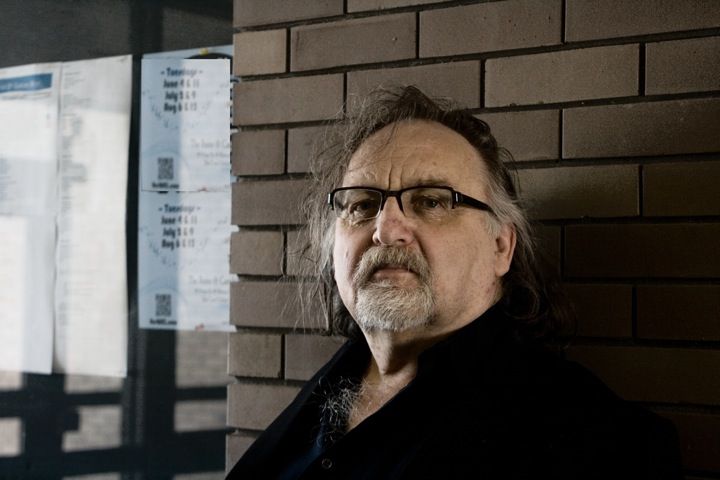
Brian Ferneyhough at JiB 2013
As a frequent guest to the festival (he was on the faculty at JiB 2005 & 2013), Ferneyhough's pieces have been consistent showstoppers, his lectures and masterclasses reliable sources of profound insight and instruction.  I can remember sitting in on a composer masterclass at JiB 2013 that I found particularly illuminating.  A young composer presented a compelling work in which, after several minutes of well-crafted, conventionally-notated music,  the score was interrupted by a brief, graphically-notated measure bearing the instruction:  "with uncontained insanity."  Ferneyhough astutely noted that this brief interruption undermined its own intent.  He stated that leaving "insanity" up to what was essentially performer improvisation would lead to a restrained kind of insanity (which is in fact, the definition of sanity), and that limiting "uncontained insanity" to a single measure was, in fact, to contain it.  He suggested instead that this section be composed out (denying the performer the chance to improvise insanity) and extended (so as to keep it uncontained).  Underlying this observation was a shrewd insight:  crazy people don't know they are crazy, they instead grapple with their perceived reality with agitated fervor and intensity.  If one is to expect "insanity" from a performer, it is perhaps best to place them in a performative situation that would test their very sanity, rather than asking them to approximate it of their own accord.  This seemed not only a valid suggestion for improving this already-strong student work, but indeed, a key aspect of Ferneyhough's own approach.  He was prescribing a rationally-composed irrationality, an architecturally structured absurdity.  He was prescribing plötzlichkeit.

There is, of course, far more to the composer's work than simple performer crazy-making.  Perhaps the greatest strength of Ferneyhough's music is the way it recaptures and re-imagines expression itself.  While much Post-War music used complexity and systemization as ways to bypass expression, Ferneyhough uses these same devices in its service.  For him, "texture and structure are the two vehicles of expressive form", and works like Bone Alphabet and Unsichtbare Farben demonstrate this in spades.  While some would criticize his music for its density and complexity, no one could say that it is cold or mechanistic.  Instead, it is brimming with life, a dynamic dance of diverse energies.  Ferneyhough's music is an enactment of a psychic drama: the id of unrestrained insanity kept in check by the expressive energy of structure's super-ego, both working simultaneously in opposition and in concert toward the construction of an art that is at once a finely crafted artifact an ever-changing sonic conflict.  It is a music of crystalline design, marred by a multitude of "divergencies and impurities", and continuously engaged in the suddenness of the present.


—Ethan Hayden

Thursday, June 6, 2013

June in Buffalo Performance Institute concert June 7th!


Eric Huebner, JiB Performance Institute Director

The June in Buffalo Performance Institute has been going strong since last Thursday, May 30th, when the JACK Quartet inaugurated the Institute with a gorgeous performance of Morton Feldman’s String Quartet No. 1 at the beautiful M&T Bank in downtown Buffalo. Since then Performance Institute participants have been working closely with the JACK Quartet, Eric Huebner, and Tom Kolor and members of the Talujon Percussion Ensemble preparing for Friday (June 7th) night’s concert at 7:30 p.m. in Baird Recital Hall at the University at Buffalo.


The full list June in Buffalo Performance Institute participants:

Ross Aftel, percussion
Hangyu Bai, piano
T.J. Borden, cello
Jade Conlee, piano           
Nicholas Emmanuel, piano
Matthew Geiger, percussion


Friday night's concert will also feature a guest appearance by violinist Irvine Arditti, who will perform Brian Ferneyhough's Intermedio alla Ciaconna, the full program is below.


June in Buffalo Performance Institute Concert, June 7th, 7:30 p.m., UB Baird Recital Hall


Chinary Ung:  Spiral no. 1                                               
Ross Aftel, percussion, T.J. Borden, cello, and Nicholas Emmanuel, piano                                                                                                      

Anton Webern:  Bagatelles, op.9                                               
members of the JACK Quartet with T.J. Borden

Brian Ferneyhough:  Intermedio alla Ciaconna                                   
Irvine Arditti, violin
                                               
                                             ---  intermission ---

Ralph Shapey:  Gottlieb Duo                          
Matthew Geiger, percussion, Manuel Laufer, piano

Anton Webern:  Two Pieces (1899), Three Little Pieces op. 11   
Hangyu Bai, piano, and Jonathan Golove, cello
                       
Charles Wuorinen:  Fifty-Fifty                                                 
Jade Conlee and Michiko Saiki, pianists           


The next day, on Saturday, June 8th, JiB Performance Institute faculty and participants will perform works by JiB composers Clint Haycraft and Megan Buegger, and works by Zimmerman, Cage, Babbitt, Carter, Stockhausen, Sciarrino, and Rivas. The concert will begin at 3:45 p.m. in B1 Slee Hall for the first piece by Megan Beugger, and then move up to Baird Recital Hall at 4:00 p.m. for the rest of the program. Check out the Performance Institute website, like their page on facebook, or follow the Center for 21st Century Music on twitter for more updates.


Link to this post here.


Monday, May 13, 2013

Composer Brian Ferneyhough at June in Buffalo 2013


We’ve been profiling some of the June in Buffalo 2013 ensembles and faculty composers, and thought we’d take a quick look at composer and longtime friend of the Center for 21st Century Music, Brian Ferneyhough.

Brian Ferneyhough
Ferneyhough was here for June in Buffalo 2005, and his music enjoyed some sensitive and virtuosic performances: Ensemble SurPlus performed his chamber work Incipits, Quatour Diotima interpretted his String Quartet No. 2, and pianist Ian Pace performed Epigrams. Ferneyhough later returned here for a short residency in February of 2009 alongside composer Hilda Paredes and the Arditti Quartet, who performed a concert in Slee Hall, as well as workshopped and recorded UB student works.

More on Ferneyhough can be found through his publisher Edition Peters, on his wikipedia article, and at the guardian.

Ferneyhough will be giving daily master classes to June in Buffalo composers during June in Buffalo 2013, as well as give a lecture on his recent projects. His music will be featured throughout the evening concerts during the week, including his chamber work Terrain, to be performed by Ensemble Signal, and Mnémosyme, for bass flute and tape, to be performed by Ensemble Linea.


Check out the video of below of Ensemble Linea interpretting Ferneyhough’s 2008 ensemble piece Chronos Aion:


Link to this post here.


Tuesday, May 31, 2011

Brice Pauset


June in Buffalo always has a strong international flavor, drawing participants and faculty from around the globe.  French composer Brice Pauset travels from his home in Germany to join this year's Senior Faculty, bringing his unique musical and intellectual perspective to the festival. His background includes studies in piano, violin, electronic music at IRCAM, medieval philosophy (in which he holds a doctorate), along with Baroque musical practice and instrumental design.

Born in 1965, Pauset has studied with many of Europe's modernist heavyweights, including Pierre Boulez, Karlheinz Stockhausen, Gérand Grisey, Brian Ferneyhough, Franco Donatoni, Stefano Gervasoni, Klaus Huber, and Michael Jarrell, among others. Yet it's clear from interviews and writings that his Baroque forebears have had as profound an effect on his music as his contemporaries. A fascinating interview in Paris Transatlantic magazine illuminates his thinking. When writer Dan Warburton asked Pauset which century he would prefer to live in, given a choice, Pauset replied, "I think, of course, the fourteenth century. The Ars Subtilior. In the medieval epoch, there was no music as such--it was a part of a larger discipline including mathematics, philosophy, astronomy.. If you look around this room, we have mathematics--there are three computers (one of which doesn't work), and there is a philosophical dimension to this work.. (Pause.) Yes, I would go back to the fourteenth century. When music didn't exist." Pauset's moody, compelling Adagio Dialettico for piano and ensemble can be heard in this audio clip (with static image).

Monday, May 17, 2010

SurPlus value


Among the noteworthy ensembles participating in June in Buffalo 2010, one name in particular may be unfamiliar to American new music fans: Ensemble SurPlus. But this highly accomplished German group plays an important role in this year's JiB, performing works by Augusta Read Thomas, Lukas Foss, Harvey Sollberger, Alvin Lucier, Charles Wuorinen, and Brian Ferneyhough on June 1, and playing participant composers' pieces on June 2. (A full concert schedule is available here.)

Based in Freiburg, Ensemble SurPlus was founded in 1992 by the eminent pianist and conductor James Avery (1937-2009). The Ensemble performs chamber music ranging from duos to large instrumental combinations, and aims to give new or unknown works optimal performances, regardless of compositional style or technical and intellectual demands. Its credits include performances at numerous European festivals including Darmstadt, Musica Viva, Donaueschingen, and others. Ensemble SurPlus has also collaborated closely with the Experimental Studio of the German Radio (SWR). Numerous CD productions and recordings (Ferneyhough, Clark, Spahlinger, Mahnkopf, Wolpe with Heinz Holliger) document the great versatility of the ensemble. For further information and sound samples, visit the Ensemble SurPlus website.

Thursday, June 18, 2009

Season retrospective, part 1


Linkphoto: Philippe Gontier

With June in Buffalo over, it's time to take a look back at the Center's past season. The next few posts will touch on a few worthy highlights.

Any given semester at UB sees a parade of world-class composers and ensembles. The Arditti Quartet came in late February for a three-day residency, highlighted by a concert at Lippes Hall and a graduate composer reading session. They were joined at UB by composers Brian Ferneyhough, Hilda Paredes, and James Clark, who each contributed works to the quartet's concert program, along with pieces by David Felder and Elliott Carter. Ferneyhough and Paredes gave master classes and lecture/demonstrations.

Garaud McTaggart reviewed the Arditti's concert for the Buffalo News: "Based upon its length of service to the cause of adventurous contemporary music and the overall quality of its playing, the Arditti Quartet can take pride in a history that has consistently showcased, in the most honorable manner, a depth of commitment to modern composers that is truly striking."

In a more traditional vein, the Lydian String Quartet came to Lippes on Friday, April 24 to perform three Beethoven quartets -- Op. 18 no. 4, Op. 135, and Op. 59 no. 2 -- as part of the Slee Beethoven Cycle. Like the Arditti, the Lydian also participated in a student composer reading session...more to come on this.