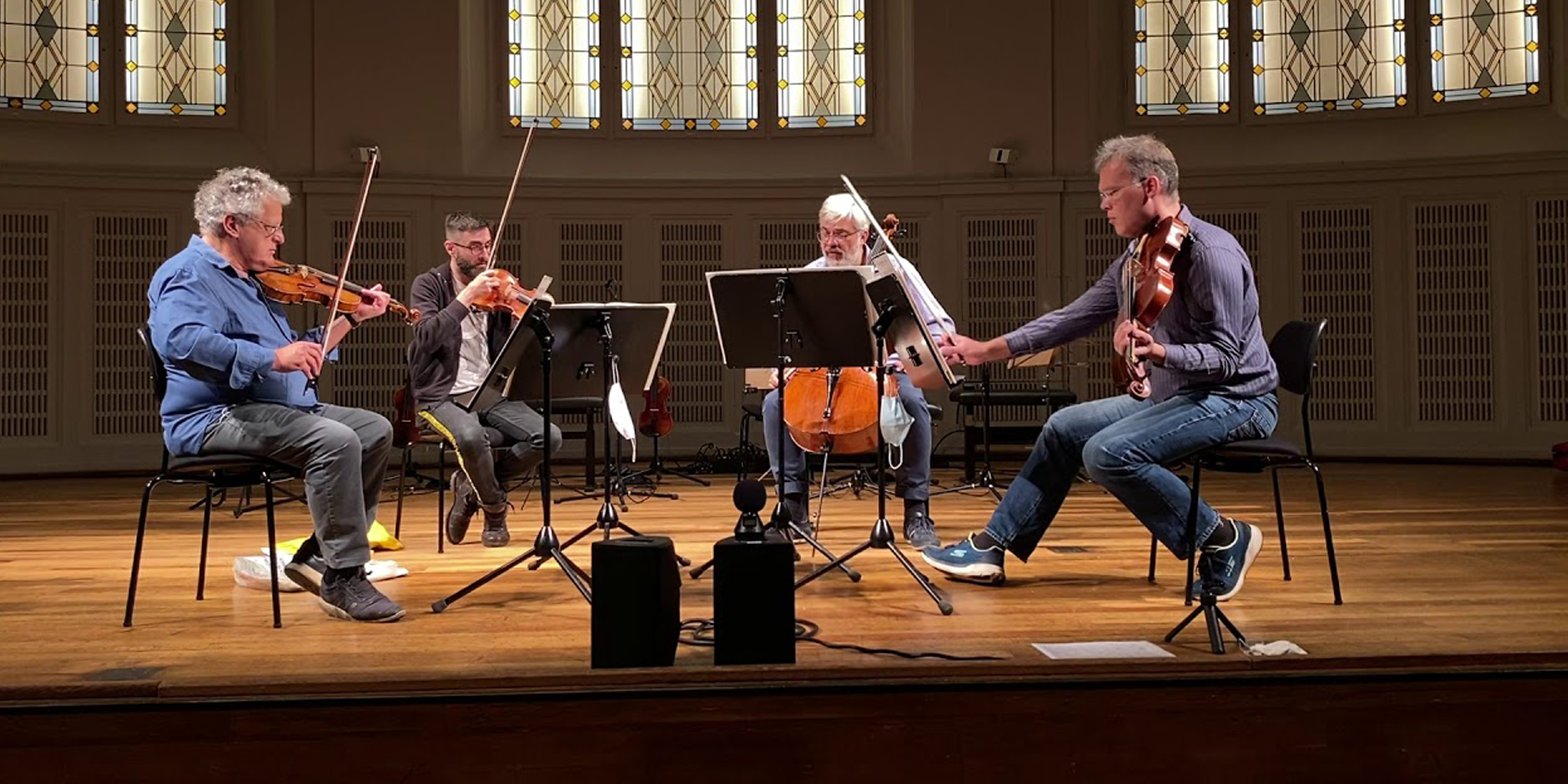
We are pleased to welcome the Arditti Quartet as one of the resident ensembles at the 2022 edition of June in Buffalo!
The Arditti Quartet enjoys a world-wide reputation for their spirited
and technically refined interpretations of contemporary and earlier
20th century music. Many hundreds of string quartets and other chamber
works have been written for the ensemble since its foundation by first
violinist Irvine Arditti in 1974. Many of these works have left a
permanent mark on 20th century repertoire and have given the Arditti
Quartet a firm place in music history. World premieres of quartets by
composers such as Abrahamsen, Ades, Andriessen, Aperghis, Birtwistle,
Britten, Cage, Carter, Denisov, Dillon, Dufourt, Dusapin, Fedele,
Ferneyhough, Francesconi, Gubaidulina, Guerrero, Harvey, Hosokawa,
Kagel, Kurtag, Lachenmann, Ligeti, Maderna, Manoury, Nancarrow,
Reynolds, Rihm, Scelsi, Sciarrino, Stockhausen and Xenakis and hundreds
more show the wide range of music in the Arditti Quartet’s repertoire.
The ensemble believes that close collaboration with composers is
vital to the process of interpreting modern music and therefore attempts
to work with every composer it plays.
The players’ commitment to educational work is indicated by their
masterclasses and workshops for young performers and composers all over
the world.
The Arditti Quartet’s extensive discography now features over 200 CDs.
42 CD’s were released as part of the ensemble’s series on Naive
Montaigne. This series set the trend, by presenting numerous
contemporary composer features, recorded in their presence as well as
the first digital recordings of the complete Second Viennese School’s
chamber music for strings. The quartet has recorded for more than 20
other CD labels and together this CD collection is the most extensive
available of quartet literature in the last 40 years. To name just a
few, Berio, Cage, Carter, Lachenmann, Ligeti, Nono, Rihm, the complete
chamber music of Xenakis and Stockhausen’s infamous Helicopter Quartet.
Some of the most recent releases with the French company Aeon include
profiles of Birtwistle, Gerhard, Ferneyhough Paredes and Dusapin, and
with Winter and Winter Abrahamsen.
Over the past 30 years, the ensemble has received many prizes for its
work. They have won the Deutsche Schallplatten Preis several times and
the Gramophone Award for the best recording of contemporary music in
1999 (Elliott Carter) in 2002 (Harrison Birtwistle) and in 2018 (Pascal
Dusapin). In 2004 they were awarded the ‘Coup de Coeur’ prize by the
Academie Charles Cros in France for their exceptional contribution to
the dissemination of contemporary music. The prestigious Ernst von
Siemens Music Prize was awarded to them in 1999 for ‘lifetime
achievement’ in music. They remain to this day, the only ensemble ever
to receive it.
The complete archive of the Arditti quartet is housed in the Sacher Foundation in Basle, Switzerland.
In our final profile of June in Buffalo faculty composers, we sit down with David Felder, JiB's Artistic Director and Birge-Cary Chair in Music Composition at UB. Felder has been directing the festival since 1985, when he restarted it with a new vision aimed toward providing young composers with a chance to hear their works realized by professional ensembles. During this year's festival, three of Felder's works will be performed: Dal Niente will present Rare Air (2008), a collection of short movements for clarinet, piano, and electronics, and the Buffalo Philharmonic Orchestra will perform Linebacker Music (1994). The festival will also feature the premiere of Felder's newest work, Netivot, a virtuosic three-movement composition for string quartet and electronics, which was composed for the Arditti Quartet. Netivot marks the third work Felder has composed for the Ardittis, a collaboration which began in 1986 with Third Face, and continued through 2007's Stuck-stücke (a selection from the latter, performed by the Ardittis, can be heard below).
Edge of the Center sat down with Felder to discuss Netivot, as well as the other pieces and the festival itself:
What were your main goals when you began composing Netivot?
Netivot is my third quartet for the Ardittis. I have had a longer relationship personally and professionally with Irvine and that extraordinary group than with any other performers. I think of the quartets I've written as a body, an entity with a variety of parts, and it is my hope to compose more quartets. This one is markedly different that the first two—in working with the group over this long period of time one is not only permitted but encouraged to innovate. I explored an inner world in this work, with only a few regions of the more typically extroverted and kinetic music that I'd previously composed for the quartet.
The piece draws a lot from vowel formants, is there an underlying text from which these sounds are drawn? What role do the electronics play in the piece?
The work revolves around sources that will have to remain largely offstage. Let me just say that there is source material but it is not text per se—the musical material is abstracted from an array of some biblical text. The relationship between the electronics and the onstage materials of the quartet is entirely consistent with what I've always done. They are fully integrated into a whole musical object at each moment and are designed to create a multi-dimensional representation of that moment.
What do the Hebrew movement headings refer to ("Devekut," "Hitbodedut," "àmud ànan/àmud èsh"), and how significant are these extra-musical references to the work?
The overall title refers to spiritual pathways, connections among many identifiable nodal points, or regions, each one a continuity of experiencing, not an aim in itself. The first movement works with powers of concentration and fine attention; the second movement responds to an unfolding metaphoric, imagistic landscape as a consequent of the first movement and begins to develop rudimentary song from an intonation of specific scale points and formants—musical objects as things arise and disappear; and in the last movement, the linear becomes vertical in two chorales; The third movement's title refers to pillars of cloud and of fire. Each region has its own feel, but all of the individual phrases and materials are made of the same basic stuff.
Many of your recent pieces make reference (implicitly or explicitly) to spiritual concepts and/or practices. Typically, one associates the idea of "spiritual music" with more muted and reflective characteristics, but your works are often, as you say, "extroverted and kinetic." Where is the connection for you between spirituality and such powerful physical gestures?
Alchemically speaking, transformation from one thing to another requires heat.
The piece is very difficult and demanding, even in places where the sounding result is more subdued. Is the drama of performative virtuosity something you specifically sought out in this piece, or is it simply a result of the harmonic and textural ideas you were working with? Since you worked closely with the Ardittis during the process of composition, what would you say their contribution was to the realization of the work?
Just a few points here—the formation itself is a kind of Ferrari, and in my first two quartets I intended to exploit the more overt aspects of performative virtuosity. But the Ardittis can do just about anything, and so looking at other aspects of virtuoso performance was a great opportunity for me—I intended to explore a finer inner micro-world and to ask the quartet to merge the live performance with the multi-layered of electronics. Next March, we will present the work in what we hope will be its final shape—my great friend Elliot Caplan is collaborating with us on a video portion, and the work will be presented here in that way. In working with the quartet, they graciously provided recorded feedback on several occasions during the process. I absolutely need real acoustic feedback when I write, especially in a work which is 'new' for me, and I am deeply grateful to the quartet for their immense help throughout the process. Working with them has been one of my great joys in my creative career.
With regard to the other works on the festival, Rare Air, as a series of miniatures, seems to be unique among your works. What attracted you to smaller forms in this piece, and how do you think it differs from your other works?
Since our culture seems to place incredible value on ad campaigns and commercials, with thematically linked and developing characters who we can identify and presumably identify with (the GEICO Neanderthal, Flo the Progressive saleswoman, etc.), I decided to make a set of commercials with linked thematic materials that would interrupt the regular flow of a concert. Clarinetist Jean Kopperud encouraged me to do something I had always wanted to do, but hadn't, and so…
I am guessing by Rare Air's movement titles "Boxmundsson" and "Boxmunsdottir", that the piece has some relation to BoxMan, your earlier work for trombone and electronics? Is that correct?
I love the Nordic tradition in family naming, so we have dottirs and ssuns, with cartoon versions of cantus firmi expropriated from my earlier piece BoxMan and realized anew for bass clarinet and piano.
You say in Linebacker Music's program note that the piece is based around a series of 'macro-crescendos', can you elaborate on this idea?
Linebacker is a kind of concert overture that offers a tribute to the physical. It was composed during my time as composer-in-residence with the BPO in the early-mid 90's, and was designed to speak to our local community as a part of its charge. It turns the Buffalo Bills 'shout' theme on its head, and attempts to replicate imagining the experience of being in a lot of traffic, in the way that a linebacker in football has to sort through the tremendous wash all around in order to deliver impact. There are a set of hits at the end of the piece followed by a sad little moan intended to remind the locals that yes, indeed, we went to four Superbowls in a row and lost them all.
Finally, June in Buffalo celebrated a big anniversary last year, with it being the 40th anniversary of the festival and your 30th anniversary as Artistic Director. With this being the first year after such a milestone, where do you see the festival moving forward, beginning with this year and in years to come?
The festival is always a function of the individuals who are brought together for the week, all of the composers and performers. Nothing changes about that; but we’ll have new groups and new composers coming more regularly in each of the next years and for the foreseeable future. It is exciting each year to be a part of those dynamics. There could be some occasional thematically based years sprinkled in as well…
We'll look forward to hearing Netivot's first performance, as well as Rare Air and Linebacker Music. We're also excited to see where the festival takes audiences and participants this year, and how it will continue to grow and transform in years to come.
Few ensembles have made as significant a mark on the world of contemporary composition as the Arditti Quartet. Since their formation by first violinist Irvine Arditti in 1974, hundreds of pieces have been composed especially for them, and many of these works—by the likes of Andriessen, Birtwistle, Cage, Carter, Ferneyhough, Gubaidulina, Kurtág, Lachenmann, Ligeti, Nancarrow, Sciarrino, Stockhausen, and Xenakis among many others—have themselves had significant resonances throughout the music world. This year, June in Buffalo is excited to count the Ardittis as one of the festival's many renowned resident ensembles.
The Arditti Quartet has received a number of prestigious awards for their contributions to the field, including winning the Deutsche Schallplatten Preis multiple times, as well as Gramophone Awards for "Best Recording of Contemporary Music" in 1999 for recordings of Carter and again in 2002 for recordings of Birtwistle. Also in 1999, they became the only ensemble to receive the celebrated Ernst von Siemens Music Prize for "Lifetime Achievement" in music. More recently, they were awarded the "Coup de Coeur" prize by the Academie Charles Cros in France for their work in disseminating contemporary music.
Prolific both onstage and in the studio, the Arditti Quartet has recorded over 200 CDs, creating one of the most extensive collections of contemporary quartet literature. Significant entries include the first digital recordings of the complete string chamber music of the Second Viennese School, the complete chamber music of Xenakis (see below for a classic recording of 1978's Ikhoor), and Stockhausen's (in)famous Helicopter Quartet, among other significant works by the likes of Berio, Nono, Rihm, Harvey, Gerhard, and Paredes. Because the quartet finds that close collaboration with composers is essential to interpreting the broad spectrum of works in the field, many of these recordings are made with the composers on hand in the studio. The same is true for their concert performances, as the Ardittis attempt to work with every composer whose music they play. This ethic expands into their educational work as well: through masterclasses and workshops for young performers and composers, the quartet has had a significant role in guiding a younger generation of artists around the world. This will continue at June in Buffalo, as the Ardittis will present two workshops at which they will perform works by emerging composers.
Franco Donatoni
In addition to these workshops, the quartet will present an evening program which will feature works by JiB faculty, alongside Franco Donatoni's La Souris sans sourire ("The Mouse without a Smile," 1988). Donatoni's work is marked by a comic frenzy, with Carl Stalling-esque evocations of exaggerated gestures and animated pursuits. The program will also include Joshua Fineberg's La Quintina (2012) a work inspired by the repertoire of Sardinian vocal polyphony in which four singers manage to create an phantom fifth voice via overtones and intonation (for more on this piece, see our profile on Fineberg).
The program then moves into Hans Abrahamsen's Fourth Quartet, a work originally commissioned for the Ardittis in the early 1990s, but which was only recently completed. The piece is marked by a quiet, soft music of icy string harmonics, which the composer describes in German as "hoch im Himmel gesungen…" ("High singing in heaven…"). The piece consists of four movements each with their own scordatura. The opening texture of the first movement treads territory not unlike that of Abrahamsen's Schnee: high, delicate—even brittle—airy melodies. The compose describes the following movements:
The second movement is fast and "movement and joy"-like. It consists of two duets and a reverse-style counterpoint. […] "Dark, heavy and earthy" is the third movement and its pizzicato recalls big black raindrops falling to the ground. It is the dark and grainy counterpart to the first movement, whereas the fourth movement corresponds to the second. The fourth movement was planned as a dark and heavy counterpart but it turned out to be like "babbling" music of a child.
Finally, the piece will close with the world premiere of David Felder's Netivot, for quartet and electronics, a work that manages an effective balance between dense virtuosity and pensive reflection through an evocative harmonic language extracted from vowel formants. (More on this piece in our upcoming profile of David Felder).
In performing these works, as well as the works of the festival's young composers, the Arditti continue their longstanding tradition of assisting artists in realizing their ideas, a collaborative practice which has and which will continue to make them an integral ensemble in the contemporary field.
This year, June in Buffalo is excited to welcome to the festival for the first time Danish composer Hans Abrahamsen. A skilled orchestrator as renowned for his arrangements as his compositions, Abrahamsen has been celebrated for his monodrama, let me tell you (2013)—which received the 2016 Grawemeyer Award for Music Composition—and his canonic Schnee (2006-08), for two pianos, percussion, and contrasting trios, which has been frequently identified as one of the landmark pieces of the early century. Paul Griffiths has described the composer's music as "Resonant with the western tradition in all its facets, with ancient folk melody, with nature, with the vibrant structure of sound itself, [it] yet has the freshness of something untouched—untouched, and touching by being so."
Abrahamsen's music has a gained a reputation for its literal and figurative evocations of winterscapes, and even Griffiths' reference to the "untouched" quality of his work alludes to the condition of freshly fallen snow. This is perhaps most apparent in Schnee, but is also present in his earlier work Winternacht (1976-78), as well as in the "glacial world of high harmonics" elicited by his Fourth String Quartet, the glistening austerity of let me tell you, and the solitary winterreise of Left, alone (2014-15), a concerto for piano left hand. It would be understandable for a composer to feel some anxiety about being branded 'the winter composer', but Abrahamsen maintains the confidence of an artist who has created an aesthetic realm of their own, and who is content to reside there comfortably: the composer is currently composing an opera based on Hans Christian Andersen's The Snow Queen.
The composer was perhaps not always so comfortable, famously taking a break from composition that lasted nearly a decade in the early 1990s. Before that, the Ligeti student's early works were associated with a Danish trend called the "New Simplicity," which reacted against the complexity of the Darmstadt school by seeking a music that increased objectivity by, in Erik Jakobsen's words, "[aiming] to liberate musical material from the composer’s personal attitudes and feelings." [NB: This is distinct from the later, more subjective German style of the same name, of which Wolfgang Rihm is the most recognizable adherent.] Abrahamsen's orchestral piece Skum (1970) most clearly demonstrates this early approach. By the mid-1970s, however, he had developed a more distinct style, as evident in the orchestral nocturne Nacht und Trompeten (1981), the frigid underbrush of Winternacht, and perhaps most famously, in the seven piano studies of 1984 (later expanded to ten studies). In the following decade, the composer's compositional activity ceased, though he continued arranging, producing adaptations of works by Bach and Nielsen. One must admit a certain level of artist boldness to not only know when to stop composing, but more significantly, when to start again. It was after this break that Abrahamsen's music began to bear the "untouched" quality spoken of earlier, as if the composer found a way to reset, and to make a new music unhindered by his previous explorations.
His later style is marked by a pronounced intimacy, even in the larger ensemble works like Schnee. This is perhaps most evident in a piece like Wald (2009), in which the micropolyphony of his former teacher is matched with modal folk-music melodies in a variation form that is at turns rhythmically erratic and ominously understated (see below). The Four Pieces for Orchestra (2004), arrangements of his earlier piano studies, emphasize his unique orchestrational perspective, employing a large ensemble that includes a full percussion battery and Wagner tubas.
Audiences at June in Buffalo will hear Signal Ensemble perform Schnee on the evening of Friday June 10th (for more on that performance, see our Signal profile). In addition, the Arditti Quartet will present the composer's Fourth Quartet (2012). "[It] has become in its way a serene and cool piece," Abrahamsen says of the piece, which the composer began before his hiatus. "So the Quartet has been finished luckily after twenty years—it was already in 1990 that I was commissioned by Wittener Tage für Neue Musik to write the piece for Arditti Quartet." Dal Niente will perform the aforementioned Winternacht, a four-movement work whose title comes from a poem by Georg Trakl. "The music has a strong impressionistic quality," says Poul Ruders, "four introverted still lives of the velvety, dark iceness of a silvery winter night (one can veritably sense the fairy tale-like sleigh ride in the two outer movements)." Those outer movements are dedicated to Trakl, while the more classical form of the third movement bears a dedication to Stravinsky, and the eccentric density of the second is an hommage to M.C. Escher. Finally, the earliest work of Abrahamsen's presented at the festival will be 1975's Stratifications, performed by the Buffalo Philharmonic Orchestra. "The stratifications referred to in the title unfold on two different levels," the composer explains. "There is the stratification of the time dimension produced by the opposition of contrasting parts; at the same time the polyphony, the presence of several simultaneously sounding layers, is of great importance to the music." Several elements of the early New Simplicity style are superimposed into a more complex amalgam. "It is like seeing lantern slides. But this 'fictive form crackles and the music gets attentive and real. [It] is in a nightmare condition, where it is not getting anywhere in spite of a great dynamic display. But finally is liberating itself and rising 'in triumph'."
The word 'organic' is often (over-)used in music writing to describe music that develops seemingly of its own accord, that avoids blocky, sudden changes in favor of naturally flowing lines that coalesce toward arrival points that seem both unexpected and inevitable. In truth, the word has often been used specifically to contrast the lyrical textural subtleties of French composers against the (perceived) mechanical intellectual rigor of Germanic music. But the problem with the term 'organic' is that it relies on the untruth that any music could be 'natural'—as a cultural expression of human beings, music does not evolve of its own accord (at least, not composed music), but is always deliberately constructed and organized.
Heydar Aliyev Center, designed by Zaha Hadid
No composer's work exemplifies this paradox perhaps as well as Joshua Fineberg. Much of the neo-spectralist's output is marked by a Debussyan emphasis on texture, a highly decorated, contemplative attention to timbral detail. However—as Fineberg will be the first to admit—this 'organic' appearance is illusory. Instead, it is the result of careful psychoacoustic observation, research, and a meticulous compositional construction. The result is something which is both free-flowing and punctiliously assembled, a kind of 'organic architecture'—not in the Fallingwater sense, but like the more recent work of Frank Gehry or Zaha Hadid—works that maintain the superficial impression of diaphanous elegance while clearly the result of careful and considered construction.
Fineberg, one of the foremost experts on the tradition of spectral music, studied with Tristan Murail at IRCAM before returning to the US to pursue a PhD in composition at Columbia. He was the John L. Loeb Associate Professor for the Humanities at Harvard University from 2000-2007, and since then has been a professor, and director of the Center for New Music, at Boston University. An accomplished writer on music, Finberg's book Classical Music, Why Bother? was published by Routledge Press in 2006, and he has served as editor for two issues of The Contemporary Music Review on Spectral Music (Vol. 19 pt. 2 and 3) and for a double-issue featuring the collected writings of Tristan Murail in English (Vol. 24 pt. 2 and 3).
We are excited that Fineberg will be joining the composition faculty at June in Buffalo 2016. As a gifted pedagogue, his expertise will surely prove insightful to the emerging composers with whom he will be working. The festival will see the performances of three of the composer's works, including an early piece, Paradigms, for six instruments and live electronics, which will be performed by Dal Niente. The work's title illustrates the composer's frequent reliance on models in his work, whether these be "acoustic, physical, energetic, or simply poetic."
The festival will also feature a performance by Ensemble Uusinta of Objets trouvé, a piece based on an idea that has been frequently explored by visual artists: that a familiar object may shift into "something else, something startling, or strange, or even beautiful." [The Center was proud to host Ensemble Court Circuit in 2013, the ensemble for whom the piece was composed, who played it during their residency that year.] In addition, the Arditti Quartet will be on hand to perform La Quintina, a work for string quartet and electronics Fineberg composed in collaboration with the ensemble in 2012. The composer describes the inspiration for the piece:
There is a wonderful repertoire of four-part vocal polyphony in Sardinia in which singers attempt to create an illusory fifth voice while singing in harmony through excellent intonation, careful shaping of vowels, and the acoustics of resonant churches. Our auditory processing system misinterprets the combinations of the vocal quartet’s overtones and suppressed frequency regions as a separate voice, producing this astonishing effect. This vaguely feminine phantom voice is called la quintina (the fifth part), and is considered to be the Virgin Mary singing along.
In Fineberg's piece, the four members of the quartet combine to produce similar phantom tones acoustically, until the electronics eventually join in to assemble these ghostly fragments into an autonomous fifth part. While a piece so dependent on resonance and acoustics can likely only be fully appreciated in a live performance, a well-rendered studio realization can be heard below.
Such works will put on display for listeners the aforementioned organic architecture of Fineberg's music, the effortful effortlessness of his colors and textures, and the dynamic interplay between study and realization.
Ensemble SIGNAL will be among the
resident ensembles at June in Buffalo 2016
The Center is excited to announce the June in Buffalo 2016 call for works! Below you can find application requirements for composers interested in attending the festival and writing for one of the many renowned resident ensembles, including the Arditti Quartet, Uusinta Ensemble, Dal Niente, and Ensemble SIGNAL. Additional information can be found on the June in Buffalo website.
JUNE IN BUFFALO CALL FOR WORKS:
Presented by the Department of Music and The Robert and Carol Morris Center for 21st Century Music, June in Buffalo, a festival and conference dedicated to composers, will take place from June 6-12, 2016 at the University at Buffalo. June in Buffalo offers an intensive schedule of seminars, lectures, master classes with selected faculty composers, workshops, professional presentations, participant forums and open rehearsals as well as afternoon and evening concerts open to the general public and critics. Each of the invited composers will have one of his/her pieces performed during the festival (please see application process for specifics). Evening performances feature faculty composers, resident ensembles and soloists renowned internationally as interpreters of contemporary music.
Application Procedures
A résumé or curriculum vitae detailing your education, experience, and creative activity.
A letter of reference from someone acquainted with your current compositional activity.
A proposal requesting the performance of a recent work for:
Proposals with electronics and/or multimedia will be considered.
Included with the proposal should be a brief description of the work that includes length, full instrumentation, and any technical requirements. Proposals for works in progress will be considered. A portion of the score plus the description listed above must be included with application materials for in-progress works.
One or two scores that demonstrate your recent work and accompanying recordings, if available.
A $25 non-refundable processing fee. Checks or money orders should be made payable to June in Buffalo. Foreign applicants must pay by international money order in US currency. Do not send cash.
An e-mail address at which you can be easily contacted and a SASE (optional) for the return of application materials.
Application materials sent to:
June in Buffalo
220 Baird Hall
Department of Music
University at Buffalo
Buffalo, NY 14260
To apply as an auditor please send a resume and the processing fee. Auditors attend all June in Buffalo events, but will not have a piece performed.
Participant fee is $775 USD
Auditor fee is $400 USD
Application materials must be postmarked by February 15, 2016.
Continuing our series of posts on recent and soon-to-be graduates of UB's composition program, here are some remarks by Trevor Bjorklund, who graduated in 2010 and is currently serving as a Visiting Assistant Professor of Composition at the University of Pittsburgh.
Trevor's musical background is eclectic, to say the least. From the ages of eight to ten, he sang in the San Francisco Boys' Choir and performed in several productions of the San Francisco Opera. In the years that followed, he began composing while playing guitar, trumpet, euphonium, and percussion. He attended San Francisco State University as a composition major, winning the Theodore Presser Fellowship, and studied trombone with with McDowell Kenley. He graduated summa cum laude from SFSU with a Bachelors of Music in Composition while taking part in an exchange program in Trossingen, Germany. He stayed in Germany to compose and perform as a trombonist and drummer for the next 3 years.
His music has been performed in the United States, Germany, Korea, The Czech Republic, Italy, Switzerland, France, and The Netherlands, and at major festivals including June in Buffalo and the Darmstadt Ferienkurse. It has been played by internationally renowned groups and artists including the Arditti Quartet and Valerio Fasoli, and has been conducted by James Avery, Manfred Schreier, Christian Hommel, and Christian Baldini.
In addition to his activities as a composer of contemporary music, he continues to perform traditional and modern repertoire as a trombonist, and plays drums for the international funk band, Blind-Ass Chicken, in which he is a founding member and songwriter. These diverse interests and influences are reflected in his dissertation work for UB, Deus Ex Machina, which is scored for "large chamber ensemble and heavy metal trio." You can hear it here.
Says Trevor, "I arrived in Buffalo after having spent several years in the new music scene in Germany and was more than a little unsure about my role as a composer in general. What I found at UB was an entirely open environment that had no preconceived notions about what "good" or "real" music is (or isn't), and I found a small community of musicians developing their own identities in a variety of ways.
Trevor Bjorklund
"My composition teachers there (Jeffrey Stadelman for my first year and then David Felder) whole-heartedly supported the exploration and development of my own unique artistic personality. They were also extremely patient with me as I went through the shock of re-entery into the States after having lived abroad. I was provided with opportunities to hear my own creations performed by some stunningly talented and dedicated musicians. In fact, without David's gentle but consistent encouragement, I could never have even begun composing some of my most successful pieces... not necessarily successful because they are masterworks of the 21st century, but because they form an honest reflection of my own particular musical perspective. For me, creating honest work is the single most important thing an artist can do.
"Although Buffalo is a small city, seemingly remote from the larger American new music community, it is a place of where astounding musical events transpire. In my humble opinion, June in Buffalo has become one of the best, if not THE best, festivals for new music in America and trumps some of the more well-known European festivals. During my tenure as a graduate student and since, David Felder continually ups the ante, bringing in some of the best performers in the world to perform contemporary masterworks, read and perform student pieces, and lecture about their work.
"Another important aspect of my UB education was an excellent platform for professional development. I had the opportunity to teach a variety of important courses that prepared me (and qualified me!) for the post-graduate school world of American Academia. The constant and continued support and advice I received from my teachers and especially my advisor, David Felder, have led me to opportunities for performances and employment that would never have happened had I chosen a different path.
"I recently visited Buffalo and the feeling of walking into Baird Hall was like coming home. There is a family there, my family, and UB and I will remain lifelong friends."
As noted in our previous post, UB's composition program has a global reach. Composer/pianist/singer Diana Soh came to Buffalo from Singapore to study with David Felder. Not only is she earning her PhD, but she ended up working for UB's Center for 21st Century Music as an assistant to Managing Director J. T. Rinker. She's returned to her native country, where she has just been appointed to the Music Faculty of Singapore's School of the Arts. Her career is flourishing: she has just been nominated for the prestigious Gaudeamus Prize, and has been selected for the IRCAM 1 course in Paris. But she retains many fond memories of the Center.
"I really miss Buffalo, all my friends and working with JT and David on Center events as well as being a graduate student there. I find that the artists that the center brings to UB are all top-notch and I have learnt so much from each and everyone of them. Not just musically but especially in the more human aspects. Some of whom I still keep in contact with, with no other reasons than that we got along and I regard them as friends.
"The next best thing, besides having David as your teacher, is the numerous opportunities to have your works read by important ensembles like Ensemble Surplus and the Arditti Quartet, JACK quartet and numerous others. And to have real life feedback with such established groups. I'd like to think that such an opportunity is priceless...well, put it this way, even if you had x amount of $ to spend, these groups just might not play your music, but if you are a UB student, they have been hired just for you to workshop and record your music! Amazing right?
"The program is also very supportive of our external activities, premieres, festivals etc and provides a flexibility much needed for a developing composer. Also I must highlight strongly that the centers support of the new and untested is very encouraging and of extremely high standards on the global scale...as this is not the case in most parts of the world, be it for financial reasons, sense of security or even a matter of 'taste.'
"Also, it's exciting to have monthly lectures by renowned musicians and composer to share their work and their views and to have masterclasses with them. I found the composition program to be enriching and stimulating with a varied group of composers and mentors like David and Jeff who are experienced experts that have helped me blossomed over the past 4 years. The electronic studies with Cort Lippe has also yielded brilliant students like Chikashi Miyama among others.
"There is a sense of camaradarie in the Buffalo group of composers and no one is shy to share their views which makes for a great platform of exchange. I miss them very much and I urge them to make full use of their time in Buffalo as once we are out in the real world...life is different."
Now available at the Center for 21st Century Music's official site, the complete schedule of concerts for June in Buffalo, including works by participating composers. As noted previously, a distinguished array of performers and ensembles will be on hand, including the Arditti Quartet, Signal, Ensemble Laboratorium, Ensemble SurPlus, and as always, the Slee Sinfoniettaand the Buffalo Philharmonic Orchestra. All concerts are open to the public, and many are free. With thirteen new music concerts in seven days, June in Buffalo offers an exceptionally rich experience for insiders and casual listeners alike.
Composer Hannah Lash, a PhD candidate at Harvard, is attending June in Buffalo for the first time this year. Hannah is a rising figure on the new music scene, with performances at the Times Center, Chicago Art Institute, Tanglewood Music Center, Harvard University, and on the American Opera Project's stage in New York City. She has written pieces for such artists and ensembles as the Arditti Quartet, Alarm Will Sound, harpist Yolanda Kondonassis, mezzo-soprano Abigail Fischer, and Ensemble NEM. Her recent orchestral work, Leave, was selected to be performed by Harvard University's Composer's Orchestra.
"I applied to June in Buffalo because it's solely dedicated to new music and specifically geared to emerging composers," says Hannah. "Younger composers have the opportunity to share their music in masterclasses with an array of established composers. There are concerts every night featuring the music of the composers in residence at the festival.
"I look forward to meeting many colleagues with whom I might not have contact otherwise, sharing my music with them, and hearing their work. I'm also looking forward to interacting with the composers in residence, some of whom are former teachers of mine; it will be fun to reconnect.
"Also exciting for me is a performance I'll have of my recent piece for Pierrot ensemble: A Matter of Truth. The fact that this performance is not a premiere makes it almost more interesting for me; I had a wonderful premiere of it by Talea this past spring, and I'm fascinated to discover how another performance may differ and how other performers might interpret the piece.
"This brings me to another very important reason why I applied to JiB, and that is the resident ensembles. I've worked with the Arditti Quartet in the past, and also the Buffalo Philharmonic in a reading, but the rest I have not yet had the chance to meet. Although not all of them will be playing my music, I'm really excited about the opportunity to meet and talk with them, and find out what each one is all about."
David Felder, director of the Center and Birge-Cary Professor of Composition at UB, is widely known as a leader in his generation of American composers. His music has been heard at major international new music festivals worldwide, including those in Holland, Huddersfield, Darmstadt, Brussels, Geneva, Ravinia, Aspen, Tanglewood, Bourges, and Vienna, to name a few. Commissions include works for the New York New Music Ensemble, Arditti Quartet, American Composers Orchestra, Buffalo Philharmonic, American Brass Quintet, and many others. His work has been broadly characterized by its highly energetic profile, through its frequent employment of technological extension and elaboration of musical materials (including his “Crossfire” video series), and its lyrical qualities.
Two brand-new recordings offer a superb introduction to his compelling work. Shamayim, released October 1 (Albany 1137), is a DVD documenting a film collaboration between Felder and filmmaker Elliot Caplan. December 1 brought BoxMan (Albany 1153), a composer portrait CD compiling works written for the Arditti Quartet, New York Virtuoso Singers, New York New Music Ensemble, and trombonist Miles Anderson. Together, the two releases reveal a composer at the height of his powers.
Shamayim began with Felder’s work with Nicholas Isherwood on a piece for voice and electronic sounds and Caplan’s interest in a series of images having to do with nature. Shamayim uses Hebrew letters as the base structure for the music, while Caplan uses the numeric values of these letters as inspiration for the images. In some cases, Caplan attempted to be as close to the sound as possible in creating the images and in others Felder would compose based on the images. The results are strikingly beautiful: meditative yet rich in incident. Isherwood's resonant, sometimes eerily deep voice is set against an everchanging electronic backdrop that evokes the mysterious workings of the natural world.
The Italian website MusicalNews.com called Shamayim "A DVD not to be missed: a masterpiece of our times. The music of Felder looks to the future with deep roots in the past in a spiral of sounds that envelop the viewer."
At first glance, the four compositions on the BoxMan disc might seem very disparate: Stuck-Stücke, an aphoristic string quartet; Memento mori, an elegiac piece for unaccompanied choir; partial [dis]res[s]toration, a sextet with electronic ambience; and finally the title track, a theatrical trombone solo in which the electronic interventions come right into the foreground. On listening, however, the differences begin to dissolve, leaving behind them the outlines of a distinct creative personality. One feature they share is fearlessness; another is their rhythmic dynamism and another is the containment of rhythmic and harmonic tensions in small motifs.
Reviewing BoxMan in the Buffalo News, Mary Kunz Goldman wrote, "UB composer in residence David Felder has a sense of humor that runs like a live nerve through this record, adding a needed extra dimension to sounds that would otherwise be alien to the ear. The sparks and spiky texture of one of the Stuck-Stuecke—good title there—appeals when you see it is marked “Effervescent.” “Mechanically!— incessant,” “Chorale-still,” “Bubbly”—the evocative words sum up the sounds brilliantly. [Felder] seems to be trying to put something into music that cannot be put into music. A string quartet has to make a sound like murmuring, or dancing, or breathing, or bouncing off the walls. In “Memento Mori,” a chorus takes up the challenge and it sounds otherworldly, like the sounds picked up by ghosthunters at the Iron Island Museum. I kept visualizing the changing harmonies like rays of light passing through a prism."
Aspiring composers take note! The deadline for applying to participate in June in Buffalo 2010 is February 16, 2010. JiB promises to be more exciting than ever in its 35th anniversary season, which also marks the festival's 25th anniversary under the direction of the Center's director, David Felder. It will take place from May 31 - June 6 at the University at Buffalo, with the usual panoply of seminars, lectures, master classes, workshops, professional presentations, participant forums and open rehearsals as well as afternoon and evening concerts open to the general public and critics. Each of the invited composers will have one of his/her pieces performed during the festival. Evening performances feature faculty composers, resident ensembles and soloists renowned internationally as interpreters of contemporary music.
In addition to Felder, the senior faculty will also include Steve Reich, Roger Reynolds, Augusta Read Thomas, and Olivier Pasquet. Equally impressive are the resident ensembles: the Arditti Quartet, Signal, Ensemble Laboratorium, Ensemble SurPlus, and as always, the Slee Sinfonietta and the Buffalo Philharmonic Orchestra. Application information can be found here.
The Center has announced its programming for the 2009-10 season, and it's an exciting one indeed, with concerts by the Slee Sinfonietta (with Elmar Oliveira and Eric Huebner as soloists), Signal, JACK Quartet, Music from Copland House, and others. There will be visits by composers Ben Thigpen (Paris), Roberto Fabricciani (Italy), Olivier Pasquet (Paris), Robert Beaser, David Dzubay, Joshua Feinberg, and Chinary Ung (USA).
June in Buffalo (May 31 - June 6, 2010) is marking the 35th anniversary of its founding and the 25th anniversary of David Felder's stewardship. To celebrate, there will be performances by the Arditti Quartet, Buffalo Philharmonic Orchestra, Slee Sinfonietta, Signal, and an array of distinguished soloists. Festival faculty will include David Felder, Olivier Pasquet, Steve Reich, Roger Reynolds, Augusta Read Thomas, and others to be announced.
All in all, as the late author Donald Barthelme once wrote in a different context, "there's more than enough aesthetic excitement here to satisfy anyone but a damn fool." See for yourself at the Center's website.
Over the next few weeks we'll be previewing some of these events in a bit more detail. But to whet your appetite, here's a clip of Signal - recently described by The New York Times as “one of the most vital groups of its kind,” - performing Reich's Music for 18 Musicians, caught last September at Le Poisson Rouge in NYC.
With June in Buffalo over, it's time to take a look back at the Center's past season. The next few posts will touch on a few worthy highlights.
Any given semester at UB sees a parade of world-class composers and ensembles. The Arditti Quartet came in late February for a three-day residency, highlighted by a concert at Lippes Hall and a graduate composer reading session. They were joined at UB by composers Brian Ferneyhough, Hilda Paredes, and James Clark, who each contributed works to the quartet's concert program, along with pieces by David Felder and Elliott Carter. Ferneyhough and Paredes gave master classes and lecture/demonstrations.
Garaud McTaggart reviewed the Arditti's concert for the Buffalo News: "Based upon its length of service to the cause of adventurous contemporary music and the overall quality of its playing, the Arditti Quartet can take pride in a history that has consistently showcased, in the most honorable manner, a depth of commitment to modern composers that is truly striking."
In a more traditional vein, the Lydian String Quartet came to Lippes on Friday, April 24 to perform three Beethoven quartets -- Op. 18 no. 4, Op. 135, and Op. 59 no. 2 -- as part of the Slee Beethoven Cycle. Like the Arditti, the Lydian also participated in a student composer reading session...more to come on this.



 Posts
Posts


