Showing posts with label June in Buffalo 2016. Show all posts

Wednesday, June 1, 2016

Hanna Eimermacher: On Movement and Space


Hanna Eimermacher
Continuing our profiles of June in Buffalo faculty composers, we look at the music of Hanna Eimermacher.  Eimermacher has studied in Bremen, Graz, Frankfurt, and Buffalo, with Younghi Pagh-Paan, Beat Furrer, Pierluigi Billone, Mark Andre, and David Felder.  She has received a number of prestigious prizes and awards, including the Berlin-Rheinsberger Kompositionspreis (2012), a scholarship of the Deutsche Bundesregierung for Villa Massimo Rome (2014), and, most recently, a scholarship to study in Villa Concordia in Bamberg where she currently resides.  She has had works commissioned by SWR Südwestrundfunk, MaerzMusik Berliner Festspiele, Donaueschinger Musiktage, Deutsche Oper Berlin, and the Frankfurt Opera, and has worked with new music ensembles such as Ensemble Modern, Ensemble Interface, Ensemble Moto Perpetuo, and Klangforum Wien, for whom she is currently composing a music theatre piece.

Much of Eimermacher's music focuses on, in the composer's words, "the relationship between ear and eye:  sound, light, movement, picture, and space."  For her, this stems from the observation that "composition includes all these elements and the deep connection between them."  Such ideas manifest in a variety of different ways.  For instance, Hommage an den Klimerkasten (2011) takes its influence from a sculpture by the Swiss surrealist/existentialist artist, Alberto Giacometti.  The piece examines the ways that the perception of space can be impacted by the articulation of sounds in the quietest dynamic ranges.  Such sonic subtlety requires extremes of focus on the part of both the audience and the performer—for whom the fragility of these sounds require significant instrumental skill—and such sounds will be perceived differently in different spaces, indeed, in different locations in the same space.  "The piano fixes the axis of the piece, leading the other instruments in relationships of contrast and fusion with the details of their sonorities."  Commissioned by the French Ministry of Culture, the piece can be heard below in a performance by Ensemble Linea.


A related focus on space can be seen in Überall ist Wunderland, a large-ensemble work in which the twenty-three performers are positioned across a wide stage in a symmetrical manner.  The piece takes advantage of the spatial positioning to create canons and dialogues that move back-and-forth across the performance area.  When the performers are not playing, they stand still and stare forward in a statuesque manner, creating a ritualistic character to the overall performance (a factor most apparent during the final silence during which they all lean slightly toward stage right).  The work therefore explores the relationship between body, movement, and stage, and in a larger sense, between sound, location, and form.  (A live performance can be seen here.)

Audiences at June in Buffalo will hear the Slee Sinfonietta perform Eimermacher's Luftpost für L. (2012) for two 'celli and percussion, a work marked by even greater subtlety than the two pieces above, as soft 'cello oscillations encircle one another, occasionally undergirded by erratic bass drum pulses.  Ensemble Uusinta's program will feature two of the composer's works:  Transparenz (2003) for three percussionists playing glass bottles, accompanied by fixed media electronics; and Kannst du diesen verkehrt iegenden Vogel sehen? (2008) for bass flute and accordion.  Both works have a unique mix of innocence and sophistication—the former in the understated simplicity of their materials (most apparent in the delicate austerity of the bottle sounds in Transparenz), the latter in the way these materials are developed and incorporated into the composer's ongoing explorations of movement, space, and form.


We're looking forward to hearing not only Eimermacher's music, but also to hear her elaborate on these explorations during her lecture (June 9th, 10:00am).  Her perspective will be a valuable one to fellow composers and interested audiences alike.


Tuesday, May 31, 2016

Josh Levine: Imagination and Memory


June in Buffalo has been an international festival since its inception, attracting composers, performers, and other artists from around the world.  Its aesthetic has always been a broad one, where one is likely to hear American experimentalists programmed alongside the European avant garde.  It is for this reason, that Josh Levine makes a perfect addition to the JiB faculty, as he is an American composer with significant international ties, and a broadly cosmopolitan aesthetic.

Josh Levine
While he was born in Oregon, Levine originally trained as a classical guitarist in Basel, Switzerland.  He continued his musical studies in the same country as he switched to composition, studying with Balz Trümpy.  He later studied at the Paris Conservatory with Guy Reibel, and worked at IRCAM, later returning to the US to earn his PhD from UC San Diego, where he studied principally with Brian Ferneyhough.  Since then, his music has been internationally recognized and has received several awards, including First Prize and a Euphonie d'Or at the Bourges International Electroacoustic Music Competition.  His works have been commissioned by widely-recognized soloists including Aiyun Huang, Marcus Weiss, and Jürg Wyttenbach, as well as ensembles such as the soundSCAPE Trio, Calliope Duo, Ensemble Contrechamps, and Les Solistes de l’Ensemble Intercontemporain.  He currently serves as Assistant Professor of Composition at Oberlin.

For Levine, music is a locus where the unity of imagination and memory can be found.
The musical work is, for me, a site where the irrational and the rational, the sensual and the conceptual, and, most basically, sound and silence, spar and dance and transcend their seeming dichotomies.  Through ever-evolving interpretations of recurring musical materials, I explore the unity of memory and imagination—remembering as an act of imagining, and imagining as an act of remembering.  My composing is inspired by movement and the contemplation of change, whether in the physical world or in the psyche.
Despite the abstractness of such conceptual imagery, Levine's music is dynamic and rooted in the concreteness of the physical gesture.  "The physicality of musical performance and our emotional identification as listeners with its energy, gestures, and implicit drama are among its further driving forces."  His early work in the field of electroacoustic music led to an interest in temporal fluidity and harmonic nuance, as well as an attention to detail that seeks to bring "a richer resonance to every moment."  Such temporal and timbral examination can be heard in Levine's recent acousmatic piece, Oneirograph, which uses violin samples as its source material, but pulls open these sounds, finding vast resonant soundscapes within.  The piece's title refers to an instrument for measuring dreams—dreams, of course, being another site in which the divisions between memory and imagination become suspect.


This year's festival will see the performances of three of Levine's pieces.  The Slee Sinfonietta will present two of these.  The first, Four places, many more times (2011), is a percussion quartet which revolves around twelve specially tuned metal pipes.  Continuing Levine's interest in flexible perceptions of time, the composer describes the work as a series of "'sound objects' [which] shift and spin through space and different time zones in a kind of timbral kaleidoscope."  The second, Former Selves, for solo guitar, ensemble, and electronics features JiB special guest Magnus Andersson.  Approaching the idea of memory from a different angle, this work incorporates elements from several of the composer's earlier works, both as musical gestures articulated by the performers, as well as samples which are transformed by the electronics—even to the extent of incorporating recorded material from the piece's own 2007 premiere.  Levine describes the relationship between the soloist and ensemble:  
[The ensemble's music moves in largely homophonic blocks, like forms emerging from a void and receding again for no apparent reason.  The guitar does not participate in their creation, but passes between them.  As the homophony gradually unravels, the guitar in its turn begins to find openings into the ensemble, eventually (re)discovering there the full sound of its voice.
Levine, Former Selves (2007)
Finally, the Uusinta Ensemble will open their program with Levine's Glimpses (1986), an earlier work which reverses the play of memory found in Former Selves:  rather than pulling from previous works, Glimpses consists of material that would preoccupy the composer for years to come—that is, musical ideas that would be continuously remembered.  "The listener 'glimpses' moments of parallel musical narratives, aural images whose incompleteness leaves their possible pasts and futures to the imagination.  Much of the material is heard again in new contexts, but it rarely seems the same."  This work also features Andersson on guitar, who whispers a description of this material during the work's own performance, referring to them as "points of embarkation on a bankless river."

As a guitarist himself, it is no surprise that Levine's work often emphasizes that instrument, and as a performer, Levine has performed with the likes of Ensemble Contrechamps, the Basel ISCM Ensemble, the Nouvel Ensemble Contemporain, SONOR, and members of the sfSoundgroup.  He has recorded works by Mark Applebaum and Kristian Ireland on the Innova label.

As a dedicated teacher, Levine takes great joy in hearing the different approaches the students embrace in their own music.  As he explains:
I love it when a student comes in to the lesson, puts the music on the music stand, and it may be—in fact, it's almost surely going to be—in a style, or with a particular aesthetic orientation that doesn't correspond to what I personally would write.  But it's so fascinatingly done—it explores in such a beautiful way certain ideas, instrumental colors, or sounds that I've never quite explored in that way, and yet that I can empathize with and communicate with both through the score and through my personal relationship to them.
There is perhaps no better place for Levine to encounter the varied aesthetic orientations of young artists than at June in Buffalo, and we are excited for the composers who will learn from their dialogues with him, as they reckon with their own imaginations and memories.

Friday, May 27, 2016

Dal Niente: Young Punks and Established Masters


Ensemble Dal Niente
This year, among the resident ensembles at the June in Buffalo festival will be a Chicago-based ensemble the New York Times has called a "superb contemporary-music collective", Dal Niente.  The ensemble's evocative name ("from nothing") comes from Helmut Lachenmann's Dal niente (Interieur III), a work whose "revolutionary style" has served as an inspiration to its members.  The name also refers to the group's humble beginnings:  initially formed as a collective of graduate composers at Northwestern University, the ensemble's introduction to the international music community was quickly boosted during their Darmstadt residency in 2012, at which they became the first ensemble to be awarded the prestigious Kranichstein Music Prize.  Since then, Dal Niente has made it their mission to present new works in ways that "redefine the listening experience and advance the art form", through "immersive experiences which connect audiences with the music of today."  They have been quite successful with the latter, as the Chicago Tribune has described them as "a model of what contemporary music needs, but seldom gets, to reach and engage a wider public."

Dal Niente are nothing if not active, and have built a reputation for exciting and prolific programming.  Some recent projects include "Canciones", a three-week tour of Latin America, including stops in Colombia, Mexico, and Panama which featured four world premieres, as well as the Chicago premiere of Georg Friedrich Haas's in vainwidely recognized as one of the early masterpieces of the 21st century.  The ensemble's varied concert series have included Proximity Portraits, which seek to introduce local audiences to international composers whose music is rarely performed in the group's native Chicago (a series which has thus far featured music by Andriessen, Ligeti, Stockhausen, and Claude Vivier), and Punks, a project which "celebrates composers whose independent spirit has led to musical experiences that are uniquely original and ambitious in reinventing the art form."  The latter series has featured music by Raphaël Cendo and Natacha Diels, and a collaboration with Greg Saunier of the band Deerhoof, who arranged the Deerhoof Chamber Variations for the ensemble.  This latter collaboration eventually led to the ensemble's most recent project, a collaboration with Deerhoof for a recording of Saunier's Variations, as well as a new work composed by Marcos Balter.


Dal Niente is known locally for their Hard Music, Hard Liquor series, which features music that requires extreme virtuosity from its performers.  Other recent projects include the audio/video concert Coming Togetherwhich featured works by American composers enhanced with live video art by the new media artist Alejandro Acierto.  One of the centerpieces of this program is Assemblage by trombonist/improviser/composer George Lewis, which can be seen below:


At June in Buffalo, Dal Niente will perform a program that will feature works by faculty composers, including Chinary Ung's Singing Inside Aura and Winternacht by Hans Abrahamsen.  No stranger to the former's music, the ensemble performed the Chicago premiere of Schnee in 2014, which Ensemble Signal will present at this year's JiB (for more on that performance, see our profile on Signal).  The program will also feature David Felder's Rare Air, for bass clarinet, piano, and electronics.  The four-movement work, originally composed for Jean Kopperud's Rated X project, is a collection of miniatures that feature an exotic menagerie of virtuosic extended techniques that create a strange-but-enticing sonic environment.  Finally, the ensemble will present Joshua Fineberg's Paradigms, for ensemble and electronics.  This latter piece is based on compositional models, as the composer explains:
I recorded several passages of instrumental music [which] were then analyzed; not, however, in the ordinary manner […].  Instead, I sought to extract the essence of the color, sound and motion not of these passages in their abstract existence, but of their realization.  To find a model in which each individual instrument playing in a precise way is fused together in one global timbre.  This global timbre then, once understood, could serve as my new model, to be re-interpreted, re-evaluated and again transformed into a new musical structure.
Dal Niente has made educational outreach an integral part of its mission, and have participated in composition workshops and masterclasses at a number of colleges and universities.  Since their formation in 2004, the ensemble has developed a particular skill for helping composers realize their visions, whether they be young punks or established masters.

Wednesday, May 25, 2016

Chinary Ung: Voices, Oracles, and Spirals


This week, we continue our profile series on June in Buffalo faculty artists with Chinary Ung, a composer the Center is excited to welcome to the festival for the first time.

Chinary Ung playing the roneat-ek
Chinary Ung was born in Takéo, Cambodia, where he studied traditional Khmer music and was a member of the first graduating class of Cambodia’s National Music Conservatory.  There he became a skilled performer on the roneat-ek, a boat-shaped xylophone of the Pinpeat tradition (used in the ceremonial music of Cambodian royal courts and temples).  Ung moved to the US in 1964, to study clarinet with Charles Russo at the Manhattan School of Music.  Ten years later, he graduated with a DMA in composition from Columbia University, where he studied with Mario Davidovsky and Chou Wen-chung.  Since 1995, he has taught at UC San Diego, where he is currently a Distinguished Professor of composition.

Ung has received a number of prestigious honors and awards, including those from the American Academy of Arts and Letters, the Kennedy Center and the Guggenheim, and the Koussevitzky, Ford, and Rockefeller foundations.  In 1989, he became the first American to win the celebrated Grawemeyer Award for music composition.

Ung has developed a reputation for his organic blend Western harmonic techniques with Eastern melodic accents.  The New York Times has said his music bears "an exotic, winding and at times gracefully ornamental character, and its dense textures dance between tonality and atonality.  Those who feel terror at the mention of multi-culturalism might listen to some of Mr. Ung's pieces.  They show that disparate musical traditions can be combined compellingly."  Attendees at June in Buffalo will hear such qualities in a number of performances, such as when Uusinta Ensemble performs 2004's Oracle for pierrot and percussion, a work which takes inspiration from the titular Nechung Oracle consulted by the Dalai Lama before his exile from Tibet (listen here).  

Chinary Ung, Spiral XI: Mother and Child, manuscript
One dramatic feature of Oracle that is common to Ung's music is that of performers vocalizing while playing their instruments.  His wife, violist Susan Ung, has become an expert in this skill.  The composer explains his frequent employment of this technique:
As a child growing up in a small village surrounded by rice fields, I was exposed to this practice as a part of folk music, and would later hear the music of other cultures share this approach.  In contemporary Western music, however, vocalization was most often used as a special effect.  I would eventually seek to incorporate vocalization in a more comprehensive manner that was integral to the work while reflecting a similar timelessness and cultural resonance as in the folk music I remembered.
Susan Ung will join Dal Niente for a JiB performance of Ung's Singing Inside Aura (2013), a piece which require the viola soloist to vocalize throughout.  The composer Adam Greene describes the piece:
[Singing Inside Aura's] notated tempo, forty-three beats per minute, suggests ritual or ceremony, when indeed a strict pulse is audible.  The ensemble texture is gossamer, threads combining into fabric.  […]  The viola and voice parts are inextricable and largely heterophonic, that is, much of the time they’re varied versions of the same melodic line.  That line or double line—matched, on occasion, in some of the ensemble instruments as well—is complex in its detail but as a result flexible and organic, like speech or improvisation.
Speaking/singing performers also appear throughout Ung's Spiral series, a collection of solo, chamber, and orchestral pieces that currently consists of fourteen works.  2007's Spiral XI: Mother and Child, for solo viola can be heard below, in a performance by Susan Ung.  For the composer, according to Greene, "the Spiral series he viewed the concept of the spiral primarily as a means of describing technical processes he had developed for dealing with pitch and large-scale form."


At June in Buffalo's final concert on June 12, the Buffalo Philharmonic Orchestra will perform Water Rings "Overture" (1993), a work marked by its expert use of instrumental color and skilled orchestration.  Ung has perhaps been most widely recognized for his orchestral writing—the Grawemeyer being awarded to him for his 1986 work Inner Voices, commissioned by the Pennsylvania Council on the Arts for Dennis Russell Davies and the Philadelphia Orchestra.  This earlier piece was described by the NY Times as "[overlaying] a richly colored backdrop of 1960's-style orchestral sound color, flecked with exotic percussion, with Cambodian-flavored melodies, most strikingly from the violas.  […It's an] evocative and engaging and a genuine contribution toward the serious fusion of Eastern and Western musical traditions."


These qualities are still present in more recent works, such as Water Rings, as the BPO's JiB audience will no doubt be able to recognize.  We look forward to hearing not only his music, but his insights into composition, orchestration, as well as voices, oracles, and spirals.

Monday, March 7, 2016

Uusinta Ensemble: JiB's 'newest' resident ensemble


It's hard to believe, but June in Buffalo is already only three months away!  We've been hard at work planning for the event, and are excited about all the great music that will be made.  This week, we begin our series of profiles on the composers, ensembles, and artists who will be in residency at this year's festival.  We begin with a newcomer to JiB, Helsinki's Uusinta Ensemble.

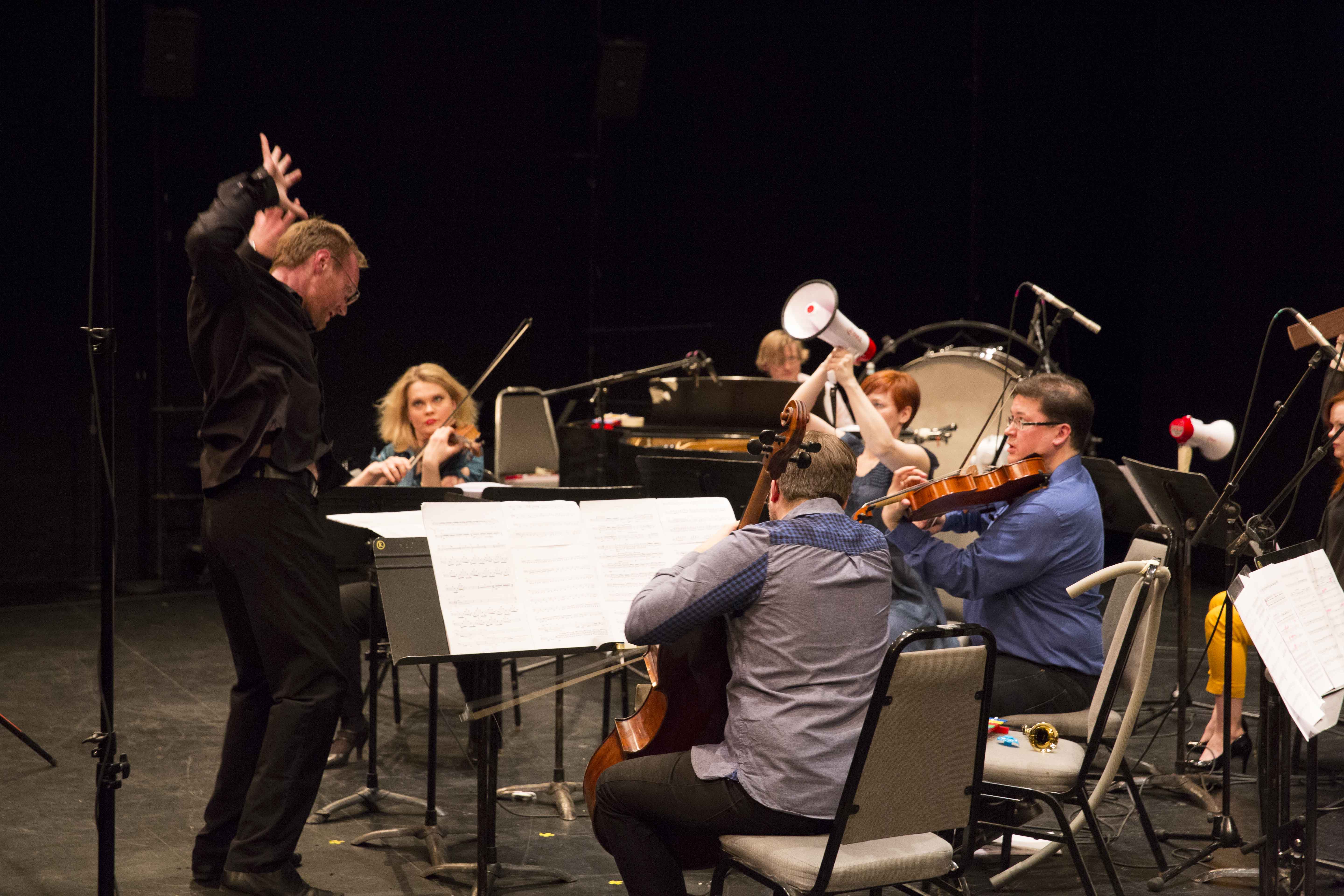
Uusinta performs at 2014 MATA Festival
Uusinta was founded by composer Osmo Tapio Räihälä in 1998, and during their early years, when most of the members were themselves composers, the ensemble specialized in premiering new works by Finnish and Nordic composers.  More recently, the ensemble's repertoire has expanded to include works by composers from around the world, and they have oriented themselves around a prime mission to "bring the most exciting composers from all countries to its concerts in Helsinki and abroad."  Over the past two decades, the ensemble has found itself at a number of highly-regarded festivals and in venues around the world, including Berlin (Ohrenstrand), Paris (Theatre Dunois), Vienna (Arnold Schönberg Center), Valencia (Mostra Sonora), Oslo (Nordic Music Days), and Tallinn (Estonian Music Days).

In particular, Uusinta's performance at the 2014 MATA Festival earned them high praise, with the New York Times remarking on their versatility and virtuosity, and describing their performance as containing "ample gravity and dignity," while being marked by an "athletic brio" and a "playful ease and anything-goes attitude."  A concert at Helsinki's Musica Nova Festival with Nicholas Hodges and Magnus Lindberg prompted the Financial Times to applaud Uusinta's combination of "waves of energy" and 'fragility,' as well as to remark on the evocative textures of "shivering strings, rustling percussion and slithering woodwinds" in their performance of Toshio Hosokawa's Poe monodrama, The Raven.


Uusinta director, Ville Raasakka
Uusinta's commitment to realizing new works is an integral part of their DNA.  Formed by composers for composers, the group has premiered over 100 new works, and has collaborated with some of the most internationally-recognized composers currently active, including Beat Furrer, Chaya Czernowin, Mark Andre, Michel van der Aa, Hèctor Parra, and fellow Finnish artist (and recent visitor to the Center) Kaija Saariaho. In 2011, Uusinta initiated the contemporary concert series, Klang, which focuses on music composed after 2000.  The most recent Klang performance featured two premieres Uusinta commissions by composers Oscar Bianchi and Max Savikangas.  In 2000, the ensemble started its own publishing house, Uusinta Publishing Company, to publish new works by Finnish composers.  Over the past sixteen years, they have published works by artists such as Ralf Gothóni, Markus Fagerudd, and friend-of-the-Center, Sebastian Fagerlund.  During their tenth season as an ensemble, Uusinta was part of the EU's Re:New project, which promoted European contemporary music in eleven countries.  Uusinta, whose name can translate as both "replay" or "newest", was well-suited for such a project, as they have devoted themselves to producing, and reproducing the most exciting new works by established and emerging composers alike.  Under the artistic direction of composer Ville Raasakka, the ensemble has continued to stay true to this mission.

It is for this reason that we are so excited to welcome Uusinta to the festival this year.  A group so devoted to the realization of new works by young composers will fit right in with the mission of the festival, and we're looking forward to hearing them play and 'replay' the 'newest' music this summer in Buffalo.

Monday, November 9, 2015

June in Buffalo 2016: Call for Works


Ensemble SIGNAL will be among the
resident ensembles at June in Buffalo 2016
The Center is excited to announce the June in Buffalo 2016 call for works!  Below you can find application requirements for composers interested in attending the festival and writing for one of the many renowned resident ensembles, including the Arditti Quartet, Uusinta Ensemble, Dal Niente, and Ensemble SIGNAL.  Additional information can be found on the June in Buffalo website.


JUNE IN BUFFALO CALL FOR WORKS:


Presented by the Department of Music and The Robert and Carol Morris Center for 21st Century Music, June in Buffalo, a festival and conference dedicated to composers, will take place from June 6-12, 2016 at the University at Buffalo.  June in Buffalo offers an intensive schedule of seminars, lectures, master classes with selected faculty composers, workshops, professional presentations, participant forums and open rehearsals as well as afternoon and evening concerts open to the general public and critics.  Each of the invited composers will have one of his/her pieces performed during the festival (please see application process for specifics).  Evening performances feature faculty composers, resident ensembles and soloists renowned internationally as interpreters of contemporary music.

Application Procedures
  1. A résumé or curriculum vitae detailing your education, experience, and creative activity.
  2. A letter of reference from someone acquainted with your current compositional activity.
  3. A proposal requesting the performance of a recent work for:
  1. 2 violins, viola, cello (or subset) – Arditti Quartet
  2. flute, clarinet, piano, percussion, violin, viola, cello (or subset) – Uusinta Ensemble
  3. flute, clarinet, piano, percussion, violin, cello (or subset) – Dal Niente
  4. flute, clarinet, oboe, piano, violin, cello (or subset) – Ensemble Signal
  5. solo instrument
Proposals with electronics and/or multimedia will be considered.

Included with the proposal should be a brief description of the work that includes length, full instrumentation, and any technical requirements.  Proposals for works in progress will be considered. A portion of the score plus the description listed above must be included with application materials for in-progress works.
  1. One or two scores that demonstrate your recent work and accompanying recordings, if available.
  2. A $25 non-refundable processing fee. Checks or money orders should be made payable to June in Buffalo.  Foreign applicants must pay by international money order in US currency. Do not send cash.
  3. An e-mail address at which you can be easily contacted and a SASE (optional) for the return of application materials.
Application materials sent to:

June in Buffalo
220 Baird Hall
Department of Music
University at Buffalo
Buffalo, NY 14260

To apply as an auditor please send a resume and the processing fee. Auditors attend all June in Buffalo events, but will not have a piece performed.

Participant fee is $775 USD
Auditor fee is $400 USD

Application materials must be postmarked by February 15, 2016.

Monday, September 7, 2015

2015-2016 Calendar of Events


The Robert and Carol Morris Center for 21st Century Music is excited to announce its 2015-2016 Calendar of Events.  The season is sure to be one full of exciting music for adventurous listeners, with performances by the Slee Sinfonietta, Mivos Quartet, Ensemble Linea, and Project Isherwood among other stellar ensembles.

Brad Lubman will direct the Slee Sinfonietta and Ensemble SIGNAL
in works by Kaija Saariaho next month!
The Center is thrilled to host the residencies of several renowned artists this year, including LoadBang, VoxNova Italia, JACK Quartet, and Oerknal Ensemble, all of whom will present concerts of cutting-edge contemporary music and work directly with Buffalo composers at student workshops.  Our Visiting Lecture Series will feature world-renowned composer Kaija Saariaho, whose time in Buffalo will coincide with the events of FinnFest 2015, including a special Slee Sinfonietta program featuring some of her most significant works.  The Lecture Series will also welcome Sebastian Fagerlund, another Finnish composer whose works have received wide acclaim, and who will be featured on an October Buffalo Philharmonic concert as part of FinnFest.

The year will culminate in June in Buffalo 2016, the Center's annual festival and conference dedicated to composers, which will welcome a number of exciting artists including the composers Hans Abrahamson, Hanna Eimermacher, Joshua Fineberg, and Josh Levine, in addition to the festival's artistic director, David Felder.  A number of spectacular resident ensembles will be in attendance, including the Arditti Quartet, the Buffalo Philharmonic Orchestra, Ensemble SIGNAL, the Slee Sinfonietta, and—in their first visits to the festival—Dal Niente and Uusinta Ensemble.   The JiB call for works will be released within the coming months…

See below for our full calendar of events, or visit the Center's website.


Robert and Carol Morris Center for 21st Century Music

2015-16 Schedule of Events


October 2, 2015
Sebastian Fagerlund
Visiting composer

October 5, 2015
[Rescheduled concert]:
Program to include works by 
Brook, Felder, Lachenmann, Stauning

October 6, 2015
Visiting composer

November 12-13, 2015
Visiting ensemble
Evening performance and composer workshop

December 4-6
Visiting ensembles
Two evenings of concerts and composer workshop

April 5, 2016
Visiting ensemble
Evening performance

April 30 - May 2, 2016
Visiting ensemble
Evening performance and composer workshop

May 2-5, 2016
Visiting Ensemble
Evening performance and composer workshop
Program to include works by 
Felder, Heidelberger, Nielson, Zorn


Slee Sinfonietta

October 6, 2015
Slee Sinfonietta Presents
Ensemble Signal
Brad Lubman, conductor
Camilla Hoitenga, flute
Lauren Radnofsky, 'cello
Featuring works by Kaija Saariaho
Part of FinnFest in Buffalo, NY

April 21, 2016
Slee Sinfonietta
Program TBA


June in Buffalo 2016
June 6-13
David Felder, Artistic Director

Faculty Composers
Hans Abrahamson
Hanna Eimermacher
David Felder
Joshua Fineberg
Josh Levine

Resident Ensembles
Arditti Quartet
Buffalo Philharmonic Orchestra
Dal Niente
Ensemble Signal
Slee Sinfonietta
Uusinta Ensemble

Special Guests
Magnus Andersson
Brad Lubman