Showing posts with label Ensemble SIGNAL. Show all posts

Saturday, April 9, 2022

June in Buffalo 2022 Resident Ensemble: Ensemble Signal

We are pleased to welcome Ensemble Signal as one of the resident ensembles at the 2022 edition of June in Buffalo!

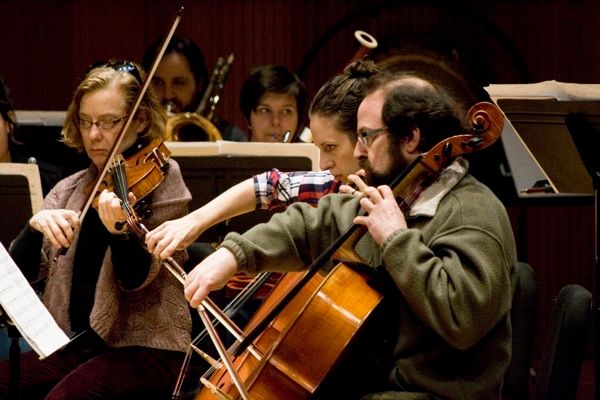
Ensemble Signal is a NY-based ensemble dedicated to offering the broadest possible audience access to a diverse range of contemporary works through performance, commissioning, recording, and education. Since its debut in 2008, Signal has performed over 350 concerts, premiered numerous works, and co-produced ten recordings.

Signal was founded by Co-Artistic/Executive Director Lauren Radnofsky and Co-Artistic Director/Conductor Brad Lubman. Described by the New York Times as "one of the most vital groups of its kind” and “A new-music ensemble that by this point practically guarantees quality performances,” Signal regularly performs with Lubman and features a supergroup of independent artists from the modern music scene. Lubman, one of the foremost conductors of modern music and a leading figure in the field for over two decades, is a frequent guest with the world’s most distinguished orchestras and new music ensembles.

The Ensemble has appeared at concert halls and international festivals including Lincoln Center Festival, the Los Angeles Philharmonic’s Series at Walt Disney Concert Hall, BIG EARS Festival, Carnegie Hall's Zankel Hall, Lincoln Center American Songbook, The Library of Congress, Washington Performing Arts, Cal Performances, Tanglewood Music Festival of Contemporary Music, Ojai Music Festival, the Guggenheim Museum (NY), NPR Tiny Desk Concerts and the Bang on a Can Marathon. They regularly work directly with nearly all the composers they perform in order to offer the most authentic interpretations, a list that includes Hans Abrahamsen, Unsuk Chin, Michael Gordon, Georg Friedrich Haas, Oliver Knussen, Helmut Lachenmann, David Lang, Hilda Paredes, Steve Reich, Kaija Saariaho and Julia Wolfe.

Recent highlights include the world premiere and 130 performances of Reich’s Reich/Richter for large ensemble, with artwork and film by Gerhard Richter for the inaugural season of New York’s multi-arts venue, The Shed (spring 2019), and the US premieres of Reich’s Runner at venues across the US (2017-18). Upcoming highlights in 2022 include the US premieres of music by Luca Francesconi and George Lewis, the world premiere of a new work by Darian Donovan Thomas, a concert of music curated by Julia Wolfe at Carnegie Hall, as well as workshop performances with the next generation of composers.

Among Signal’s recordings are Reich’s Music for 18 Musicians, which was released in May 2015 on harmonia mundi and received a Diapason d’or and appeared on the Billboard Classical Crossover Charts. Additional recordings include a CD & DVD of music by Lachenmann, with the composer as soloist in “…Zwei Gefühle…” (Mode) and Gordon/Lang/Wolfe’s Shelter (Cantaloupe).

Signal’s passion for the diverse range of music being written today is a driving force behind their projects. The Ensemble’s repertoire ranges from minimalism or pop-influenced to the iconoclastic European avant-garde. Signal’s projects are carefully conceived through close collaboration with cooperating presenting organizations, composers, and artists. Signal is flexible in size and instrumentation - everything from solo to large ensemble and opera, including film or multimedia, in any possible combination - enabling it to meet the ever-changing demands on the 21st century performing ensemble.

Monday, June 6, 2016

Hans Abrahamsen: Untouched Music


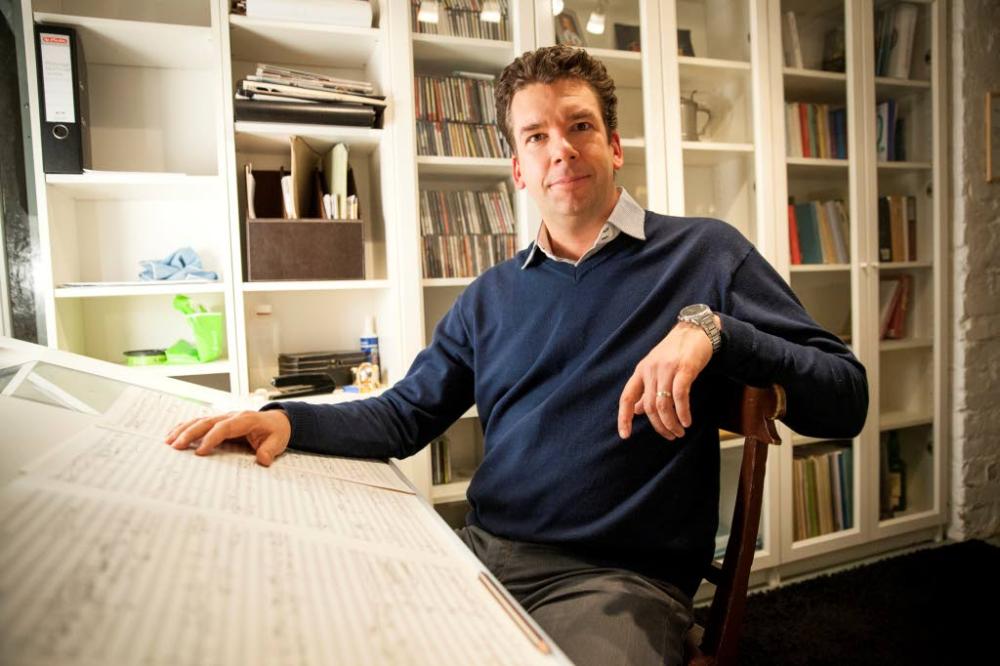
Hans Abrahamsen
This year, June in Buffalo is excited to welcome to the festival for the first time Danish composer Hans Abrahamsen.  A skilled orchestrator as renowned for his arrangements as his compositions, Abrahamsen has been celebrated for his monodrama, let me tell you (2013)—which received the 2016 Grawemeyer Award for Music Composition—and his canonic Schnee (2006-08), for two pianos, percussion, and contrasting trios, which has been frequently identified as one of the landmark pieces of the early century.  Paul Griffiths has described the composer's music as "Resonant with the western tradition in all its facets, with ancient folk melody, with nature, with the vibrant structure of sound itself, [it] yet has the freshness of something untouched—untouched, and touching by being so."

Abrahamsen's music has a gained a reputation for its literal and figurative evocations of winterscapes, and even Griffiths' reference to the "untouched" quality of his work alludes to the condition of freshly fallen snow.  This is perhaps most apparent in Schnee, but is also present in his earlier work Winternacht (1976-78), as well as in the "glacial world of high harmonics" elicited by his Fourth String Quartet, the glistening austerity of let me tell you, and the solitary winterreise of Left, alone (2014-15), a concerto for piano left hand.  It would be understandable for a composer to feel some anxiety about being branded 'the winter composer', but Abrahamsen maintains the confidence of an artist who has created an aesthetic realm of their own, and who is content to reside there comfortably:  the composer is currently composing an opera based on Hans Christian Andersen's The Snow Queen.

The composer was perhaps not always so comfortable, famously taking a break from composition that lasted nearly a decade in the early 1990s.  Before that, the Ligeti student's early works were associated with a Danish trend called the "New Simplicity," which reacted against the complexity of the Darmstadt school by seeking a music that increased objectivity by, in Erik Jakobsen's words, "[aiming] to liberate musical material from the composer’s personal attitudes and feelings."  [NB:  This is distinct from the later, more subjective German style of the same name, of which Wolfgang Rihm is the most recognizable adherent.]  Abrahamsen's orchestral piece Skum (1970) most clearly demonstrates this early approach.  By the mid-1970s, however, he had developed a more distinct style, as evident in the orchestral nocturne Nacht und Trompeten (1981), the frigid underbrush of Winternacht, and perhaps most famously, in the seven piano studies of 1984 (later expanded to ten studies).  In the following decade, the composer's compositional activity ceased, though he continued arranging, producing adaptations of works by Bach and Nielsen.  One must admit a certain level of artist boldness to not only know when to stop composing, but more significantly, when to start again.  It was after this break that Abrahamsen's music began to bear the "untouched" quality spoken of earlier, as if the composer found a way to reset, and to make a new music unhindered by his previous explorations.


His later style is marked by a pronounced intimacy, even in the larger ensemble works like Schnee.  This is perhaps most evident in a piece like Wald (2009), in which the micropolyphony of his former teacher is matched with modal folk-music melodies in a variation form that is at turns rhythmically erratic and ominously understated (see below).  The Four Pieces for Orchestra (2004), arrangements of his earlier piano studies, emphasize his unique orchestrational perspective, employing a large ensemble that includes a full percussion battery and Wagner tubas.


Audiences at June in Buffalo will hear Signal Ensemble perform Schnee on the evening of Friday June 10th (for more on that performance, see our Signal profile).  In addition, the Arditti Quartet will present the composer's Fourth Quartet (2012).  "[It] has become in its way a serene and cool piece," Abrahamsen says of the piece, which the composer began before his hiatus.  "So the Quartet has been finished luckily after twenty years—it was already in 1990 that I was commissioned by Wittener Tage für Neue Musik to write the piece for Arditti Quartet."  Dal Niente will perform the aforementioned Winternacht, a four-movement work whose title comes from a poem by Georg Trakl.  "The music has a strong impressionistic quality," says Poul Ruders, "four introverted still lives of the velvety, dark iceness of a silvery winter night (one can veritably sense the fairy tale-like sleigh ride in the two outer movements)."  Those outer movements are dedicated to Trakl, while the more classical form of the third movement bears a dedication to Stravinsky, and the eccentric density of the second is an hommage to M.C. Escher.  Finally, the earliest work of Abrahamsen's presented at the festival will be 1975's Stratifications, performed by the Buffalo Philharmonic Orchestra.  "The stratifications referred to in the title unfold on two different levels," the composer explains.  "There is the stratification of the time dimension produced by the opposition of contrasting parts; at the same time the polyphony, the presence of several simultaneously sounding layers, is of great importance to the music."  Several elements of the early New Simplicity style are superimposed into a more complex amalgam. "It is like seeing lantern slides.  But this 'fictive form crackles and the music gets attentive and real.  [It] is in a nightmare condition, where it is not getting anywhere in spite of a great dynamic display.  But finally is liberating itself and rising 'in triumph'."

Thursday, May 19, 2016

Ensemble SIGNAL: Popups and Canons


UB's spring semester opened with Ensemble SIGNAL's residency at the University's new Creative Arts Initiative—a residency that included a masterclass, an open rehearsal, a discussion on artistic entrepreneurship, and Performance in the Dark, a concert of works by Steve Reich and Georg Friedrich Haas (read more about it here).  That was just the first of two non-consecutive weeks of SIGNAL's residency, and the second week took place earlier this month, bookending the semester with exciting events featuring the NY-based ensemble.

SIGNAL's Bill Solomon performs a
solo kalimba micro-concert
The second week began on May 2, with "popup concerts" at various locations around UB's North Campus.  Consisting of 15 'micro-concerts' in a span of 30 minutes, each popup concert featured one or two of the ensemble's musicians playing brief (3-15 minutes) unannounced lunchtime concerts around the campus.  The following day featured a workshop performance of the minimalist classic In C by Terry Riley.    For this event, the ensemble invited anyone able to read music and play an instrument to sit in with them through a reading of Riley's work, introducing UB students and community members not only to the famous piece's challenging form, but also to the excitement of playing alongside some of the most skilled new music performers.  The residency concluded with a celebratory concert of works by Steve Reich.  SIGNAL have long been renowned for their interpretations of Reich's music, especially their Harmonia Mundi recording of Music for 18 Musicians (which received a Diapason d’or in June 2015 and appeared on the Billboard Classical Crossover charts in May 2015).  This concert featured several of the composer's "hits" (1972's Clapping Music, and 1985's New York Counterpoint), as well as two recent works:  Radio Rewrite (2012), based on themes from two Radiohead songs, and Quartet (2013) for two vibraphones and two pianos.

But SIGNAL is not finished yet!  The ensemble will be back next month as one of the six resident ensembles at June in Buffalo.  At this year's festival, they will perform a concert of works by JiB participants (June 7, 4:00pm, Baird Recital Hall), taking their experience collaborating with renowned composers to JiB's young artists, helping them articulate their musical visions and offering authentic interpretations of their works.  SIGNAL will also perform an evening concert (June 10, 7:30pm, Lippes Concert Hall), which will consist of a single large-scale work:  Schnee by Hans Abrahamsen.  The Danish composer—who will be on the composition faculty at this year's festival—composed Schnee ("Snow") in 2008, and the work has since been called a "hidden gem" by the New York Times.  The piece has its roots in 8 Canons, a collection of Bach arrangements which used repetition and slow durations to open up a new way of looking at time in these often taken-for-granted works:
I became totally absorbed into this music and arranged them with the intention of the music being repeated many, many times, as a kind of minimal music.  Obviously, I didn't know which durations Bach had in mind, but by listening to his canons in this way, a profound new moving world of circular time was opened to me.  Depending on the perspective on these canons, the music and its time can stand still or move either backwards or forwards.
One of these arranged canons, Kanon zu acht Stimmen, BWV 1072, can be heard below in Abrahamsen's arrangement.


Schnee emerged through a similar idea, and, using the Bach arrangements as a model, Abrahamsen composed a pair of two large-scale canons for nine instruments divided into two halves (piano and 3 strings, piano and 3 winds, with percussion in the middle).
In my own work, an ongoing idea has persisted, of at some point writing a work consisting of a number of canonical movements that would explore this universe of time.  […]  In Schnee, a few simple and fundamental musical questions are explored.  […]  Can a phrase be answering?  Or questioning?  [Schnee's] two canons are identical like a painting in two versions, but with different colors.  And where the first one does not include the space, the second one does, as well as containing more canonical traces.


The piece soon expanded into ten canons which gracefully unfold over the course of an hour.  The airy, ghostly music begins with whispering, feather-soft gestures, and reduces itself from there as the piece develops.  The performers are told to detune their instruments between movements, moving lower and lower as the piece progresses, creating stranger and more otherworldly sounds.  The work's frigid title makes reference to Hans Christian Andersen's "The Snow Queen", and many of the sparse melodies have a frosty lightness to them, sounding almost like snow falling gracefully downward.

Brad Lubman
SIGNAL is directed by Brad Lubman, who is a special guest at this year's festival.  Lubman has played an important role in contemporary music for the past twenty years, acting not only as the founding co-Artistic and Music Director of SIGNAL, but also as a frequent guest conductor of many of the world's leading ensembles (including Ensemble Modern, London Sinfonietta, Klangforum Wien, ASKO Ensemble, St. Paul Chamber Orchestra, WDR Symphony Cologne, Finnish Radio Symphony, and the Center's own Slee Sinfonietta). Currently on faculty at the Eastman School of Music, Lubman is known for his versatile conducting technique and skilled realizations of contemporary and classical works alike.


We're excited that Brad Lubman and SIGNAL will be returning to this year's festival (for more on the long, productive relationship between the ensemble and June in Buffalo, see last year's profile).  Whether realizing classical minimalist works with UB students, premiering new works by emerging composers, or articulating the delicate subtleties of wintery canons, SIGNAL is always a reliable source for strong, proficient performances.

Monday, February 8, 2016

SIGNAL Ensemble featured in CAI Pilot Project


This week, UB's new Creative Arts Initiative launches the first of several pilot projects:  the residency of Ensemble SIGNAL, which will feature a masterclass, an open rehearsal, and a discussion on artistic entrepreneurship, all leading up to Performance in the Dark, a concert in the CFA Black Box Theater featuring works by Steve Reich and Georg Friedrich Haas.

The university-wide Creative Arts Initiative is "dedicated to the creation and production of new work upholding the highest artistic standards of excellence and fostering a complementary atmosphere of creative investigation and engagement among students, faculty, visiting artists, and the community."  Through a number of programs aimed at exposing UB students to the richness of the Buffalo arts community—including artist residencies and innovative interdisciplinary course offerings—the CAI will contribute to UB's Strategic Plan by "creating opportunities for creative interaction between visiting artists, students and faculty, and the Buffalo arts community."  "We feel a tremendous amount of energy in being able to create opportunities for people to interact with really high-level, excellent artists," says co-Director, David Felder, in the CAI's introductory video (see below), "We're talking about individuals and groups, companies as well as solo [artists]."


One of the ways the CAI will engage students is through direct interaction with visiting artists.  Ensemble Signal's residency is the first of many such engagements.  The residency will feature a number of exciting events, beginning on February 10th with "Rehearsing in the Real World," an open rehearsal at which students will be able to witness how the ensemble works together to prepare Georg Friedrich Haas's famous String Quartet no. 3.  Later that evening, Signal's leadership will host "The Entrepreneurial Artist," an open discussion and Q&A covering the ensemble's history, with the aim of empowering UB students in the creation of their own community projects.  The following day will feature a public performance workshop and masterclass, at which Signal co-artistic director and others from the ensemble will coach UB music students, some of whose compositions will be performed later this semester.  

Ensemble Signal
The residency will culminate in Performance in the Dark:  Music by Steve Reich and Georg Friedrich Haas, a free concert in the CFA Black Box Theater featuring two groundbreaking works of contemporary music.  The concert will open with Part I of Reich's Drumming, performed by Doug Perkins of Signal alongside Tom Kolor and students in his percussion studio.  The 1971 work was composed after Reich's trip to West Africa, where he studied with Ghanaian master drummers.  One of the first large-scale masterpieces in American minimalism, the piece quickly became a staple of contemporary percussion repertoire, especially its opening section:  a quartet for tuned bongos which employs Reich's characteristic phasing techniques.  The concert also features Haas's more recent String Quartet no.3 „In iij. Noct.“ (2001), a piece which is "performed in complete darkness, with the musicians playing from memory in different parts of the room."  The New Yorker's Alex Ross has described the piece as one in which the performers 
seem to map the space with tones, like bats using echolocation to navigate a lightless cave.  […]  Often, the music borders on noise:  the strings emit creaks and groans, clickety swarms of pizzicato, shrill high notes, moaning glissandos.  At other times, it attains an otherworldly beauty, as the players spin out glowing overtone harmonies.
This week marks just the first of two non-consecutive weeks of Signal's residency:  the ensemble will return the week of April 30 for a second week which will include a series of "secret" pop-up concerts around UB North Campus, a collaborative performance of Terry Riley’s In C with UB students, and a large-scale concert celebrating the music of Steve Reich.  (For more about Ensemble Signal, see our JiB 2015 profile post from last year.)

The CAI is currently accepting proposals for residencies from creative artists from all fields (music, film, plastic arts, visual arts, drama, writing, and architecture).  This first open call aims to attract artists from around the world, with the aim of giving students the opportunity to interact with great artists who are not currently active in Buffalo.  CAI Managing Director, Cynthia Stewart emphasizes that the initiative is seeking artists who will be actively creating at UB.  Rather than bringing in a visiting artist to simply give a talk, the CAI seeks artists who will actually engage in artistic creation as part of their residency, with an emphasis on student involvement.  "The call is really open with regard to how to incorporate student interaction," says Stewart, "but the more student involvement the better."  Stewart stresses the lack of constraints on the scope of the residencies artists can propose.  "It might be a micro-seminar or a master class.  It might be a semester-long encounter.  There are not a lot of strictures."  The first open call has a deadline of March 1st, and the CAI is eagerly anticipating a variety of proposals from artists of diverse disciplines.

Arts One will visit the Albright Knox Gallery this semester
One of the initiative's key new programs is the Arts One course.  Aimed at introducing students to "a wide range of artistic performance and creative activity," the course consists of a unique approach:  every week, students are exposed to a new artistic exhibition.  Through a partnership with a variety of local institutions, including the Albright Knox, the Burchfield Penney Art Center, and the Buffalo Philharmonic Orchestra, students will attend a different event each week.  "This course is deliberately designed to put students in direct contact with artists and arts organizations in a very topical way. Each semester will be very different based on what’s happening in Western New York," says Felder.  This semester, the capacity-filled course will hear curator's talks at Hallwalls and the Albright Knox, attend concerts by Ensemble Linea, the BPO, and the Richmond Ballet, and will see performances by the Zodiaque Dance Company, among many others.  "The aim is to demonstrate to students the difference between a live performance and simply seeing something on YouTube," says Stewart, "it also forces them off campus and allows them to connect to the creative riches in Buffalo."

CAI co-director D. Felder
The Creative Arts Initiative was itself initiated through the hard work of co-directors David Felder and Bruce Jackson.  "It was their brainchild," says Stewart, "and they've been beating the drum for it for a long time."  Their vision was for an initiative that would see more investment in the creative arts, specifically.  "It's based on the idea that creating is a different process from studying," Stewart explains.  "Due to their work and persuasion we were able to receive a grant to get the initiative started, and using their relationships in the arts community we were able to assemble an excellent board.  This gives us a good position to help visiting artists make a splash in the community and not just here at UB."


Ensemble Signal Residency


Rehearsing in the Real World
Feb. 10, 3:00-4:00pm, B1 Slee
Open to all students

The Entrepreneurial Artist
Feb. 10, 6:30-8:30 pm, 211 Baird
Open to all students

Performance Workshop/Masterclass with UB Students
Feb. 11, 10:00am-12:00pm, B1 Slee
Open to UB music students

Performance in the Dark: Music by Steve Reich & Georg Friedrich Haas
Feb. 12, 8:00 pm, CFA Black Box Theater
Open to the public

Monday, November 9, 2015

June in Buffalo 2016: Call for Works


Ensemble SIGNAL will be among the
resident ensembles at June in Buffalo 2016
The Center is excited to announce the June in Buffalo 2016 call for works!  Below you can find application requirements for composers interested in attending the festival and writing for one of the many renowned resident ensembles, including the Arditti Quartet, Uusinta Ensemble, Dal Niente, and Ensemble SIGNAL.  Additional information can be found on the June in Buffalo website.


JUNE IN BUFFALO CALL FOR WORKS:


Presented by the Department of Music and The Robert and Carol Morris Center for 21st Century Music, June in Buffalo, a festival and conference dedicated to composers, will take place from June 6-12, 2016 at the University at Buffalo.  June in Buffalo offers an intensive schedule of seminars, lectures, master classes with selected faculty composers, workshops, professional presentations, participant forums and open rehearsals as well as afternoon and evening concerts open to the general public and critics.  Each of the invited composers will have one of his/her pieces performed during the festival (please see application process for specifics).  Evening performances feature faculty composers, resident ensembles and soloists renowned internationally as interpreters of contemporary music.

Application Procedures
  1. A résumé or curriculum vitae detailing your education, experience, and creative activity.
  2. A letter of reference from someone acquainted with your current compositional activity.
  3. A proposal requesting the performance of a recent work for:
  1. 2 violins, viola, cello (or subset) – Arditti Quartet
  2. flute, clarinet, piano, percussion, violin, viola, cello (or subset) – Uusinta Ensemble
  3. flute, clarinet, piano, percussion, violin, cello (or subset) – Dal Niente
  4. flute, clarinet, oboe, piano, violin, cello (or subset) – Ensemble Signal
  5. solo instrument
Proposals with electronics and/or multimedia will be considered.

Included with the proposal should be a brief description of the work that includes length, full instrumentation, and any technical requirements.  Proposals for works in progress will be considered. A portion of the score plus the description listed above must be included with application materials for in-progress works.
  1. One or two scores that demonstrate your recent work and accompanying recordings, if available.
  2. A $25 non-refundable processing fee. Checks or money orders should be made payable to June in Buffalo.  Foreign applicants must pay by international money order in US currency. Do not send cash.
  3. An e-mail address at which you can be easily contacted and a SASE (optional) for the return of application materials.
Application materials sent to:

June in Buffalo
220 Baird Hall
Department of Music
University at Buffalo
Buffalo, NY 14260

To apply as an auditor please send a resume and the processing fee. Auditors attend all June in Buffalo events, but will not have a piece performed.

Participant fee is $775 USD
Auditor fee is $400 USD

Application materials must be postmarked by February 15, 2016.

Wednesday, September 30, 2015

Saariaho, Fagerlund, and others celebrate FinnFest


Next week will see the beginning of FinnFest 2015 in Buffalo, an annual festival celebrating Finnish culture and heritage, which includes a variety of cultural and educational activities and events.  Due to Finland's rich musical history, the week-long festival will feature a variety of exciting musical performances, including a pair of concerts by the Buffalo Philharmonic in Kleinhans Music Hall (itself designed by Finnish architects Eliel and Eero Saarinen).  "Echoes of Sibelius" (October 9-10) will feature the first symphonies of Sibelius and Einojuhani Rautavaara, with the US premiere of Jaakko Kuusisto's Violin Concerto; "Northern Lights" (October 3-4), will feature Sibelius's Fifth Symphony and Grieg's famous Piano Concerto, alongside the US premiere of Isola, by Sebastian Fagerlund.  Both Fagerlund and Kuusisto will be present for their respective premieres, and will give preconcert talks.

Sebastian Fagerlund
The Center is also excited to welcome Fagerlund as the first guest in this season's Visiting Lecture Series, with his presentation on October 2.  Fagerlund's rich, vibrant music often carries existential themes, and has been described as "post-modern impressionism depicting mental landscapes."  Combining elements from Eastern and Western musics, minimalist electronica and Scandinavian black metal, big band and Boulez, his diverse output—while oscillating between extremes—errs on the side of rhythmic drive and unceasing energy.  "A sort of primitivism is present in many of my works, [and] as a result, rhythm, in particular, has become very important [to me]" he explains.  Isola represents these ideas well, featuring an often violent approach to the orchestra which combines performative aggression with harmonic and textural sophistication.

Kuuisto will also present at the Visiting Lecture series, the following week.  The violinist-composer began studying at the Sibelius Academy at the age of 12 and quickly made a name for himself by winning several international competitions.  As a violinist, he has performed with the Sydney, Adelaide, and Melbourne Orchestras, the Hannover NDR Orchestra, and the Belgian Royal Philharmonic Orchestra, as well as most of the major Finnish orchestras.  As a composer, his output includes chamber and vocal music, orchestral works, film music, and operas—including his most well-known work, the "family opera," Koirien Kalevala, which was presented at the Savonlinna Opera Festival to a full house for three consecutive seasons.  We look forward to hearing his insights into his work.

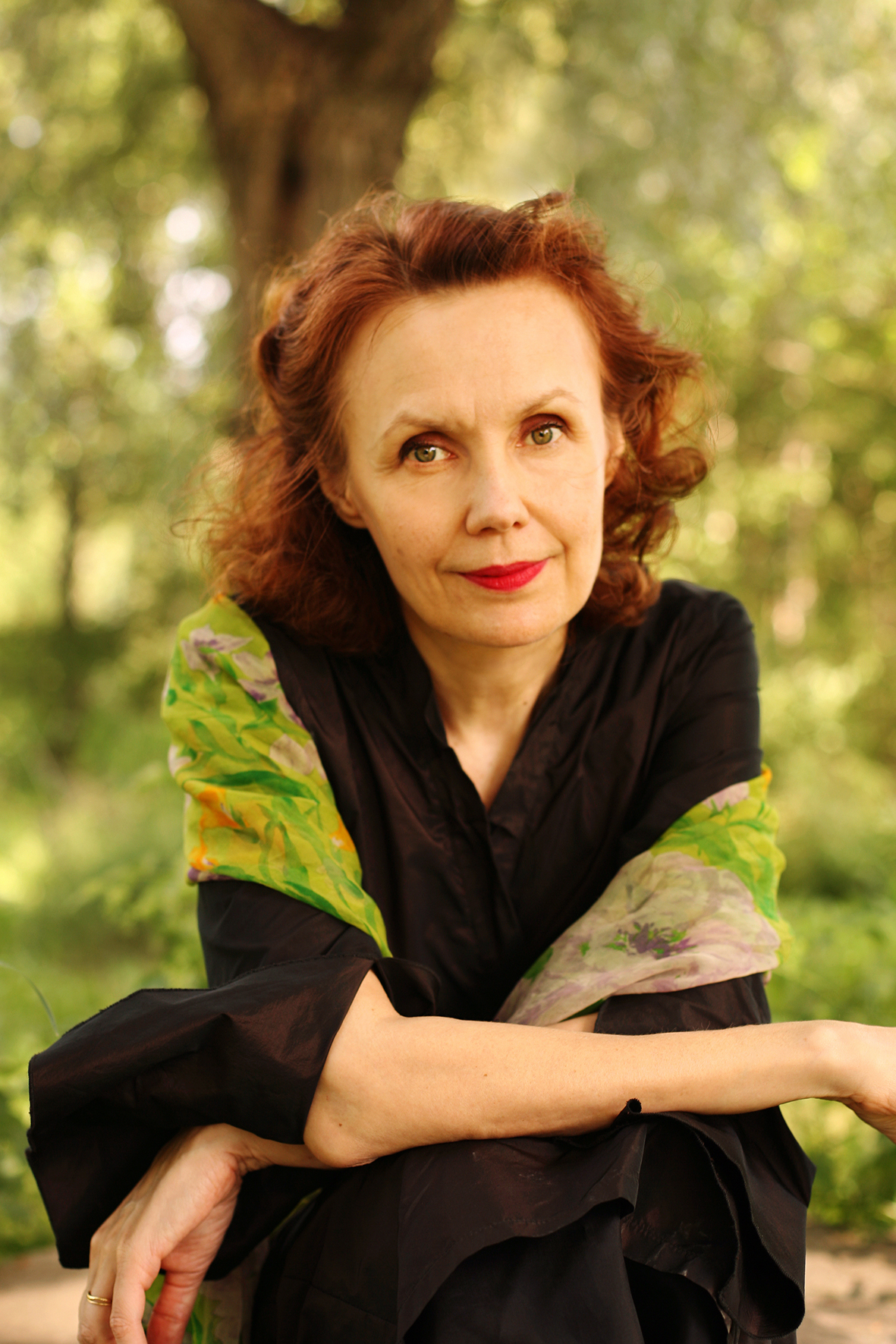
Kaija Saariaho
The Center's contributions to FinnFest do not end there.  We are excited to also host the residency of famed Finnish composer Kaija Saariaho, and to present a special Slee Sinfonietta / Ensemble SIGNAL concert  of some of the composer's most significant works on October 6.

Saariaho's music has always been marked by a fascination with color and texture, with timbre and harmony being the foundational elements.  While her earliest works showed the influence of late-modernist post-serialism—an idiom she eventually found to be constraining—her outlook shifted after being exposed to the music of Grisey and Murail while studying at Darmstadt.  As her aesthetic began to take shape during a period of research at IRCAM in Paris, Saariaho developed new expressive techniques based in analysis of the sonic spectra of instrumental sounds.  Her first computer-assisted composition was Lichtbogen, for 9 instruments and live electronics (1986), a piece whose point of departure lies in the spectrum of high harmonics which burst forth from a cello when bow pressure is increased (hence the title, which translates as "light-bow").

Paul Gauguin - NoaNoa
NoaNoa (1992), for flute and electronics, was composed in close collaboration with flautist Camilla Hoitenga, who will perform the work during next week's Sinfonietta concert.  The composer describes the work, which was inspired by the Paul Gauguin woodcut of the same title, as stemming from a desire to "write down, exaggerate, even abuse certain flute mannerisms that had been haunting me for some years."  The piece itself has become a key work in the contemporary flute repertoire and a signpost in the solo-instrument-plus-electronics genre.  Prés (1992), for solo 'cello and electronics, is also inspired by a Gauguin work (the painting, By the Sea), and pairs the string instrument with an electronic doppelgänger consisting of synthesized tones, manipulated 'cello sounds, and real-time processing of the live 'cello with resonant filters.  The piece will be played by SIGNAL executive director, Lauren Radnofsky.

The concert's most recent work is 2001's Aile du Songe, a concerto for flute, string orchestra, and percussion (also to be played by Hoitenga).  Like so much of the Saariaho's work, the piece is written in exquisitely detailed notations featuring harmonics, microtonal coloring, and a wealth of expressive markings.  Listeners will be privy to her slow timbral transformations as well as the sensitive lyricality which has been an increasingly present element in the composer's work since the late 1990s, when she began a series of operatic and vocal works.  Still marked by a sparsity characteristic of much of her earlier music, ("I don’t believe in austerity," the composer has said, "but I do [believe] in purity"), the work is sure to illustrate why the Denver Post has called "one of the most original compositional voices of our time."

The festival will include other intriguing musical events, including the Buffalo Chamber Music Society's hosting of the Carpe Diem String Quartet, who will perform a concert of Finnish works in Kleinhans' Mary Seaton room, including Sibelius's Andante Festivo, Rautavaara's first quartet, and Erkki Melartin's "The Sunflower."  In addition, Buffalo contemporary music ensemble Wooden Cities will present "A Kalevala Duo:  Playing Bones" a collaborative concert with performance artist Pia Lindman, which will feature the ancient Finnish technique of "bone-setting" set to music by recent UB-graduates Nathan Heidelberger and Brendan Fitzgerald.


Mivos Quartet
If that's not enough music for you, next week the Center will host the Mivos Quartet for a concert of new works for string quartet (including works by Taylor Brook, David Felder, Martin Stauning, and Helmut Lachenmann).  This concert (October 5) was rescheduled from last season after a blaze of Buffalonian thundersnow (read more about the program here), so don't miss your second chance to see these amazing works played by the quartet the Chicago Reader has called "one of America's most daring and ferocious new-music ensembles."

Wednesday, July 1, 2015

2014-15 Season Recap


The Slee Sinfonietta plays Ives's Three Places in New England
The Center's 2014-15 season has been an incredibly exciting one with lots of exciting concerts, including numerous premieres of new works by intrepid composers.  We saw several Slee Sinfonietta programs, including memorable performances of Elliott Carter's Triple Duo (with Ensemble SIGNAL), Charles Ives's Three Places in New England, and the production of Doug Fitch's magnificent "How Did We…?".  We had two fruitful residencies with the Mivos String Quartet and the Deviant Septet, and several visiting composers, including Larry Groupé, Rand Steiger, and Daniel Asia.

Last month, we capped off the season with the 40/30 anniversary of the June in Buffalo Festival, a vibrant week of new music that featured 16 concerts with nearly 80 adventurous new works performed—half of those by the 30 emerging composers in attendance.  The festival was a great success, a celebration of many years of great performances.  In a recent Wall Street Journal Article, author Allan Kozinn points out that, "It would be hard to name more than a handful of major composers of the past 30 years who have not appeared on its faculty roster."  Kozinn, impressed with the work of the festival's participant composers, elaborates:
[A] highlight of a Saturday afternoon program devoted to new student works was Mr. [Eric] Huebner's assured account of Music for a Mad Scientist—300+ Microvariations on a Bach Theme, an explosively virtuosic solo piano work by Texu Kim.  Mr. Kim […] hid his Bach theme amid intensely chromatic Lisztian thunder, at first.  But when the invigorating clatter briefly subsided, the score's internal joke became clear:  The work's theme is the gently arpeggiated C major Prelude that opens The Well-Tempered Clavier, Book I.  […]  Ying-Ting Lin's The Journey began murkily, with repeated bass tones in the piano punctuated by chordal bursts for bass clarinet and violin, but quickly grew into an engagingly varied, lively piece.  Liliya Ugay played the assertive, steely piano line in her own Third World Fable, but regularly ceded the spotlight, and some lovely, supple writing, to the violin and cello.  The student program's most satisfying work was its opener, Ryan Jesperson's Souvenirs/Miniatures, a tightly focused piano trio that—like Ms. Ugay's work, but with a different accent—juxtaposed tense, sharp-edge keyboard angularity with luminous string writing rooted in 19th-century shapeliness.
SIGNAL and the Slee Sinfonietta perform
David Felder's Les Quatre Temps Cardinaux
Kozinn also took note of Saturday night's stunning performance of David Felder's Les Quatre Temps Cardinaux by SIGNAL and the Slee Sinfonietta, under Brad Lubman's direction.  The chamber orchestra piece set poems by René Daumal, Pablo Neruda, Robert Creeley and Dana Gioia (read more about the work here), and featured vocal soloists Heather Buck and Ethan Herschenfeld, as well as video projections by Olivier Pasquet and 12 channels of electroacoustic sound:
The poems are heard not only in the spiky, emotionally intense vocal writing, but spoken on the recorded tracks, which also include percussion sounds and the sparkle, buzz and variegated growl of purely electronic timbres, all moving around a dozen speakers placed throughout the hall.  Abstract video by Olivier Pasquet added atmosphere rather than commentary.  All this could easily have become an exhibition of gimmickry, but Mr. Felder kept his grand audio-visual fabric focused, sober and often wrenching.
The festival saw not only great performances, but also seminars and masterclasses by its world-renowned faculty composers, which can be invaluable to emerging composers.  As noted in a recent UB Reporter article by this author:
The works of these faculty composers were featured in JiB's evening concerts, while the composers themselves gave morning seminars and consulted with participant composers in master classes.  "I am always eager to show my works to professors and peers, not to find confirmation but to collect 'data,'" says Chen.  "Then, at the end of the day, I sit down and do some 'data mining' for my future projects.  […]  JiB is only a week long, but its impact on me will surely last for years to come. I cannot wait for JiB 2016."
For those interested in learning more about the festival, be sure to check out our series of profiles of JiB artists on Edge of the Center, and visit the UB Music Library for an exhibit commemorating the festival's 40/30 anniversary, which is still on display.

Onward…

The Oerknal Ensemble will visit the Center next year
The gears are already in motion for next year's season.  We are excited that next year's events will include visits from guest composers Kaija Saariaho and Hanna Eimermacher, as well as residencies with several prominent new music ensembles, including Load Bang, Voxnova Italia/Project Isherwood, Ensemble Linea, and the Oerknal Ensemble.  We can also look forward to many spectacular Slee Sinfonietta concerts, and of course, June in Buffalo 2016, which will feature the following resident ensembles:  Arditti Quartet, Buffalo Philharmonic Orchestra, Ensemble Dal Niente, Ensemble SIGNAL, Slee Sinfonietta, Uusinta Ensemble.

Edge of the Center will announce more details on all of these events in the coming months.  It's already shaping up to be another incredible season featuring some of the most skilled performers in the city and from around the globe.


Robert and Carol Morris Center for 21st Century Music

2015-16 Schedule of Events


September 2015
Hanna Eimermacher
Visiting composer

October 5, 2015
Visiting composer

October 5, 2015
[Rescheduled concert]:
Program to include works by 
Brook, Felder, Lachenmann, Stauning

November 2015
Visiting ensemble
Evening performance and composer workshop

December 4-6
Visiting ensembles
Two evenings of concerts and composer workshop

April 2016
Visiting ensemble
Evening performance and composer workshop

May 2-5, 2016
Visiting Ensemble
Evening performance and composer workshop
Program to include works by 
Felder, Heidelberger, Nielson, Zorn
Slee Sinfonietta

October 6, 2015
Slee Sinfonietta Presents
Ensemble Signal
Brad Lubman, conductor
Camilla Hoitenga, flute
Featuring works by Kaija Saariaho and other Finnish Composers
Part of FinnFest in Buffalo, NY

April 21, 2016
Slee Sinfonietta
Program TBA


June in Buffalo 2016
June 6-13
David Felder, Artistic Director

Faculty Composers
Hanna Eimermacher
David Felder
Joshua Fineberg
Josh Levine

Resident Ensembles
Arditti Quartet
Buffalo Philharmonic Orchestra
Dal Niente
Ensemble Signal
Slee Sinfonietta
Uusinta Ensemble

Special Guests
Magnus Andersson
Brad Lubman

Monday, May 25, 2015

Ensemble SIGNAL: It's Not Difficult


Reich and Lubman at JiB 2010
Few ensembles can boast performing works by both American minimalist pioneers and cutting-edge European avant-gardists, fewer still can perform each with equal elegance, expressivity, and fluency.  Signal is one of these.  The ensemble has made a name for themselves in the past seven years by working closely with both Steve Reich and Helmut Lachenmann, while producing diverse programs that include works by Ligeti and Lang, Boulez and Wolfe, Andriessen and Ferneyhough (and even, occasionally, 18th century music).  "We’re no longer plagued by notions of borders," Signal's director, Brad Lubman tells Thought Catalog.  "No one tells you, 'You have to play it this way' or 'You have to play it that way.'  It’s a very open time.  And because of that we’re seeing an explosion of compositional languages."  Seeing an explosion of languages is one thing, mastering so many of them is quite another.  But Signal often makes it look easy, performing even the most complex music with an agility that seems to disguise the intricacy—and difficulty—of such works.  "My viewpoint is that I don’t feel one should ever say anything is difficult," Lubman continues.  "What I’ve found is that even with some very complex music, once you’ve spent enough time with it, once you assimilate its features, you start to grasp the particular style and realize it’s not really difficult.  You just have to spend the time with it."

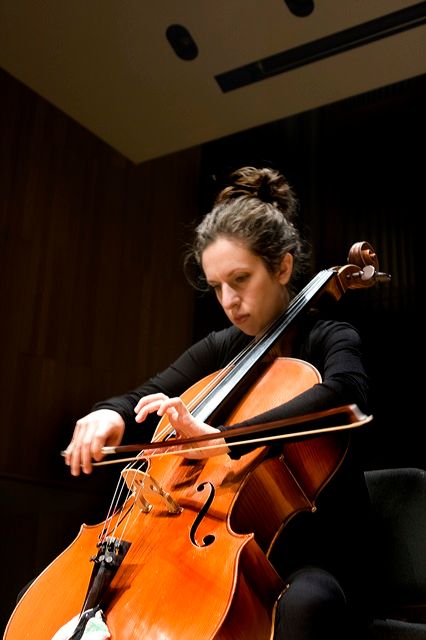
Radnofsky performing Lachenmann's
Pression during Signal's co-residency
with Lachenmann in 2010
Signal was founded in 2008 by Lauren Radnofsky and Lubman.  Radnofsky, Signal's executive director and principal 'cellist, is an important figure in contemporary string music, regularly presenting adventurous music with and without the ensemble (including appearing as the soloist in Saariaho's Amers and collaborating with JACK Quartet in performances of Xenakis's music).  Lubman has been a frequent guest conductor in many of the world's leading ensembles and orchestras, including Ensemble Modern, Klangforum Wien, and the St. Paul Chamber Orchestra.  Since its formation, Signal has performed over 100 concerts, including the premieres of more than 20 new works, while co-producing five recordings (including a critically-acclaimed new recording of Reich's Music for 18 Musicians).

Lubman's relationship with June in Buffalo extends back nearly twenty-five years.  In 1992, he made his JiB debut conducting Charles Wuorinen's ornate chamber work On Alligators, while also seeing the performance of his own Trigram.  He returned to the festival several times throughout the decade, bringing his New Millennium Ensemble in 1994 and guest-conducting the New York New Music Ensemble in 1995.  In 2000, already a renowned interpreter of Steve Reich's music, he conducted the June in Buffalo Chamber Orchestra in a performance of the composer's City Life, while sticking around to conduct the Slee Sinfonietta in Bernard Rands's Concertino (a piece he reprised with Signal just last year).  Three years later, Lubman returned to conduct a stellar performance of Reich's Triple Quartet.

A particularly important performance took place at JiB 2007.  Lubman, already laying the groundwork for what would eventually become Signal, conducted the Slee Sinfonietta—augmented with several NY-based performers that would eventually play a crucial role in Lubman and Radnofsky's ensemble—in "An Evening with Steve Reich."  The performance featured two key works, including the then-recent Daniel Variations, and the rhythmic set of psalm-settings, Tehillim.  This proto-Signal concert hinted at what was to become, according to the New York Times, "one of the most vital groups of its kind."

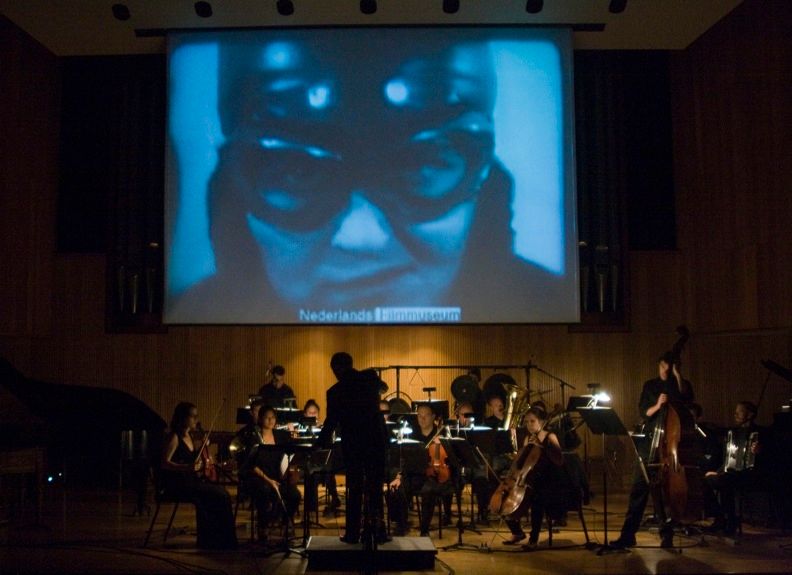
Signal performing Julia Wolfe's Impatience at JiB 2012
Signal's first June in Buffalo was in 2010, and since then, the ensemble has become one of the most vital groups to the festival, returning every year to perform works by both student composers and faculty.  That first year saw another Reich portrait concert, including the unique pairing of the composer's Sextet with his recent Pulitzer-winning Double Sextet.  The following year, the ensemble returned to feature Ligeti's Chamber Concerto alongside David Felder's Journal—and, who could forget the full-on assault of Signal's performance of this writer's The Contrabulous Fabtraption of Professor Horatio Hufnagel?  (I can't, at least.)  2012 saw the ensemble's first multimedia performance, featuring Julia Wolfe's Impatience—a quasi-symphonic work accompanying Charles De Keukeleire's quasi-Futurist film of the same title.  Signal presented a particularly ambitious program the following year, giving strong performances of two complex—but not difficult—violin concerti:  Augusta Read Thomas's Carillon Sky and Brian Ferneyhough's Terrain, both performed with Irvine Arditti.  The program ended with a show-stopping performance of Wuorinen's Big Spinoff.  


Signal and the Slee Sinfonietta premiere Felder's LQTC
This year, the ensemble returns for their sixth JiB, to present (with members of the Slee Sinfonietta) David Felder's Les Quatre Temps Cardinaux.  Lubman premiered the evening-length piece in 2013, stunning the audience with his incredible ability to command not only the large ensemble onstage with his characteristically sweeping gestures, but also to cue the electronicists seated in the back of the hall with equal urgency.  That, coupled with Felder's 12-channel electronics, made the audience feel like we were seated within the ensemble, with intriguing sonic action unfolding all around us.  We look forward to seeing the reprisal of this performance, a virtuosic display of compositional artistry and performer dexterity.  It takes just such an ensemble to perform a piece such a this:  one that is able to assimilate its features, grasp its style, and belie the fact that surely this music is quite difficult.


—Ethan Hayden

Thursday, October 2, 2014

Next week at the Center: Signal Ensemble, Brad Lubman, and Larry Groupé


Last year, the Slee Sinfonietta began their season with a program centered around Pierre Boulez's monumental Dérive 2 for 11 instruments.  Conducted by Case Scaglione, the Sinfonietta expertly wound their way through Boulez's labyrinthine gestures and abrupt texture changes, a feat which you can hear on the recording below:


On October 7, the Slee Sinfonietta will present Ensemble Signal, under the direction of Brad Lubman, kicking off the Center's fall season with Dérive 2's older sibling.  While composed for a smaller ensemble (pierrot ensemble plus vibraphone), and unravelling over a brief six minutes, Dérive 1 (1984) is no less significant than its successor.  Its title evokes the idea of "drift", and can also be translated as "derivative," the latter a reference to the fact that much of the piece's material is derived from Répons, a large-scale work for six soloists and electronics composed three years earlier.  Répons itself was derived from material from Boulez's Messagesquisse, notably a six-note chord based on the patron Paul Sacher's last name (S-A-C-H-E-R or Eb-A-C-B-E-D).  This same chord is the pillar that supports Dérive 1, reappearing in various combinations over the course of the work.  The piece unifies many of the characteristics so common to Boulez's music:  his "smooth time" marked by chaotic, irregular gestures; the "striated time" represented by rapidly articulated repeating notes; and the "metrical time" which made its first appearance in Répons, a grounding in an (admittedly highly-ornamented) regularity.  The piece is led by the piano which, in addition to introducing the piece's primary sonority, provides a subtle harmonic backdrop by using the sostenuto pedal to allow its lowest octave to resonate throughout the piece.

A fitting companion to Boulez's piece is Elliott Carter's Triple Duo.  Composed a year before Dérive 1, and for a similar instrumentation, Carter's piece is a trialogue between three instrumental pairs:  flute/clarinet, violin/'cello, piano/percussion.  This witty, mercurial piece features a number of quick cuts between differing sections, with each duo occupying its own registral and gestural spheres.  The composer David Schiff, in his monograph on Carter describes the ensemble as a 'raucous band':  "the woodwinds gurgle, shriek, and coo like a pair of amorous birds, the strings scrape and pluck comically, and the percussion and piano evoke the more angular variety of free jazz."  That final comparison is perhaps most apparent during the piece's finale, a dynamic escapade marked by syncopated tuttis, arabesque lyricism, and jerkily disjunct gestures, or as Schiff refers to it, "ultra-bop."

Charles Wuorinen's New York Notes, composed just a year before Carter's piece (1982), also divides the ensemble into three duets of related instrumental pairs, while also allowing each performer moments of virtuosic flair.  The piece is divided into a traditional fast-slow-fast three-movement structure, however, as Wuorinen explains, "The tempo is always the same, so that the differing speeds contained in the work are all expressed through note-value alterations rather than pulse changes."  This is no doubt a challenging element for Lubman and the musicians, but they are certainly up to the task!

Lubman and Signal are not the only guests visiting the Center next week, film composer Larry Groupé will be the first speaker in the Visiting Lecture Series.  Groupé has composed scores for several well-known films, including Straw Dogs (2011), Nothing but the Truth (2008), Resurrecting the Champ (2007), and, perhaps most notably, The Contender (2000).  He also acted as the co-composer and conductor for the progressive rock band Yes's 2001 album Magnification, while also writing overtures, arrangements and conducting for their Symphonic Tour of the World.  Groupé's score to the 2004 ABC series Line of Fire was nominated for a primetime Emmy, and he has received two Emmy awards for his work on the documentaries Jonas Salk: Personally Speaking (1999), and Residue (2008).  In a particularly interesting project, Groupé scored the film I Woke Up Early the Day I Died (1998), which was based on camp director Ed Wood's final, unfilmed script and starred Billy Zane and Christina Ricci.  No stranger to the avant garde, Groupé studied composition at UC San Diego with Roger Reynolds, Toru Takemitsu, Pauline Oliveros, and Bernard Rands, and computer music at Stanford with John Chowning and Leland Smith.  We look forward to hearing his presentation on October 6, at 3:00pm in Baird Recital Hall!


—Ethan Hayden

Tuesday, June 4, 2013

Yehudi Wyner's Piano Concerto "Chiavi in Mano" at June in Buffalo 2013


We’re enjoying having Pulitzer Prize-winning composer Yehudi Wyner on the Composition Faculty of June in Buffalo 2013, and looking forward to hearing his music this week. On Wednesday, June 5th, Talea Ensemble will give a concert featuring Wyner’s Refrain, and on Saturday, June 8th, SIGNAL's concert will feature Wyner’s Passage, which will be conducted by Brad Lubman, and feature soloists Irvine Arditti on violin and Ken Radnofsky on saxophone. Both concerts will be at 7:30 p.m. in Slee Hall.

Yehudi Wyner
The final concert of June in Buffalo 2013 will be on Sunday, June 9th, at 2:30 p.m. in Slee Hall, when the Buffalo Philharmonic Orchestra will perform works by JiB Faculty composers that will conclude with Wyner’s Piano Concerto, Chiavi in Mano, which won the Pulitzer Prize in 2006. Our guest Geoffrey Burleson will join JoAnn Falletta and the BPO as the piano soloist on Chiavi in Mano – Burleson’s playing has been described as “vibrant” and “compelling”  by the New York Times, who also praised his “command, projection of rhapsodic qualities without loss of rhythmic vigor, and appropriate sense of spontaneity and fetching colors.”

A recent 55-minute audio interview with Yehudi Wyner, by Christopher Lyon, is available at the Huffington Post. For a little more information, we’ve excerpted a small bit from Wyner’s biography and reproduced it below, the complete bio can be found at the Milken Archive:

“For nearly a half century Yehudi Wyner has been recognized as one of America’s most gifted composers. Although born in Calgary, Alberta, Canada, he grew up in New York City. His father, Lazar Weiner (1897–1982), was a leading exponent of Yiddish high musical culture, both as a choral conductor and as a composer, and is now the acknowledged avatar of the Yiddish art song medium. Throughout his youth, Wyner was exposed to his parents’ Yiddishist intellectual milieu, and their home was frequented by literati and artists from the Yiddish cultural orbit. (His father had the spelling of his children’s surname changed—though not his own—to preclude a common mispronunciation.)

“By the age of four or five, no doubt inspired by the music he heard in that environment, Wyner began improvising short pieces that had an eastern European Jewish folk or Hassidic character. He started his formal musical life as a pianist, although he never studied with his father—who was himself a brilliant pianist. While a piano student of Loni Epstein at The Juilliard School, Wyner became increasingly attracted to composition, which he then studied at Yale with Richard Donovan and Paul Hindemith, and at Harvard with Randall Thompson and Walter Piston. After completing his undergraduate work, he spent a summer in residence at the Brandeis Arts Institute in Santa Susana, California, a division of the Brandeis Camp, where the music director was Max Helfman (1901–1963), one of the seminal figures in Jewish music in America. That program brought together college-age students as well as established Jewish—and especially Israeli—composers, in an effort to broaden the Jewish artistic horizons of young musicians. There, Wyner came into contact with some of the most creative and accomplished Israeli composers and other artists of that period, and he was introduced to new artistic possibilities inherent in modern Jewish cultural consciousness.”


Check out the video below of Yehudi Wyner's Quartet for Oboe and String Trio, performed by the Mimesis Ensemble at Fenway Park:


Link to this post here.


Thursday, May 16, 2013

Ensemble Signal returns for June in Buffalo 2013


Ensemble Signal 
We’re looking forward to Ensemble Signal joining us for June in Buffalo 2013 – we just recently enjoyed hosting them for the world premiere of David Felder’s recent Koussevitsky commission Les Quatre Temps Cardinaux, where they assembled an orchestra of 35 musicians and were joined by soprano Laura Aikin, bass-baritone Ethan Herschenfeld, and 12 channels of electronics. Check out more on the premiere from our friends at the Buffalo NewsArtvoice, and Sequenza21.


More recently, Signal celebrated the release of their Helmut Lachenmann DVD on Mode Records, which features a performance of Zwei Gefühle with Lachenmann himself, which they performed here at Slee Hall back in 2010. Other recent projects of Signal’s include a staged production of the NY Premiere of Charles Wuorinen’s It Happens Like This at the Guggenheim Museum, performing the music of Brian Ferneyhough at The Tanglewood Festival of Comtemporary Music, and the recent premiere of Señales by Hilda Paredes, written for Signal and Irvine Arditti.


Signal will be rehearsing and performing the works of June in Buffalo composer participants on June 4th, and on June 8th they will offer a concert of June in Buffalo faculty composers, including Brian Ferneyhough’s Terrain (1992), Charles Wuorinen’s Big Spinoff (2011), Augusta Read Thomas’ Carillon Sky (2005), and Yehudi Wyner’s Passage (1983). Brad Lubman will be wielding the baton and will be joined by Irvine Arditti on violin and Kenneth Radnofsky on saxophone.


Enjoy the excerpt below of Signal’s recent Lachenmann release on Mode Records:


Link to this post here.