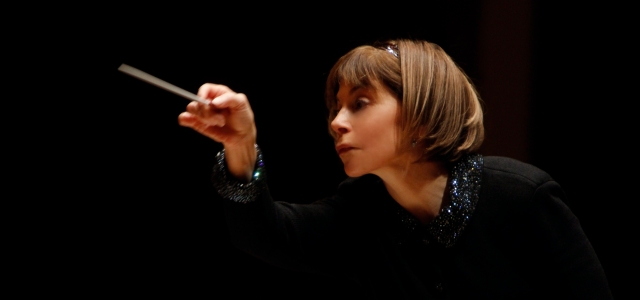
June in Buffalo was proud to have the Buffalo Philharmonic join us at recent festivals, most recently conducted by Fernanda Lastra in the Festival's first program comprised entirely of works by female composers. On the occasion of her BPO swan song, Ms. Lastra was interviewed by a local culture magazine. From the magazine:
Lastra also supports contemporary classical music composers through continued involvement with the internationally acclaimed University at Buffalo's June in Buffalo Festival, where she has made some of the most challenging music accessible to concert-goers: "It has been a unique experience working alongside remarkable living composers at the June in Buffalo Music Festival. Collaborating directly with composers is not only fascinating but also enriching. It provides conductors real-time interactions with composers and insights that deepen our understanding of the music-making process. Moreover, the pieces highlighted in this festival often push the boundaries of music and creativity, challenging both musicians, myself as a conductor, and the audience to explore new sounds and artistic expressions that are at the forefront of contemporary classical music."
In our final profile of June in Buffalo faculty composers, we sit down with David Felder, JiB's Artistic Director and Birge-Cary Chair in Music Composition at UB. Felder has been directing the festival since 1985, when he restarted it with a new vision aimed toward providing young composers with a chance to hear their works realized by professional ensembles. During this year's festival, three of Felder's works will be performed: Dal Niente will present Rare Air (2008), a collection of short movements for clarinet, piano, and electronics, and the Buffalo Philharmonic Orchestra will perform Linebacker Music (1994). The festival will also feature the premiere of Felder's newest work, Netivot, a virtuosic three-movement composition for string quartet and electronics, which was composed for the Arditti Quartet. Netivot marks the third work Felder has composed for the Ardittis, a collaboration which began in 1986 with Third Face, and continued through 2007's Stuck-stücke (a selection from the latter, performed by the Ardittis, can be heard below).
Edge of the Center sat down with Felder to discuss Netivot, as well as the other pieces and the festival itself:
What were your main goals when you began composing Netivot?
Netivot is my third quartet for the Ardittis. I have had a longer relationship personally and professionally with Irvine and that extraordinary group than with any other performers. I think of the quartets I've written as a body, an entity with a variety of parts, and it is my hope to compose more quartets. This one is markedly different that the first two—in working with the group over this long period of time one is not only permitted but encouraged to innovate. I explored an inner world in this work, with only a few regions of the more typically extroverted and kinetic music that I'd previously composed for the quartet.
The piece draws a lot from vowel formants, is there an underlying text from which these sounds are drawn? What role do the electronics play in the piece?
The work revolves around sources that will have to remain largely offstage. Let me just say that there is source material but it is not text per se—the musical material is abstracted from an array of some biblical text. The relationship between the electronics and the onstage materials of the quartet is entirely consistent with what I've always done. They are fully integrated into a whole musical object at each moment and are designed to create a multi-dimensional representation of that moment.
What do the Hebrew movement headings refer to ("Devekut," "Hitbodedut," "àmud ànan/àmud èsh"), and how significant are these extra-musical references to the work?
The overall title refers to spiritual pathways, connections among many identifiable nodal points, or regions, each one a continuity of experiencing, not an aim in itself. The first movement works with powers of concentration and fine attention; the second movement responds to an unfolding metaphoric, imagistic landscape as a consequent of the first movement and begins to develop rudimentary song from an intonation of specific scale points and formants—musical objects as things arise and disappear; and in the last movement, the linear becomes vertical in two chorales; The third movement's title refers to pillars of cloud and of fire. Each region has its own feel, but all of the individual phrases and materials are made of the same basic stuff.
Many of your recent pieces make reference (implicitly or explicitly) to spiritual concepts and/or practices. Typically, one associates the idea of "spiritual music" with more muted and reflective characteristics, but your works are often, as you say, "extroverted and kinetic." Where is the connection for you between spirituality and such powerful physical gestures?
Alchemically speaking, transformation from one thing to another requires heat.
The piece is very difficult and demanding, even in places where the sounding result is more subdued. Is the drama of performative virtuosity something you specifically sought out in this piece, or is it simply a result of the harmonic and textural ideas you were working with? Since you worked closely with the Ardittis during the process of composition, what would you say their contribution was to the realization of the work?
Just a few points here—the formation itself is a kind of Ferrari, and in my first two quartets I intended to exploit the more overt aspects of performative virtuosity. But the Ardittis can do just about anything, and so looking at other aspects of virtuoso performance was a great opportunity for me—I intended to explore a finer inner micro-world and to ask the quartet to merge the live performance with the multi-layered of electronics. Next March, we will present the work in what we hope will be its final shape—my great friend Elliot Caplan is collaborating with us on a video portion, and the work will be presented here in that way. In working with the quartet, they graciously provided recorded feedback on several occasions during the process. I absolutely need real acoustic feedback when I write, especially in a work which is 'new' for me, and I am deeply grateful to the quartet for their immense help throughout the process. Working with them has been one of my great joys in my creative career.
With regard to the other works on the festival, Rare Air, as a series of miniatures, seems to be unique among your works. What attracted you to smaller forms in this piece, and how do you think it differs from your other works?
Since our culture seems to place incredible value on ad campaigns and commercials, with thematically linked and developing characters who we can identify and presumably identify with (the GEICO Neanderthal, Flo the Progressive saleswoman, etc.), I decided to make a set of commercials with linked thematic materials that would interrupt the regular flow of a concert. Clarinetist Jean Kopperud encouraged me to do something I had always wanted to do, but hadn't, and so…
I am guessing by Rare Air's movement titles "Boxmundsson" and "Boxmunsdottir", that the piece has some relation to BoxMan, your earlier work for trombone and electronics? Is that correct?
I love the Nordic tradition in family naming, so we have dottirs and ssuns, with cartoon versions of cantus firmi expropriated from my earlier piece BoxMan and realized anew for bass clarinet and piano.
You say in Linebacker Music's program note that the piece is based around a series of 'macro-crescendos', can you elaborate on this idea?
Linebacker is a kind of concert overture that offers a tribute to the physical. It was composed during my time as composer-in-residence with the BPO in the early-mid 90's, and was designed to speak to our local community as a part of its charge. It turns the Buffalo Bills 'shout' theme on its head, and attempts to replicate imagining the experience of being in a lot of traffic, in the way that a linebacker in football has to sort through the tremendous wash all around in order to deliver impact. There are a set of hits at the end of the piece followed by a sad little moan intended to remind the locals that yes, indeed, we went to four Superbowls in a row and lost them all.
Finally, June in Buffalo celebrated a big anniversary last year, with it being the 40th anniversary of the festival and your 30th anniversary as Artistic Director. With this being the first year after such a milestone, where do you see the festival moving forward, beginning with this year and in years to come?
The festival is always a function of the individuals who are brought together for the week, all of the composers and performers. Nothing changes about that; but we’ll have new groups and new composers coming more regularly in each of the next years and for the foreseeable future. It is exciting each year to be a part of those dynamics. There could be some occasional thematically based years sprinkled in as well…
We'll look forward to hearing Netivot's first performance, as well as Rare Air and Linebacker Music. We're also excited to see where the festival takes audiences and participants this year, and how it will continue to grow and transform in years to come.
The last of the June in Buffalo resident ensemble's we'll profile is the Buffalo Philharmonic Orchestra. This year, the BPO continues its annual tradition of closing out the festival with a concert of orchestral works by faculty composers, and this year's program will feature works by Abrahamsen, Felder, Stucky, and Ung, under the direction of BPO music director, JoAnn Falletta.
JoAnn Falletta
Falletta has been praised by the Washington Post as having "Toscanini’s tight control over ensemble, Walter’s affectionate balancing of inner voices, Stokowski’s gutsy showmanship, and a controlled frenzy worthy of Bernstein." In addition to being the BPO's music director, she directs the Virginia Symphony Orchestra and serves as Principal Guest Conductor of the Brevard Music Center. Under her direction, the BPO has recorded frequently for the Naxos label, earning six Grammy nominations, and received a double Grammy Award in 2009 for their recording of John Corigliano’s Mr. Tambourine Man: Seven Poems of Bob Dylan (2003)with Hila Plitmann.
Sunday's BPO program will open with David Felder's Linebacker Music, a work commissioned by the orchestra during the early-1990s, when the Buffalo Bills were one of the country's most successful teams (making it to the super bowl four consecutive years). Felder's piece "epitomize[s] the strength, speed, power, and indeed the fury and violence of the game of football." Herman Trotter of the Buffalo News said of the piece: "Don't expect Linebacker Music to remind you of The Blue Danube. Wholly consistent with its subject matter, it has a very declamatory opening, then proceeds to be stridently aggressive and percussion-laced, and to convey a feeling of massive strength at all times." (To read more about the piece, see our interview with the composer).
Chinary Ung's Water Rings "Overture" (1993) will follow. The work, while much more subdued than his other works (avoiding the dramatic gestures common to the Spirals series), maintains the expressive language the composer is known for. Ung wrote the work quickly, and it functions as a sort of improvisation, with the composer positioned inside the orchestra, playing it as if it were the traditional Cambodian Pinpeat ensemble. As such, the piece, as the program note explains, "uses dance rhythms and folk tunes from Cambodia, and while the instrumental writing is not as florid as his other works, the parts are drawn with the same characteristic nuance, elegantly shaped and generously inflected."
Steven Stucky
The concert will close with Jeu de timbres, a brief, single-movement composition by Steven Stucky. The new music world was shocked and saddened to hear of his death from cancer earlier this year, as he was one of the most widely performed and celebrated American composers. Stucky was a June in Buffalo regular, and was on the faculty at last year's festival (see our profile of Stucky from last year's series on JiB faculty), at which audiences heard his 2005 Piano Quartet performed by Performance Institute faculty, and Refrains (1979) for percussion quintet realized by Talujon. This year will mark the second time the BPO has performed Jeu de timbres at the festival, the first being when Stucky himself was on faculty in 2012. That performance was praised by Allan Kozinn of the New York Times as "packed with shimmering string and woodwind textures yet with a changeability and bite that are among the most recognizable hallmarks of Mr. Stucky’s music." Stucky himself described the piece as "[spending] most of its energy on rhythmic verve and luminous orchestral colors. […] The title (play, or game, of musical colors) both alludes to these Gallic tendencies in general and makes a small, specific inside joke: jeu de timbres is the French name for the orchestra bells or glockenspiel, an instrument that makes an occasional appearance in this piece. There are other inside jokes, too, including two admiring glances at works by Ravel—one oblique, the other (at the end) quite direct."
We look forward to hearing Buffalo's orchestra close out the festival as it always does, with exciting new works by faculty composers, presenting all variety of dramatic gestures and games of color.
This year, June in Buffalo is excited to welcome to the festival for the first time Danish composer Hans Abrahamsen. A skilled orchestrator as renowned for his arrangements as his compositions, Abrahamsen has been celebrated for his monodrama, let me tell you (2013)—which received the 2016 Grawemeyer Award for Music Composition—and his canonic Schnee (2006-08), for two pianos, percussion, and contrasting trios, which has been frequently identified as one of the landmark pieces of the early century. Paul Griffiths has described the composer's music as "Resonant with the western tradition in all its facets, with ancient folk melody, with nature, with the vibrant structure of sound itself, [it] yet has the freshness of something untouched—untouched, and touching by being so."
Abrahamsen's music has a gained a reputation for its literal and figurative evocations of winterscapes, and even Griffiths' reference to the "untouched" quality of his work alludes to the condition of freshly fallen snow. This is perhaps most apparent in Schnee, but is also present in his earlier work Winternacht (1976-78), as well as in the "glacial world of high harmonics" elicited by his Fourth String Quartet, the glistening austerity of let me tell you, and the solitary winterreise of Left, alone (2014-15), a concerto for piano left hand. It would be understandable for a composer to feel some anxiety about being branded 'the winter composer', but Abrahamsen maintains the confidence of an artist who has created an aesthetic realm of their own, and who is content to reside there comfortably: the composer is currently composing an opera based on Hans Christian Andersen's The Snow Queen.
The composer was perhaps not always so comfortable, famously taking a break from composition that lasted nearly a decade in the early 1990s. Before that, the Ligeti student's early works were associated with a Danish trend called the "New Simplicity," which reacted against the complexity of the Darmstadt school by seeking a music that increased objectivity by, in Erik Jakobsen's words, "[aiming] to liberate musical material from the composer’s personal attitudes and feelings." [NB: This is distinct from the later, more subjective German style of the same name, of which Wolfgang Rihm is the most recognizable adherent.] Abrahamsen's orchestral piece Skum (1970) most clearly demonstrates this early approach. By the mid-1970s, however, he had developed a more distinct style, as evident in the orchestral nocturne Nacht und Trompeten (1981), the frigid underbrush of Winternacht, and perhaps most famously, in the seven piano studies of 1984 (later expanded to ten studies). In the following decade, the composer's compositional activity ceased, though he continued arranging, producing adaptations of works by Bach and Nielsen. One must admit a certain level of artist boldness to not only know when to stop composing, but more significantly, when to start again. It was after this break that Abrahamsen's music began to bear the "untouched" quality spoken of earlier, as if the composer found a way to reset, and to make a new music unhindered by his previous explorations.
His later style is marked by a pronounced intimacy, even in the larger ensemble works like Schnee. This is perhaps most evident in a piece like Wald (2009), in which the micropolyphony of his former teacher is matched with modal folk-music melodies in a variation form that is at turns rhythmically erratic and ominously understated (see below). The Four Pieces for Orchestra (2004), arrangements of his earlier piano studies, emphasize his unique orchestrational perspective, employing a large ensemble that includes a full percussion battery and Wagner tubas.
Audiences at June in Buffalo will hear Signal Ensemble perform Schnee on the evening of Friday June 10th (for more on that performance, see our Signal profile). In addition, the Arditti Quartet will present the composer's Fourth Quartet (2012). "[It] has become in its way a serene and cool piece," Abrahamsen says of the piece, which the composer began before his hiatus. "So the Quartet has been finished luckily after twenty years—it was already in 1990 that I was commissioned by Wittener Tage für Neue Musik to write the piece for Arditti Quartet." Dal Niente will perform the aforementioned Winternacht, a four-movement work whose title comes from a poem by Georg Trakl. "The music has a strong impressionistic quality," says Poul Ruders, "four introverted still lives of the velvety, dark iceness of a silvery winter night (one can veritably sense the fairy tale-like sleigh ride in the two outer movements)." Those outer movements are dedicated to Trakl, while the more classical form of the third movement bears a dedication to Stravinsky, and the eccentric density of the second is an hommage to M.C. Escher. Finally, the earliest work of Abrahamsen's presented at the festival will be 1975's Stratifications, performed by the Buffalo Philharmonic Orchestra. "The stratifications referred to in the title unfold on two different levels," the composer explains. "There is the stratification of the time dimension produced by the opposition of contrasting parts; at the same time the polyphony, the presence of several simultaneously sounding layers, is of great importance to the music." Several elements of the early New Simplicity style are superimposed into a more complex amalgam. "It is like seeing lantern slides. But this 'fictive form crackles and the music gets attentive and real. [It] is in a nightmare condition, where it is not getting anywhere in spite of a great dynamic display. But finally is liberating itself and rising 'in triumph'."
Next week will see the beginning of FinnFest 2015 in Buffalo, an annual festival celebrating Finnish culture and heritage, which includes a variety of cultural and educational activities and events. Due to Finland's rich musical history, the week-long festival will feature a variety of exciting musical performances, including a pair of concerts by the Buffalo Philharmonic in Kleinhans Music Hall (itself designed by Finnish architects Eliel and Eero Saarinen). "Echoes of Sibelius" (October 9-10) will feature the first symphonies of Sibelius and Einojuhani Rautavaara, with the US premiere of Jaakko Kuusisto's Violin Concerto; "Northern Lights" (October 3-4), will feature Sibelius's Fifth Symphony and Grieg's famous Piano Concerto, alongside the US premiere of Isola, by Sebastian Fagerlund. Both Fagerlund and Kuusisto will be present for their respective premieres, and will give preconcert talks.
Sebastian Fagerlund
The Center is also excited to welcome Fagerlund as the first guest in this season's Visiting Lecture Series, with his presentation on October 2. Fagerlund's rich, vibrant music often carries existential themes, and has been described as "post-modern impressionism depicting mental landscapes." Combining elements from Eastern and Western musics, minimalist electronica and Scandinavian black metal, big band and Boulez, his diverse output—while oscillating between extremes—errs on the side of rhythmic drive and unceasing energy. "A sort of primitivism is present in many of my works, [and] as a result, rhythm, in particular, has become very important [to me]" he explains. Isola represents these ideas well, featuring an often violent approach to the orchestra which combines performative aggression with harmonic and textural sophistication.
Kuuisto will also present at the Visiting Lecture series, the following week. The violinist-composer began studying at the Sibelius Academy at the age of 12 and quickly made a name for himself by winning several international competitions. As a violinist, he has performed with the Sydney, Adelaide, and Melbourne Orchestras, the Hannover NDR Orchestra, and the Belgian Royal Philharmonic Orchestra, as well as most of the major Finnish orchestras. As a composer, his output includes chamber and vocal music, orchestral works, film music, and operas—including his most well-known work, the "family opera," Koirien Kalevala, which was presented at the Savonlinna Opera Festival to a full house for three consecutive seasons. We look forward to hearing his insights into his work.
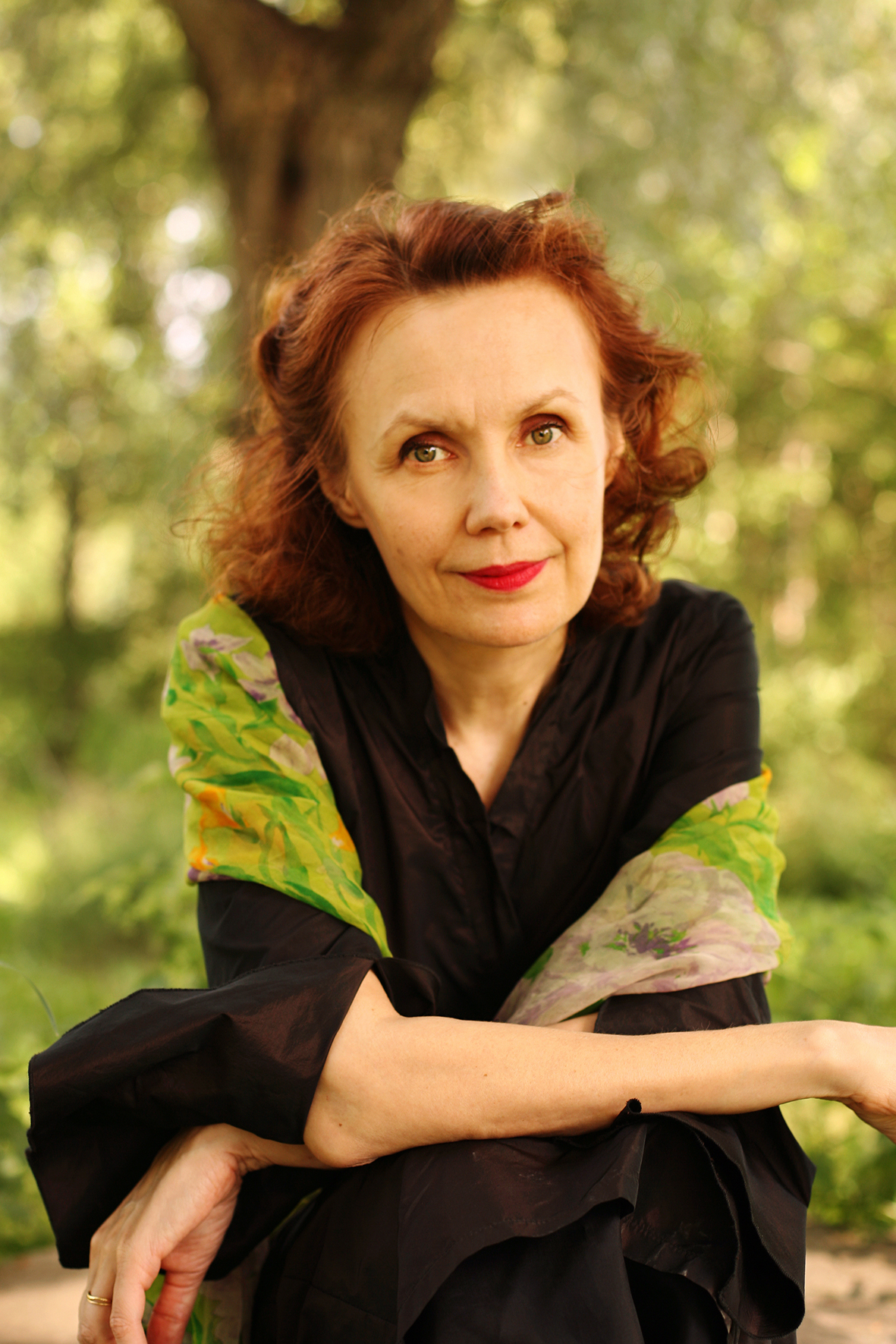
Kaija Saariaho
The Center's contributions to FinnFest do not end there. We are excited to also host the residency of famed Finnish composer Kaija Saariaho, and to present a special Slee Sinfonietta / Ensemble SIGNAL concert of some of the composer's most significant works on October 6.
Saariaho's music has always been marked by a fascination with color and texture, with timbre and harmony being the foundational elements. While her earliest works showed the influence of late-modernist post-serialism—an idiom she eventually found to be constraining—her outlook shifted after being exposed to the music of Grisey and Murail while studying at Darmstadt. As her aesthetic began to take shape during a period of research at IRCAM in Paris, Saariaho developed new expressive techniques based in analysis of the sonic spectra of instrumental sounds. Her first computer-assisted composition was Lichtbogen, for 9 instruments and live electronics (1986), a piece whose point of departure lies in the spectrum of high harmonics which burst forth from a cello when bow pressure is increased (hence the title, which translates as "light-bow").
Paul Gauguin - NoaNoa
NoaNoa (1992), for flute and electronics, was composed in close collaboration with flautist Camilla Hoitenga, who will perform the work during next week's Sinfonietta concert. The composer describes the work, which was inspired by the Paul Gauguin woodcut of the same title, as stemming from a desire to "write down, exaggerate, even abuse certain flute mannerisms that had been haunting me for some years." The piece itself has become a key work in the contemporary flute repertoire and a signpost in the solo-instrument-plus-electronics genre. Prés (1992), for solo 'cello and electronics, is also inspired by a Gauguin work (the painting, By the Sea), and pairs the string instrument with an electronic doppelgänger consisting of synthesized tones, manipulated 'cello sounds, and real-time processing of the live 'cello with resonant filters. The piece will be played by SIGNAL executive director, Lauren Radnofsky.
The concert's most recent work is 2001's Aile du Songe, a concerto for flute, string orchestra, and percussion (also to be played by Hoitenga). Like so much of the Saariaho's work, the piece is written in exquisitely detailed notations featuring harmonics, microtonal coloring, and a wealth of expressive markings. Listeners will be privy to her slow timbral transformations as well as the sensitive lyricality which has been an increasingly present element in the composer's work since the late 1990s, when she began a series of operatic and vocal works. Still marked by a sparsity characteristic of much of her earlier music, ("I don’t believe in austerity," the composer has said, "but I do [believe] in purity"), the work is sure to illustrate why the Denver Post has called "one of the most original compositional voices of our time."
The festival will include other intriguing musical events, including the Buffalo Chamber Music Society's hosting of the Carpe Diem String Quartet, who will perform a concert of Finnish works in Kleinhans' Mary Seaton room, including Sibelius's Andante Festivo, Rautavaara's first quartet, and Erkki Melartin's "The Sunflower." In addition, Buffalo contemporary music ensemble Wooden Cities will present "A Kalevala Duo: Playing Bones" a collaborative concert with performance artist Pia Lindman, which will feature the ancient Finnish technique of "bone-setting" set to music by recent UB-graduates Nathan Heidelberger and Brendan Fitzgerald.
Mivos Quartet
If that's not enough music for you, next week the Center will host the Mivos Quartet for a concert of new works for string quartet (including works by Taylor Brook, David Felder, Martin Stauning, and Helmut Lachenmann). This concert (October 5) was rescheduled from last season after a blaze of Buffalonian thundersnow (read more about the program here), so don't miss your second chance to see these amazing works played by the quartet the Chicago Reader has called "one of America's most daring and ferocious new-music ensembles."
"About that music festival I've been thinking of—You know how they talk about April in Paris? Well, I think we should call it June in Buffalo. Yeah, why not?" — Morton Feldman*
June in Buffalo is an international festival that attracts some of the most widely-renowned artists from across the world. But it is first and foremost a festival in Buffalo, and there is perhaps no ensemble more firmly and proudly Buffalo than the city's orchestra. Founded in 1935, the Buffalo Philharmonic Orchestra has been one of the city's most important cultural institutions for eighty years. The orchestra has become an integral part of June in Buffalo, concluding the festival each year with its Sunday afternoon concert of new orchestral compositions.
The BPO was founded shortly before the Great Depression, during which it was supported by funds from the Works Progress Administration and Emergency Relief Bureau. Over the years, the orchestra has had some of the most significant artists of the twentieth century serve as music director, including William Steinberg, Josef Krips, Lukas Foss, Michael Tilson Thomas, Maximiano Valdez, Semyon Bychkov and Julius Rudel. Always actively recording, the orchestra has released a number of significant LPs over the years, including the world premiere recording of Shostakovich's Symphony No. 7 "Leningrad" in 1946. In 1977, under the direction of Michael Tilson Thomas, BPO recorded a successful LP titled Gershwin on Broadway. The recording made such an impact on Woody Allen, that the director used several of the LP's selections in the soundtrack to his 1979 film, Manhattan. Under the current direction of JoAnn Falletta, the orchestra has released thirty-two CDs, including a Grammy-winning recording of John Corigliano's Mr. Tambourine Man: Seven Poems of Bob Dylan (2003).
Lukas Foss
When Lukas Foss took over the BPO's directorship in 1963, the composer/conductor led the orchestra in new, experimental directions. At his opening night at the baton, Foss programmed Stravinsky's Rite of Spring, a work still considered at that time to be shockingly avant garde. Foss continued his cutting-edge programming throughout his tenure, which included performances of Stockhausen's Momente, and works by John Cage. This adventurous spirit continued under the direction of Foss's successor, Michael Tilson Thomas, who premiered some important works by Morton Feldman (The Viola in My Live IV, Voices and Instruments II), and programmed Lutosławski's Concerto for Orchestra and several works by American experimental luminaries Charles Ives and Carl Ruggles.
The orchestra has always had a close relationship with its city. At the 2012 Spring for Music festival at Carnegie Hall, the BPO broke the record for hometown fan attendance. From 1992-96, JiB artistic director, David Felder was the orchestra's Meet the Composer Composer-in-Residence. During these years, the Buffalo-based composer wrote a number of new orchestral works for the BPO, including Three Pieces for Orchestra, composed for the ensemble's 60th anniversary. [The first of these pieces, Linebacker Music, was composed in the midst of the early-1990s Buffalo Bills string of successes—a Buffalo composer writing a piece for a Buffalo orchestra, about the city's most beloved pastime].
Charles Ives
The BPO has continued its devotion to new music with its annual EarShot New Music Readings, a program put on in collaboration with the American Composers Orchestra, which presents new orchestral works by emerging composers. This month, the BPO will return to the work of Charles Ives as it takes part in the Charles Ives: An American Maverick festival. The week-long festival will include two Ives portrait concerts (April 11 & 12) by the BPO, at which the orchestra will present the composer's Second Symphony, The Unanswered Question, Variations on America, Henry Brandt's orchestration of "The Alcotts" (from the Concord Sonata) and John Adams's orchestration of Ives's Five Songs. The festival also includes performances by the Slee Sinfonietta (performing works by Ives, Ruggles, Nancarrow, and Harrison), Harmonia Chamber Singers, a UB masterclass with baritone William Sharp, and presentations at the Burchfield Penney and Erie Public Library.
Eliot Fisk plays Beaser's Guitar Concerto
with the BPO at JiB 2012
The BPO has a long history with June in Buffalo, and the festival has seen a number of significant performances by the orchestra. One memorable concert took place at JiB 1997, at which the BPO played Feldman's 'Cello and Orchestra (1972), Edgard Varèse's Octandre (1923), and Charles Wuorinen's River of Light. Notably, this program featured Jonathan Golove (of this year's Performance Institute faculty) playing Feldman's wistful 'cello concerto, and Wuorinen himself conducting his orchestral ballet. The year before that, the orchestra played a program featuring Felder's Three Pieces, Donald Erb's Solstice, and Toru Takemitsu's Requiem. The latter piece, composed forty years earlier, was performed in memory of its composer, who passed away earlier that year. This concert was echoed a decade later at JiB 2009, when the BPO reprised the program, substituting Takemitsu's piece with a related memorial work by their former director: Lukas Foss's For Tōru (1996) for flute and orchestra. Other significant performances of recent years have included a 2012 program which included Felder's dynamic Incendio, Fred Lerhdahl's Cross-Currents, Steven Stucky's Jeu de Timbres, and Robert Beaser's Guitar Concerto, which featured a moving performance by world-renowned guitarist Eliot Fisk.
BPO Associate Conductor,
Stefan Sanders
We're thrilled that the BPO will continue its tradition of enriching Buffalo with exciting orchestral performances at this year's festival, under the baton of associate conductor Stefan Sanders. We can look forward to them wrapping up June in Buffalo with a program featuring the music of the festival's artistic directors past and present: opening with Morton Feldman's On Time and the Instrumental Factor (1969), and concluding with David Felder's Six Poems from Neruda's "Alturas" (also composed during his BPO residency). It's sure to be an exciting concert that will conclude a fantastic week of new music from around the world, performed in Buffalo.
—Ethan Hayden
*Quoted in Renée Levine Packer, This Life of Sounds: Evenings for New Music in Buffalo (Oxford University Press, 2010), 143.
We’re excited about the final concert of June in Buffalo
2013 with the Buffalo Philharmonic Orchestra, which will conclude the festival on
Sunday, June 9th, at 2:30 p.m. in Slee Hall at the University at Buffalo. This
year’s festival has been especially inspiring, not only because of the great
mix of faculty and participant composers, but also because of the inauguaration
of the June in Buffalo Performance Institute, which helped finish off the
festival with concerts on both Friday and Saturday. Music journalist Daniel J. Kushner recently published an insightful and enthusiastic review of Friday
night’s concert under the title “Eclectic Performance
Institute is a fine fit for June”, which can be found in the Buffalo News. We've also received some great recent press from Jan Jezioro, who has published a nice write-up on the BPO at June in Buffalo at the Artvoice, which includes a fantastic quote by Alex Ross, “Having appeared in Spring for Music [at Carnegie Hall], the Buffalo Philharmonic will return home for June in Buffalo, which this year presents a particularly fascinating lineup of resident composers as well as a new, contemporary-oriented Performance Institute under the direction of Eric Huebner.” Read Jezioro's full piece here.
JoAnn Falletta
The final concert on Sunday, with the BPO under the baton of
JoAnn Falletta, will begin with David Felder’s Linebacker Music, originally
written for the BPO in 1993. You can sample the beginning of Linebacker Music
on the Center’s soundcloud.
The second piece of the concert will be by composer Augusta Read Thomas, described in October 2012 by the New Yorker as “a true virtuoso
composer”. The BPO will perform her recent work Aureole, which was just given
its world premiere by the DePaul Symphony Orchestra only a week ago.
The final piece of the concert, which will follow without an
intermission, will be Yehudi Wyner’s Pulitzer Prize-winning Piano Concerto
Chiavi in Mano, and will feature soloist Geoffrey Burleson. We recently blogged
about Chiavi in Mano, read more about it here.
Ticket information can be found here. We look forward to seeing you at Slee Hall!
We’re enjoying having Pulitzer Prize-winning composer Yehudi Wyner on the Composition Faculty of June in Buffalo 2013, and looking forward
to hearing his music this week. On Wednesday, June 5th, Talea Ensemble will give a concert
featuring Wyner’s Refrain, and on Saturday, June 8th, SIGNAL's concert will feature Wyner’s Passage, which will be conducted by Brad Lubman, and
feature soloists Irvine Arditti on violin and Ken Radnofsky on saxophone. Both
concerts will be at 7:30 p.m. in Slee Hall.
Yehudi Wyner
The final concert of June in Buffalo 2013 will be on Sunday,
June 9th, at 2:30 p.m. in Slee Hall, when the Buffalo Philharmonic Orchestra will perform works by JiB Faculty
composers that will conclude with Wyner’s Piano Concerto, Chiavi in Mano,
which won the Pulitzer Prize in 2006. Our guest Geoffrey Burleson will join
JoAnn Falletta and the BPO as the piano soloist on Chiavi in Mano – Burleson’s
playing has been described as “vibrant” and “compelling” by the New York Times, who also praised
his “command, projection of rhapsodic qualities without loss of rhythmic vigor,
and appropriate sense of spontaneity and fetching colors.”
A recent 55-minute audio interview with Yehudi Wyner, by
Christopher Lyon, is available at the Huffington Post. For a little more information, we’ve excerpted a small
bit from Wyner’s biography and reproduced it below, the complete bio can be
found at the Milken Archive:
“For nearly a half century Yehudi Wyner has been recognized
as one of America’s most gifted composers. Although born in Calgary, Alberta,
Canada, he grew up in New York City. His father, Lazar Weiner (1897–1982), was
a leading exponent of Yiddish high musical culture, both as a choral conductor
and as a composer, and is now the acknowledged avatar of the Yiddish art song
medium. Throughout his youth, Wyner was exposed to his parents’ Yiddishist
intellectual milieu, and their home was frequented by literati and artists from
the Yiddish cultural orbit. (His father had the spelling of his children’s
surname changed—though not his own—to preclude a common mispronunciation.)
“By the age of four or five, no doubt inspired by the music
he heard in that environment, Wyner began improvising short pieces that had an
eastern European Jewish folk or Hassidic character. He started his formal
musical life as a pianist, although he never studied with his father—who was
himself a brilliant pianist. While a piano student of Loni Epstein at The
Juilliard School, Wyner became increasingly attracted to composition, which he then
studied at Yale with Richard Donovan and Paul Hindemith, and at Harvard with
Randall Thompson and Walter Piston. After completing his undergraduate work, he
spent a summer in residence at the Brandeis Arts Institute in Santa Susana,
California, a division of the Brandeis Camp, where the music director was Max
Helfman (1901–1963), one of the seminal figures in Jewish music in America.
That program brought together college-age students as well as established
Jewish—and especially Israeli—composers, in an effort to broaden the Jewish
artistic horizons of young musicians. There, Wyner came into contact with some
of the most creative and accomplished Israeli composers and other artists of
that period, and he was introduced to new artistic possibilities inherent in
modern Jewish cultural consciousness.”
Check out the video below of Yehudi Wyner's Quartet for Oboe and String Trio, performed by the Mimesis Ensemble at Fenway Park:
We’re looking forward to the opening weekend
of June in Buffalo 2013! The festival will kick off with a concert by the JACK
Quartet on Thursday, May 30, at 6:30 p.m., at One M&T
Plaza, a special historical building in downtown Buffalo
which was designed and built in 1966 by Minoru
Yamasaki, the architect for the World Trade Center in New
York City. In addition to opening JiB 2013, the concert is also part of
the Center for 21st Century Music’s Music in Buffalo’s Historic Places
series (more on the event and the series here), and will open with a brief presentation by
UB Professor of Architecture, Brian Carter, who recently published M&T
Bank, a book detailing the history and design of the building.
The concert,
which starts at 7:00 p.m., will consist entirely of Morton Feldman’s String Quartet No. 1, performed
by the JACK Quartet. There will be a nice reception with wine and light snacks
before the concert, hosted by M&T Bank, and it’s likely the concert will
sell out, so we recommend you RSVP.
Eric Huebner
Jonathan Golove
The concert on the following day will be held
here at UB in Slee Hall on Friday, May 31st, at 7:30 p.m., and will feature
soloists Eric Huebner on piano, and Jonathan Golove on cello and Theremin cello.
The program will include Iannis Xenakis' Kottos for solo cello (1977), Roger Reynolds' imAge/E and imagE/E (2007), Edgard Varése's Density 21.5 (1936, revised 1946) arranged
for Theremin cello by Jonathan Golove, the world premiere of Eric Wubbels' Psychomechanochronometer (2013), which was commissioned with support from the Mikhashoff
Trust for New Music, Elliott Carter's Sonata for cello and piano (1948), and some selections from György Ligeti's Études (1985-94).
Saturday, June 1st, boasts another
concert of virtuosic contemporary music in Slee Hall, this time performed by the Talujon Ensemble. Their concert will feature Brian Ferneyhough's Fanfare for Klaus Huber (1987), Charles Wuorinen's Marimba Variations (2012), Marc Mellits' Gravity (2013), Ross Bauer's Echometry (2013), and Iannis Xenakis' Okho (1989).
Talujon Ensemble
RSVP here for the inauguration of the June in Buffalo Performance Institute on Thursday, May 30th, at 6:30 p.m., with the JACK Quartet -- we'll be keeping everyone updated on June in Buffalo 2013 at the Center for 21st Century Music, as well as through facebook and twitter. Also, stay tuned for more on our finale concert on Sunday, June 9th, at 2:30 p.m. with the Buffalo Philharmonic Orchestra, under the baton of JoAnn Falletta, with pianist Geoffrey Burleson, featuring the work of JiB faculty composers at the University of Buffalo in Slee Hall.
We at the Center are gearing up for Tim Fain's
critically-acclaimed multimedia work Portals,
at 7:30 p.m. on Friday, Jan. 25, in the Drama Theater in the Center for
Performing Arts. We are also pleased to report that the next day, on Saturday, Jan. 26, Fain will offer a question-and-answer session and masterclass in Kleinhans Music Hall, where he will mentor
three young students from the Buffalo area.
"A masterclass and question-and-answer session with Fain will
take place at 10:30 a.m. Saturday, Jan. 26 in the Mary Seaton Room at Kleinhans
Music Hall, 3 Symphony Circle, Buffalo. It is free and open to the public. The
Mary Seaton Room will be given a coffeehouse feel, with complimentary hot
beverages and pastries.
"Three local music students have been chosen to receive
coaching. Mandela Namaste is a sophomore at Williamsville East High School and
a student at Buffalo Suzuki Strings. Teagan Faran is a junior at Williamsville
East High School and performs with the Greater Buffalo Youth Orchestra. Amirah Muhammed
serves on the BPO Youth Outreach Committee, and is a homeschooled 11-year-old
who studies at the Muhammad School of Music. Fain will also answer questions
from the audience. Anyone wishing to attend the masterclass may reserve a free
space at www.bpo.org.
"Fain performs on a 1717 violin made by Francesco Gobetti in
Venice. The violin is on loan to him from Clement and Karen Arrison through the
Stradivari Society of Chicago. Karen Arrison serves on the Buffalo Philharmonic
Orchestra's board of trustees and spearheaded the efforts to bring Fain to
Western New York."
Now available at the Center for 21st Century Music's official site, the complete schedule of concerts for June in Buffalo, including works by participating composers. As noted previously, a distinguished array of performers and ensembles will be on hand, including the Arditti Quartet, Signal, Ensemble Laboratorium, Ensemble SurPlus, and as always, the Slee Sinfoniettaand the Buffalo Philharmonic Orchestra. All concerts are open to the public, and many are free. With thirteen new music concerts in seven days, June in Buffalo offers an exceptionally rich experience for insiders and casual listeners alike.



_-_Google_Art_Project.jpg)


.png)


 Posts
Posts