
 |
| Charles Wuorinen |
The first word that occurs to me when I think of Wuorinen's music is craft. Having composed over 260 works, Wuorinen's output is one based in a meticulous study of past styles, and written with painstaking exactitude. Works like the third Piano Sonata, Archæopteryx, and Epithalamium require a certain diligent focus and calculated intentionality on the part of the performer, but on hearing such works it's difficult not to hear the same diligence on the composer's part. Wuorinen is famously a composer who wakes each morning and composes for most of the day, and this devotion to craft is clearly audible in his work. Take for instance, his recent Trio for flute, bass clarinet, and piano (2008), in which snaky, angular lines create tense, constantly transforming contrapuntal webs, which occasionally erupt into sonorous bursts of energy. The piece virtuosically weaves a narrative through which the ensemble acts both as a trio of independent agents and as a unified body moving together with the agility of a school of fish (listen below).
It is perhaps this devotion to craft that inspired Vera Stravinsky to entrust some of her late husband's unfinished compositional fragments to Wuorinen, which the composer used to construct A Reliquary for Igor Stravinsky (1975), a work which contains both a simulacrum of Stravinsky's late style and a clear expression of Wuorinen's own voice. Indeed, Wuorinen's voice, both through his singular musical output and his lectures and writings, has been one of the most passionate and eloquent advocates for American serialism, most notably in his 1979 compositional treatise, Simple Composition.
 |
| Charles Wuorinen conducting at Guggenheim |
One of Wuorinen's significant early achievements was the founding of the Group for Contemporary Music in 1962 with Harvey Sollberger (another JiB faculty composer) and Joel Krosnick. The first new music ensemble to be based at a university and directed by composers, the GCM quickly received acclaim for its virtuosic performances (including Wuorinen's own skilled piano playing and conducting) and innovative programming (the ensemble premiered significant works by Wolpe, Babbitt, Carter, and Davidovsky). The GCM's success inspired the Rockefeller Foundation to fund several similar composer-led ensembles at other universities, including UB's Center for the Creative Associates, an ensemble which regularly included Wuorinen's work in their programming. The June in Buffalo festival was established in 1975 partly as a way for the Creative Associates to take advantage of Rockefeller funding during the slower summer months, branching out from an innovative ensemble to a widely respected international festival.
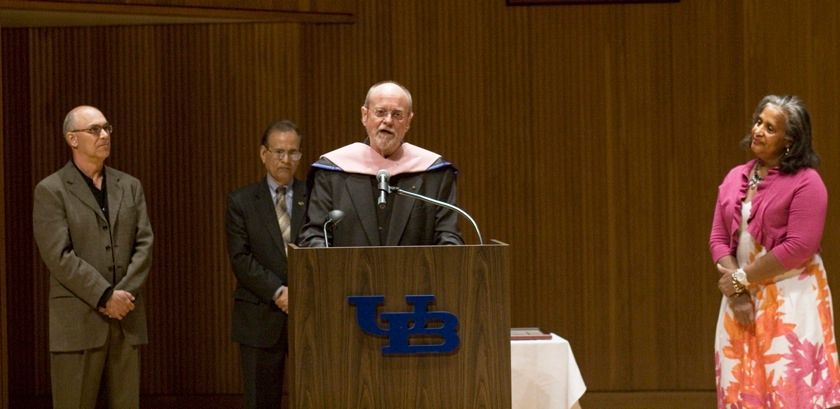 |
| Wuorinen speaking at JiB 2013 after receiving his honorary doctorate |
 |
| Tom Randle and Daniel Okulitch in Brokeback Mountain |
—Ethan Hayden


 Posts
Posts


