Showing posts with label Irvine Arditti. Show all posts

Monday, March 7, 2022

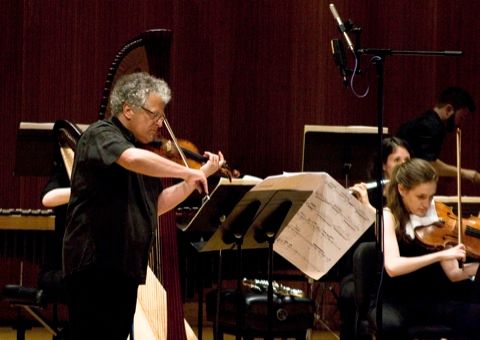
Jeu de Tarot 2 Rehearsal


The Slee Sinfonietta rehearsing Jeu de
Tarot 2
on March 7, 2022
The view from the percussion section

Thursday, March 3, 2022

Irvine Arditti Residency, Jeu de Tarot 2, and Student Composer Recordings

See the source image
Irvine Arditti


Irvine Arditti Residency

The Center for 21st Century Music is excited to announce a residency by Irvine Arditti on March 6-10, 2022. He will be joined by the Slee Sinfonietta, conducted by Daniel Brottman, to perform David Felder's violin chamber concerto Jeu de Tarot 2.

 Jeu de Tarot 2

 Jeu de Tarot 2 was commissioned by Ensemble Mise-En, with support from the New York State Council on the Arts. Like its predecessor, Jeu de Tarot (details below), the work is a violin chamber concerto based on selected cards from the Tarot. The work is scored for flute (doubling), oboe (doubling), B-flat clarinet (doubling), F Horn, Bass Trombone, Percussion, Harp, Piano (with sampler), violin, viola, cello, contrabass, and the solo violin. The composition is in 6 movements, numbered 8-13, in this way contiguous with the first Jeu. The movements are:

Image result for tarot card the chariot
The Chariot, from the Tarot
8. Death
9. Judgement/Resurrection
10. Temperance
11. The Wheel
12. The Tower
13. The Chariot 

Student Composer Recordings

In addition, these four students will have works recorded:

Alex Buehler - Diffraction Grating 
With this piece I wanted to combine the individual instruments into larger meta-instruments and approach the piece as if I was writing for a contemporary jazz combo. I was particularly inspired by the sounds of Matana Roberts and her album “Coin Coin Chapter two: Mississippi Moonchile”. I was also interested in a sound I was introduced to by trombonists David Whitwell and Kalun Leung in which they used an individual karaoke mic to generate feedback that  could be controlled with the left hand and the trombone. By using the trombone sound as a type of filter, the sounds of the meta-instruments and the combo are altered and replace each other.
  
 
Ka Shu (Kenneth) Tam - Path of Earth
"Path of Earth" is one of the three pieces in my "Cosmic Trinity" series. The trinity includes the Heaven, the Earth and the Mankind. This three ideas form the skeleton of the Taoist philosophy about the universe. In these pieces, I attempted to articulate the irresistible nature (force majeure) of the universe with an entropic composition process derived from the western scientific concept "entropy," a quantity of disorder in a system.

(Richard) Ruixing Wang - TBA


Jeu de Tarot


Jeu de Tarot is a chamber violin concerto commissioned by Ensemble LINEA, and its conductor J.P Wurtz, with solo violinist extraordinaire Irvine Arditti, and is dedicated to these musicians. The work was composed in 2016-17, and is in seven movements. It is scored for flute, doubling, oboe doubling, clarinet doubling, horn, percussion, harp, and keyboard (piano, harpsichord, keyboard controller for electronic samples), solo violin, violin (doubling mandolin optionally), viola, cello, and contrabass.

The composition is in seven movements titled after seven selected cards from the twenty-two major arcana of the Tarot deck. They are:

The Juggler

The Fool

The High Priestess

The Hermit

The Empress (Whorld)

The Hierophant 

Moonlight 

Performance:
 

Friday, May 15, 2015

Irvine Arditti: The Practicality of the Impossible


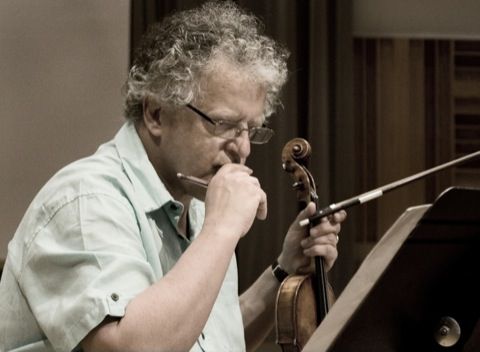
Irvine Arditti during a JiB 2014 composer workshop
Few performers have had a more significant impact on the contemporary music scene than Irvine Arditti.  As the founder of the Arditti Quartet, he has worked with some of the world's most adventurous composers, commissioning hundreds of works, and recording over 180 CDs.  Some of the most important string quartets of the past forty years have been composed for the Ardittis, including works by Brian Ferneyhough, Helmut Lachenmann, and Harrison Birtwistle just to name a few.  The Ardittis are partly responsible for revitalizing the genre itself, which, along with the symphony, had fallen out of favor with many post-war composers.  They even convinced modernist stalwart Karlheinz Stockhausen to write a string quartet (albeit, one that required four helicopters).

Working closely with composers is of great importance to Arditti.  His introduction to the new music world happened at age 12, when he met Messiaen and Xenakis at the English Bach Festival.  Just a few years later he was studying at the Darmstadt summer courses, with the likes of Stockhausen and Boulez.  For Arditti, working with composers is a key part of the adventure.  "I love the idea of going to the limit of what you can do," he says.  "With the music I and my quartet play […] it’s all to do with getting inside a living composer’s mind.  There is no performing tradition.  We have to create it, we have to turn these very odd-looking marks into music which has never been heard before."

Perhaps the most well known account of Arditti's virtuosity has to do with John Cage's Freeman Etudes.  The famously difficult piece has been called "impossible" by James Pritchett, who compared its requirements to "a track and field athlete who must run, jump, and throw, but do so in rapid succession, and, at the same time, to have a dancer's control of the body, so that the feet always land in precise locations, the arms and legs bent at precise angles."  Cage, who used star maps and the I Ching to determine most of the work's musical material, originally composed the work for a virtuoso violinist, who, upon seeing the first completed etudes, deemed them "quite unplayable."  Discouraged by this verdict, Cage abandoned the project, until they were picked up years later by Arditti, who was not only able to perform the piece, but performed it faster than the notated tempo(!), inspiring Cage to complete the project.   In fact, Arditti—following Cage's performance note that the piece should be performed in "as short a time-length as [the player's] virtuosity permits"—has continued to increase the piece's tempo with each performance (see a recent performance below).  With regard to the etudes' difficulty, Cage said, "These are intentionally as difficult as I can make them, because I think we're now surrounded by very serious problems in the society, and we tend to think that the situation is hopeless and that it's just impossible to do something that will make everything turn out properly. So I think that this music, which is almost impossible, gives an instance of the practicality of the impossible."  Or, in Arditti's words, "Nothing is impossible if you rehearse it enough."


Arditti has been an important presence at June in Buffalo for many years, both as a soloist and as part of the Arditti Quartet.  In 2007, the Ardittis were a resident ensemble at the festival, workshopping student pieces and presenting a concert of works including Roger Reynold's Ariadne's Thread, David Felder's Stuck-Stücke, and Lachenmann's String Quartet No. 3 "Grido", all of which were composed specifically for the quartet (indeed, the latter takes its name from the name of the quartet's members—the "i" in "Grido" is for "Irvine").  In 2010, the quartet returned for two sessions of student workshops, as well as another evening concert of exciting music, including Reynolds' Not Forgotten, Felder's Third Face, Xenakis's Tetras, and Feldman's early quartet, Structures (1951).  That same year, Arditti performed Reynolds' Aspiration with the Slee Sinfonietta, another work composed for the violinist.  In 2011, Arditti returned as a special guest to play two works on a chamber music concert:  Hilda Paredes's Memoriam Thomas Kakuska and Salvatore Sciarrino's Sei Caprici—the latter, an extraordinary tour de force and study in extended string techniques, made a particular impression on the young composers present, with both the work's inherent virtuosity and Arditti's bold performance acting as a demonstration of the amazingly extensive sound-world of the violin.

Arditti performs Paredes's Señales with SIGNAL at JiB 2014
Arditti returned as a soloist in 2013, performing two works for large ensemble and violin with SIGNAL:  Augusta Read Thomas's Carillon Sky and Ferneyhough's Terrain (the latter, another work composed for Arditti, which the Guardian has referred to as an "uber-concerto").  Also at JiB 2013, Arditti became one of the few non-composers to give a morning lecture (a small group that also includes Tonmeister François Eckert), taking the opportunity to demonstrate several extended string techniques and discuss strategies for composing for violin.  Finally, last year saw Arditti performing Paredes's Señales with SIGNAL, in addition to presenting a full solo recital which included classic works, including the Sei Caprici and Donatoni's Argot, alongside more recent compositions like Martino Traversa's Red (2012) and Toshio Hosokawa's Elegy (2007).

This anniversary year, Arditti will return for another solo recital of adventurous string music, including Ferneyhough's labyrinthine Unsichtbare Farben and Reynolds' Kokoro (both dedicated to the violinist), as well as Feldman's For Aaron Copland and Elliott Carter's famous Duo for Violin and Piano—definitely not a performance to miss.  As Tom Service has noted, "Any Arditti performance is not just an interpretation, but a performance informed by decades of the subtle oral tradition of working with the world's greatest composers.  They are living, breathing music history."  Indeed, and not just a living history, but a demonstration of the "practicality of the impossible."


—Ethan Hayden

Thursday, June 6, 2013

June in Buffalo Performance Institute concert June 7th!


Eric Huebner, JiB Performance Institute Director

The June in Buffalo Performance Institute has been going strong since last Thursday, May 30th, when the JACK Quartet inaugurated the Institute with a gorgeous performance of Morton Feldman’s String Quartet No. 1 at the beautiful M&T Bank in downtown Buffalo. Since then Performance Institute participants have been working closely with the JACK Quartet, Eric Huebner, and Tom Kolor and members of the Talujon Percussion Ensemble preparing for Friday (June 7th) night’s concert at 7:30 p.m. in Baird Recital Hall at the University at Buffalo.


The full list June in Buffalo Performance Institute participants:

Ross Aftel, percussion
Hangyu Bai, piano
T.J. Borden, cello
Jade Conlee, piano           
Nicholas Emmanuel, piano
Matthew Geiger, percussion


Friday night's concert will also feature a guest appearance by violinist Irvine Arditti, who will perform Brian Ferneyhough's Intermedio alla Ciaconna, the full program is below.


June in Buffalo Performance Institute Concert, June 7th, 7:30 p.m., UB Baird Recital Hall


Chinary Ung:  Spiral no. 1                                               
Ross Aftel, percussion, T.J. Borden, cello, and Nicholas Emmanuel, piano                                                                                                      

Anton Webern:  Bagatelles, op.9                                               
members of the JACK Quartet with T.J. Borden

Brian Ferneyhough:  Intermedio alla Ciaconna                                   
Irvine Arditti, violin
                                               
                                             ---  intermission ---

Ralph Shapey:  Gottlieb Duo                          
Matthew Geiger, percussion, Manuel Laufer, piano

Anton Webern:  Two Pieces (1899), Three Little Pieces op. 11   
Hangyu Bai, piano, and Jonathan Golove, cello
                       
Charles Wuorinen:  Fifty-Fifty                                                 
Jade Conlee and Michiko Saiki, pianists           


The next day, on Saturday, June 8th, JiB Performance Institute faculty and participants will perform works by JiB composers Clint Haycraft and Megan Buegger, and works by Zimmerman, Cage, Babbitt, Carter, Stockhausen, Sciarrino, and Rivas. The concert will begin at 3:45 p.m. in B1 Slee Hall for the first piece by Megan Beugger, and then move up to Baird Recital Hall at 4:00 p.m. for the rest of the program. Check out the Performance Institute website, like their page on facebook, or follow the Center for 21st Century Music on twitter for more updates.


Link to this post here.


Wednesday, June 15, 2011

The Fickle Judge


To help wrap up our coverage of June in Buffalo 2011, we're pleased to welcome guest blogger Daniel J. Kushner, reviewing the June 9 concert with Signal and guest violinist Irvine Arditti. Daniel is a music critic whose work has been published by Opera News, The Huffington PostNewMusicBox, and Symphony, among others.  His vivid and insightful writing can be found at  http://www.huffingtonpost.com/daniel-j-kushner and http://postpostrock.com. Though his subject matter ranges widely, he most often writes about the burgeoning musical region in which classically-trained musicians and artists from the world of indie rock are finding common ground. Here follows Daniel's review. 
_______________________


The Fickle Judge
By Daniel J. Kushner

June in Buffalo is a festival for the new music cognoscenti—a welcome destination for some, an alienating locale for others.  But new music sprawls itself out over a vast landscape, and great variety can coexist even with pieces of comparable aesthetic value.  The festival’s June 9 concert, featuring the New York-based chamber ensemble Signal led by conductor Brad Lubman, exemplified this truth.

The program began with David Felder’s 1990 work Journal for chamber orchestra.  Signal communicated with vibrant poignancy the sonorous, cataclysmic evidence of fear made audible, of some unspoken yet inescapable conflict.  Within the composition, melodies are not shaped and sheltered by phrases, but are rather splintered into three and four-note shards, and then dispelled into the ether.  If Felder’s Shamayim—a 2009 collaboration with filmmaker Elliot Caplan performed earlier in the week at the festival—felt cold and clinical, Journal exudes an emotional, reverberating warmth that doesn’t circumvent Felder’s arresting harmonic sensibility, but instead speaks through it.  The work is at times lush and lyrical, even while possessing a thin, fragile texture capable of some impending devolution—hinted at toward the outset—that never comes. 

Featuring a smaller configuration of Signal aided by solo violinist Irvine Arditti, Brice Pauset’s highly gestural and expressionistic Vita Nova (2006) evinced the atonal priorities so readily embraced in many compositional circles of academia.  While certainly intriguing, the piece seemed destined to retreat from my recollection into oblivion.  But why?  Clearly the composition was well constructed, with a keen spatial sense of orchestration and containing proven techniques of modern articulation, including the ingenuous effect of strumming the string instruments with guitar picks.  Its lack of readily discernible melodies is not in and of itself grounds for dismissal.

But if melody does not implant itself in the ear, some other compositional (component(s) may need to take its place—an alluring succession of harmonies, or a novel polyrhythmic device—to bridge the chasm between performance and memory (I took with issue with Hilda Paredes’s Ah Paaxo’ob of 2001, which closed the concert, for similar reason).  One doesn’t even necessarily need to remember a single note of the composition, but rather the response it elicited from within.  Ultimately, the hard reality is that it comes down to the decision of a manifestly fickle, yet unerring judge—emotional resonance.

Fortunately, György Ligeti’s Chamber Concerto (1969-1970) exemplified the atonal aesthetic at its most vibrant and engaging—from the bleary, circular phrases in the woodwinds to the crystalline dizziness of the harpsichord, to the ominous trills in the violins.  Each sonic occurrence seemed to impart some mystical coded meaning.   In the moment, Chamber Concerto struck me as more focused, less visceral yet more palpable, more ethereal yet less distant than the works I had heard earlier in the evening.

Was my response the effect of a placebo?  Does a piece by the venerated Ligeti immediately deserve more respect?  Perhaps vain pride would have me answer, “Yes.”  But, in the interest of being as much of a new-music-hipster as possible, the answer could just as easily be “No.”  In the end, I was drawn in by Ligeti’s use of technical proficiency through such musically volatile means, to achieve such emotionally immediate ends.

Tuesday, February 22, 2011

June in Buffalo: a timely reminder


If you're reading this blog, you're no doubt aware of June in Buffalo, the annual festival and conference that offers a select group of rising composers the opportunity to study with leading teachers in the field, and have scores performed by top ensembles. For those interested in applying, the deadline is Friday, February 25. Application and program details can be found here

Presented by University at Buffalo's Department of Music and the Robert and Carol Morris Center for 21st Century Music, June in Buffalo features an enticing of seminars, lectures, workshops, professional presentations, participant forums and open rehearsals as well as afternoon and evening concerts open to the general public and critics. Each of the invited composers will have one of his/her pieces performed during the festival. Evening performances feature faculty composers, resident ensembles and soloists renowned internationally as interpreters of contemporary music. Here's the rundown on this year's luminaries:

Senior Faculty
Edmund Campion
Eric Chasalow
David Felder
Hilda Paredes
Brice Pauset
Jeffrey Stadelman
 
Resident Ensembles and Special Guests
Magnus Andersson
Irvine Arditti
Roberto Fabbriciani
Ensemble Linea
Brad Lubman
SIGNAL
Slee Sinfonietta