Showing posts with label György Ligeti. Show all posts

Thursday, November 6, 2014

Eric Huebner discusses Doug Fitch's "How Did We…?"


Doug Fitch

Internationally renowned producer, designer, artist, and choreographer Doug Fitch has been in residency at UB as the first ever WBFO Visiting Professor.  Fitch is working with with UB students, staff, and faculty in the Theatre and Music departments to produce an elaborate and surreal new theatre work called How Did We…?.  The project will be performed on November 13, 14, and 15th at 7:30pm in the CFA Drama Theater.

Fitch is well known in the contemporary music world for directing the New York premiere of György Ligeti's absurdist opera, Le Grand Macabre, with the New York Philharmonic in 2010.  Fitch, along with his production company, Giants are Small, has also directed productions of Janáček's The Cunning Little Vixen (NY Philharmonic), Prokofiev's Peter and the Wolf (LA Philharmonic), Puccini's Turandot (Santa Fe Opera), in addition to works by Carter, Stravinsky, Weill, Hindemith, and Thomson.  Beginning in his family's touring puppet theatre and going on to team up with the likes of Peter Sellars (Der Ring des Nibelungen), Robert Wilson (The Civil Wars), and Jim Henson (The Muppets), Fitch is no stranger to collaboration, and excels at bringing diverse artists together to create great works that are far more than sums of parts.


How Did We…?, Fitch's production at UB, has been described as an "opera of images."  A recent press release describes the (seemingly indescribable) work:
The show features odd characters, giant ships passing in the night, digital people-surfing, a “Ballet of the Sensory Organs,” water drumming (in which drum chambers are filled with varying amounts of water to create unique sounds), a jungle of social media, high tea, dancing Tibetan Buddhist icons and much more.
The performance will be supported with live music by composers Alfred Schnittke, David Felder, Paul Moravec, Doug Cuomo, Su Lee, Franz Schubert and Frederick Chopin performed by UB’s Slee Sinfonietta, a Balkan banda and an onstage string quintet.
Eric Huebner, world-renowned pianist and member of the Music Deptartment faculty, has worked with Fitch before, playing in the NY Phil's performance of Le Grande Macabre.  Huebner—who is also the coordinator of the June in Buffalo Performance Institute—is playing a big part in the production of How Did We…? acting as the project's music director.  I had a chance to interview him about the work, and his insights only made me more excited about seeing the production!

Eric Huebner
How did this project come together? How many departments and students are collaborating on it?

I, along with Music Department chair Jeff Stadelman and Theater and Dance chair Lynne Koscielniak, proposed Doug Fitch for the inaugural WBFO Visiting Art Professor position. The production of Doug’s show, How Did We…? is a collaboration between students and faculty from the Music Department and the Department of Theater and Dance. The ensemble cast includes 18 student actors and dancers and nearly two dozen student designers and technicians.

What role does the music play in the production? The piece has been called an "opera of images," how does that phrase relate to the music's role?

The phrase “opera of images” means the story is told primarily by the scenes on stage and the music. In this case, the music moves the action forward. It is the catalyst for nearly all of the scenic changes taking place on stage. Each image or scene morphs organically into the next. Characters (some quite strange!) appear and disappear as if in a dream.

The piece seems to pull together a lot of diverse elements, do they all serve a continuous narrative?

Yes, absolutely. The show is about one man’s journey to become more comfortable with himself. The main character is played by actor Connor Graham, a student in the department of Theater and Dance.
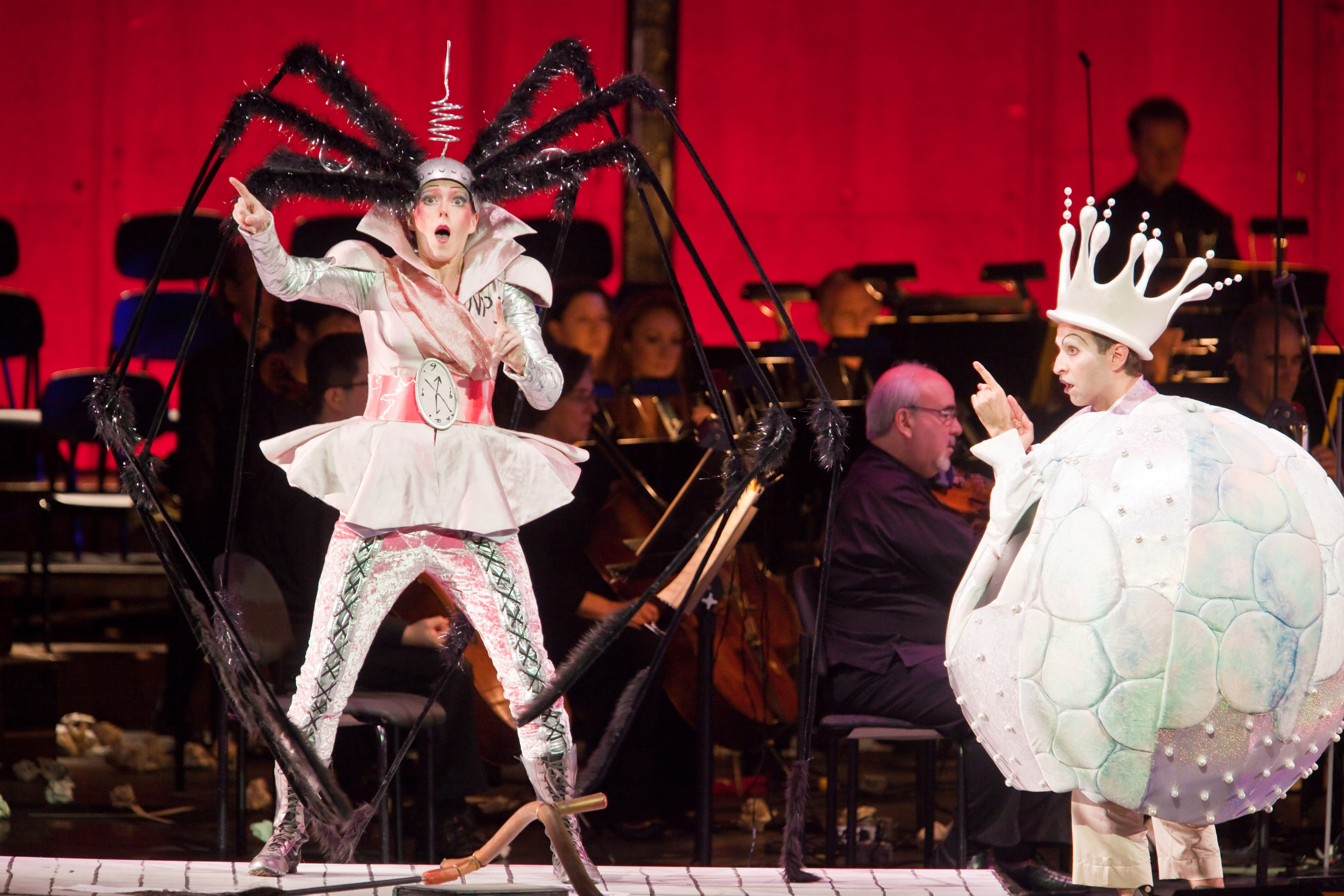
Ligeti's Le Grand Macabre
Fitch is no stranger to contemporary music, having worked on The Grand Macabre and The Civil Wars among so many others. How does that aesthetic sensibility manifest itself in this work, or in particular, in how he utilizes the music in this work?

Mostly, I think it’s his general openness to contemporary music and his own highly developed musical sensibility from having worked with so many orchestra and musicians over the years in addition to his work in opera. He revels in musical abstraction and senses immediately the possibility of connection between the world he is seeking to create on stage 
and the music that might go with it.

There is a very diverse grouping of composers represented in the piece, from 19th century composers to UB faculty and students. How do the different pieces work together?

As de facto Music Director for How Did We…? my biggest concern was finding music that fit Doug’s vision of a particular scene while making sure the overall collection of pieces and electronic excerpts worked musically together. There are moments when one piece overlaps with another in musically interesting ways and still others where very different pieces of music are juxtaposed, one right after the next. The excerpts from the Schnittke Piano Quintet that open and close the show helps to give the musical score a dramatic underpinning. Mostly the music was excerpted from pre-existing works. In choosing the music, I was looking to include excerpts of works by our own students and faculty as well as my two composers, Paul Moravec and Douglas Cuomo, that Doug Fitch had expressed an interest in working with. The composer Douglas Cuomo wrote original music to accompany the penultimate scene which features Yamantaka—the Tibetan killer of death—which features a part for Alex Glenfield, a Buffalo-based Tuvan throat singer. Additionally, the Pulitzer-prize winning composer and Buffalo native, Paul Moravec arranged a portion of his orchestral work “Capitol Unknowns” for the Slee Sinfonietta. Of course I wanted to include work by our own excellent faculty and student composers and found the perfect compliments for several scenes in works by Professor David Felder and current PhD composition student Su Lee.

The works by Schubert, Chopin and Dinicu provide a depth and dimensionality to the musical score and in the case of the Schubert and Dinicu, are part of the action on stage.

Who is conducting the Sinfonietta? How about the Balkan banda or the string quintet, are they also made up of musicians from the department?

Dan Bassin will be conducting the Sinfonietta. Moshe Shulman, a recent PhD in composition graduate from UB and a violinist will be heading up a trio of musicians, including Miguel Benitez on guitar and Jeremy Spindler on accordion. They will be playing Grigoras Dinicu’s “March Hora” from on top of a tall piece of scenery on-stage at one point in the show.

The opening of the Adagio to Schubert's string quintet in C Major will be played on-stage by a group of student musicians from the Music Department and includes: Aidan Scoccia, Blair Sailer violins; Jessica Oemcke, viola; Lisa Gagnon, cello; Stanzi Vaubel, cello.

Do you know anything about the piece with the "water-drumming”?

Yes! It was choreographed with assistance from Jason Ross—a graduate student in percussion who happens also to be a champion clog dancer! A portion of the stage will be covered in water. I think to say much more will spoil the surprise!

What is it like as a performer being a part of a multimedia production such as this?

These kinds of productions always bring with them an added sense of excitement as well as organizational challenges. We're fortunate in this regard to have the support of a number of individuals associated with the Music Department and the Center for 21st Century Music as well as of course, the technical staff at the Center for the Arts and from the Department of Theater and Dance.

In the video below, Fitch says the piece is about the "unanswered questions we have hovering in the back of our minds." This, of course, makes me think of Ives's The Unanswered Question. What do you, as a musician and teacher, think about music's role in helping us grapple with difficult questions?

I think that it tells us these questions are, in some way, universal. We all hear different things in the music we listen to, but still there is a sense of discovery while listening to any worthwhile piece of music that enriches us and let’s us know that difficult questions may not have “right” answers.

Is there anything else you'd like to say about this project?

Please come see it! Everyone who’s worked on it is very excited about it!


Douglas Fitch and the Slee Sinfonietta
How Did We…?
November 13-15, 2014
Center for the Arts, Drama Theater
7:30pm
ticket info


—Ethan Hayden

Sunday, October 28, 2012

Hornist Adam Unsworth performs with the Slee Sinfonietta!


We’re excited about our Second Fall Slee Sinfonietta concert coming up on Tuesday, October 30, at 7:30 p.m., and are happy to have received a thoughtful write-up in this week’s Buffalo Artvoice by Jan Jezioro, which is largely about the evening’s conductor Daniel Bassin, “Now in his third academic year as the UB Symphony Orchestra’s music director, Daniel Bassin enjoys his hectic schedule of music making. In addition to his duties as the UBSO music director, Bassin has also been conducting some very challenging works on this season’s Slee Sinfonietta series, yet he also somehow manages to find the time to perform often as a trumpeter with jazz ensembles in venues throughout the city. And he does this all while pursuing his PhD in musical composition at the University.” Read the entire article here.

We thought we'd do a little profile on french hornist Adam Unsworth, who will be joining us for the evening, hailing all the way from the University of Michigan in Ann Arbor. His ensemble, the Adam Unsworth Ensemble, has recently released two CDs, Next Step, and Excerpt This!, which received rave reviews, including a terrific piece in All About Jazz, by Ken Kase, "Unsworth's debut recording does what the best jazz should do by asking questions, shunning orthodoxy and predictability and having a few laughs along the way. His virtuosity is undeniable... Unsworth and his group have created something rare and distinctive." Read more about Unsworth's work here

Next Step by the Adam Unsworth Ensemble

Some background on Unsworth from his extensive biography:

“Adam Unsworth is Associate Professor of Horn at the University of Michigan in Ann Arbor. Prior to his joining the faculty at Michigan, he spent nine years as a member of the horn section of The Philadelphia Orchestra and three years in the Detroit Symphony. Adam has appeared as a recitalist and clinician at many universities throughout the United States, and has performed repeated solo and chamber concerts at Carnegie's Weill Recital Hall. He is the leader of his own jazz group, the Adam Unsworth Ensemble, which recorded the critically acclaimed CD, Excerpt This! and now has completed a second recording, entitled Next Step. The group embarked on its first U.S. tour in October 2007.

Next Step, the Adam Unsworth Ensemble's 2008 release, is a culmination of work done after his leaving the Philadelphia Orchestra in 2007, a move made in order to devote more time and energy to teaching and creative endeavors. It features new Unsworth compositions for jazz quintet of horn, woodwinds, vibraphone, bass, and drums, and two original works by multi-woodwind virtuoso Les Thimmig.

“In 2006, Unsworth released Excerpt This!, a groundbreaking recording for the French horn that looks to redefine the virtuosic boundaries of the instrument. Highlighted on the CD are five of Unsworth's compositions for jazz sextet. The instrumentation of horn, violin, alto flute, bass clarinet, vibraphone, bass, and drums is unique and creates a texture that truly embodies the term chamber jazz. Joining Unsworth on Excerpt This! are Philadelphia jazz greats Tony Miceli, Diane Monroe, Ranaan Meyer, and Cornell Rochester, as well as Les Thimmig from Madison, WI. In addition to the works for sextet, the CD includes unaccompanied jazz works for horn by Unsworth, Les Thimmig, and Dana Wilson.”

Adam Unsworth, Yuki Numata, and Eric Huebner,
rehearsing György Ligeti's Trio for horn, violin, and piano,
in UB's Slee Hall, 

Rehearsals over the weekend have been going swimingly, as Maestro Bassin recently tweeted, “Great 1st rehearsal of Feldman's "De Kooning" - my first time conducting his music! These musicians are fantastic! #SleeSinfonietta10/30/12”


Slee Sinfonietta
Tuesday, October 30, 2012, 7:30 pm
Lippes Concert Hall in Slee Hall
Daniel Bassin, conductor
Yuki Numata, violin
Adam Unsworth, horn
Eric Huebner, piano

Ticket information can be found here


Link to this here.


Thursday, October 18, 2012

The Slee Sinfonietta performs seminal 20th century works!


Our September Slee Sinfonietta concert was a great success and enjoyed a huge turnout, and received a very thoughtful write-up in the Buffalo News by Daniel J. Kushner. We’re already gearing up for the second Fall Slee Sinfonieta concert, which will take place on Tuesday, October 30, at 7:30 p.m., in Lippes Concert Hall. Maestro Daniel Bassin will be conducting some of the most seminal works of 20th century chamber music, and will be joined by violinist Yuki Numata, hornist Adam Unsworth, and pianist Eric Huebner.

Program:
Daniel Bassin conducting David Rappenecker's Emergence

Morton Feldman - De Kooning
György Ligeti - Trio for horn, violin and piano

--- intermission ---

Pierre Boulez – Notations 8, 3, 9
Karlheinz Stockhausen - Kreuzspiel
Tristan Murail - Vues aeriennes
Witold Lutosławski - Dance Preludes


We sat down with Daniel Bassin and asked him about the program, how the pieces fit together, and if he could give us a sneak preview of the music in store for us: 

“They’re all major works, each and every one on the program, but the biggest work is Ligeti’s Trio for horn, violin, and piano, which Ligeti considered to be the first work of his late period, and which represents the culmination of the musical ideas he had been working with during the late 60s and 70s, and a maturation into a lyrical and autumnal style. On the other hand, there is Stockhausen’s Kreuzspiel, which Stockhausen said he considered to be his first true composition – he felt that this was his first work that wasn’t a study or copying someone else’s style, but was a true composition of his own. And we added to the program three of Boulez’s twelve Notations, for piano, written when Boulez was only 20 years old, but which present a nice context for hearing the Stockhausen, in terms of the composers’ treatment of the piano, and the techniques they employed related to total serialism. Bookending the concert are pieces by Feldman and Lutoslawski, both of whom are experiencing something of an anniversary – 2012 being the 25th anniversary of Feldman’s passing, and 2013 will be the 100th anniversary of Lutoslawski’s birth.*

“Morton Feldman’s De Kooning is a piece of chamber music with the unique instrumental combination of muted french horn, violin, cello, percussion (crotales, vibraphone, chimes, tenor drum, and bass drum), and piano/celeste. It was originally written to accompany a film on Feldman’s friend, the 20th century painter Willem de Kooning, created by German-American director Hans Namuth. Feldman once remarked of de Kooning’s work, that at first impression it seemed as if his canvases were painted quickly, but when watching de Kooning paint, he saw that he was painstakingly deliberate and slow, and I think the piece, in a way, mimics de Kooning's process. In Feldman’s composition, the individual instrumental tones succeed one another without regard to metric pulse, but rather with a cryptic instruction from the composer that each sound only begin when the preceding one starts to fade away. 

“The concert closes with the third version of Polish composer Witold Lutoslawski’s Dance Preludes.  The piece was originally written for clarinet and piano, and was derived from Polish folk dances and melodies. In an intervening version, Lutoslawski developed the work into a concertante version featuring the clarinet as soloist, however, in this final version composed for the group Czech Nonet, the composer treats the four string players and members of the woodwind quintet equally, while creating chamber orchestral textures which point forward to his more mature symphonic work.While the works in the program by Stockhausen, Boulez, and Ligeti each mark important turning points in those composer’s compositional output, it is with this final arrangement of the Dance Preludes that Lutoslawski made the artistic decision to abandon the folk arrangements and transcriptions that he had previously been compelled to write as a Soviet-era composer.

“The concert will also feature the composition Vues Aeriennes, by a Darmstadt composer from a later generation, Tristan Murail. In this work, the composer seeks to depict an object – in reality a set of musical processes – in four different qualities of light. Murail breaks it down into four movements: 1. morning light (clear light, very obtuse angles, maximum distortion), 2. light in the rain (soft-focus effect, softer angles, slighter distortion), 3. midday light (brilliant light, frontal view, no distortion), and 4. evening light (warm light, long shadows, heavy distortion). The horn player, throughout the four movements, travels an arc across the stage – he begins off stage to the right, in the second movement plays from stage right, in the third movement plays from center stage, and finally concludes the work off stage left.”

We look forward to seeing you all there!

Slee Sinfonietta
Tuesday, October 30, 2012, 7:30 pm
Lippes Concert Hall in Slee Hall
Daniel Bassin, conductor
Yuki Numata, violin
Adam Unsworth, horn
Eric Huebner, piano

Ticket information can be found here


 * Note: Daniel Bassin will be presenting two other concerts associated with the Lutoslawski centennial: on Tuesday, February 2nd, at a Brown Bag concert in Slee Hall featuring chamber music from across Lutoslawski’s compositional career, and on Friday, March 1st, when TJ Borden will give the Buffalo premeire of Lutoslawski’s 1970 cello concerto with the UBSO.


Link to this post here.


Wednesday, September 12, 2012

Robert Treviño conducts the Slee Sinfonietta to kick off the 2012-2013 season with Berg, Ligeti, and Adams!


The Center is pleased to announce the first Slee Sinfonietta concert of the 2012-2013 season, on Monday, September 24th, at 7:30 p.m. in Lippes Concert Hall. We’ll be welcoming a handful of exciting guests, including conductor Robert Treviño, violinist Yuki Numata, and pianist Daniel Pesca, for a concert of pieces by Alban Berg, György Ligeti, and John Adams.

Robert Treviño
Our guest conductor Robert Treviño has an impressively long resumé for someone who his only 28 years old, and is currently serving his second season as the Associate Conductor of the Cincinnati Symphony Orchestra, as well as debuting this year with the California Symphony Orchestra and the Shippensburg Music Festival. He has worked with a long list of ensembles, symphonies, and orchestras, including the Orchestras of Cleveland and Philadelphia, the Symphonies of Cincinnati, Baltimore, Charlotte, Memphis, Napa Valley, New World, the Philharmonics of Chicago, Louisiana, Tanglewood Music Center Orchestra, Aspen Music Festival Orchestra, Suwon Philharmonic of South Korea, Wuppertal Symphony of Germany, Montpellier National Orchestra of France, Universidad Nacional Autonoma De Mexico Philharmonic of Mexico, the Millennium Chamber Players, and the Jusqu’aux Oreilles Festival of Canada. Treviño also served a month-long residency with the Helsinki Philharmonic, where he assisted Music Director Leif Segerstam through a season of the complete symphonies of Sibelius.
Alban Berg

The first half of the program will include Alban Berg's op. 5, Four Pieces for Clarinet and Piano, featuring UB faculty pianist Eric Huebner and UB faculty clarinetist Jean Kopperud, and Berg’s Chamber Concerto for Violin and Piano with 13 wind instruments, which will feature guest soloist violinist Yuki Numata, whose playing has been described by the New York Times as possessing “virtuosic flair and dexterous bravery,” and guest pianist Daniel Pesca, who was recently in residence at the Aspen Music Festival. The second half of the program will feature some exciting and rarely performed works from the late 20th century: György Ligeti's Melodien, and John AdamsChamber Symphony.

For information about tickets, contact the UB Department of Music Concert Series.


Friday, June 17, 2011

"A Positive Signal"


Garaud MacTaggart of the Buffalo News offered another view of Signal's June in Buffalo concert on June 9. Headlined "A Positive Signal," MacTaggart's review praised the playing of this much-lauded group: "The same care and attention to detail that Signal displayed during their workshop for student composers on Tuesday afternoon was evidenced at Thursday night’s performance of scores by more mature composers. Given the level of material they had to work with in the later concert, the results were even more impressive.

"David Felder’s Journal from 1990 was the first composition on the evening’s program and it was clear from the start that if the bones of the score were sturdy, then Signal could flesh out the sound. Under the guidance of the troupe’s conductor, Brad Lubman, the music was revealed as a tautly constructed work but not one so tightly wound that emotion was banished..."

As in Daniel J. Kushner's review, MacTaggart reserved his highest praise for the classic score that ended the concert, Ligeti's Chamber Concerto, which "received a marvelous performance that had echoes of Debussy and Bartok with occasional brief stabs of sound reminiscent of the shower scene from Psycho as a change of pace. OK, that’s a bit of an overstatement but the change in sonic textures from loud to soft, from prickly to flowing had a logic to it that Lubman and Signal were able to convey with the conviction Ligeti deserved to receive. It was probably the highlight performance of the evening."

You can read MacTaggart's entire review here.

Wednesday, June 15, 2011

The Fickle Judge


To help wrap up our coverage of June in Buffalo 2011, we're pleased to welcome guest blogger Daniel J. Kushner, reviewing the June 9 concert with Signal and guest violinist Irvine Arditti. Daniel is a music critic whose work has been published by Opera News, The Huffington PostNewMusicBox, and Symphony, among others.  His vivid and insightful writing can be found at  http://www.huffingtonpost.com/daniel-j-kushner and http://postpostrock.com. Though his subject matter ranges widely, he most often writes about the burgeoning musical region in which classically-trained musicians and artists from the world of indie rock are finding common ground. Here follows Daniel's review. 
_______________________


The Fickle Judge
By Daniel J. Kushner

June in Buffalo is a festival for the new music cognoscenti—a welcome destination for some, an alienating locale for others.  But new music sprawls itself out over a vast landscape, and great variety can coexist even with pieces of comparable aesthetic value.  The festival’s June 9 concert, featuring the New York-based chamber ensemble Signal led by conductor Brad Lubman, exemplified this truth.

The program began with David Felder’s 1990 work Journal for chamber orchestra.  Signal communicated with vibrant poignancy the sonorous, cataclysmic evidence of fear made audible, of some unspoken yet inescapable conflict.  Within the composition, melodies are not shaped and sheltered by phrases, but are rather splintered into three and four-note shards, and then dispelled into the ether.  If Felder’s Shamayim—a 2009 collaboration with filmmaker Elliot Caplan performed earlier in the week at the festival—felt cold and clinical, Journal exudes an emotional, reverberating warmth that doesn’t circumvent Felder’s arresting harmonic sensibility, but instead speaks through it.  The work is at times lush and lyrical, even while possessing a thin, fragile texture capable of some impending devolution—hinted at toward the outset—that never comes. 

Featuring a smaller configuration of Signal aided by solo violinist Irvine Arditti, Brice Pauset’s highly gestural and expressionistic Vita Nova (2006) evinced the atonal priorities so readily embraced in many compositional circles of academia.  While certainly intriguing, the piece seemed destined to retreat from my recollection into oblivion.  But why?  Clearly the composition was well constructed, with a keen spatial sense of orchestration and containing proven techniques of modern articulation, including the ingenuous effect of strumming the string instruments with guitar picks.  Its lack of readily discernible melodies is not in and of itself grounds for dismissal.

But if melody does not implant itself in the ear, some other compositional (component(s) may need to take its place—an alluring succession of harmonies, or a novel polyrhythmic device—to bridge the chasm between performance and memory (I took with issue with Hilda Paredes’s Ah Paaxo’ob of 2001, which closed the concert, for similar reason).  One doesn’t even necessarily need to remember a single note of the composition, but rather the response it elicited from within.  Ultimately, the hard reality is that it comes down to the decision of a manifestly fickle, yet unerring judge—emotional resonance.

Fortunately, György Ligeti’s Chamber Concerto (1969-1970) exemplified the atonal aesthetic at its most vibrant and engaging—from the bleary, circular phrases in the woodwinds to the crystalline dizziness of the harpsichord, to the ominous trills in the violins.  Each sonic occurrence seemed to impart some mystical coded meaning.   In the moment, Chamber Concerto struck me as more focused, less visceral yet more palpable, more ethereal yet less distant than the works I had heard earlier in the evening.

Was my response the effect of a placebo?  Does a piece by the venerated Ligeti immediately deserve more respect?  Perhaps vain pride would have me answer, “Yes.”  But, in the interest of being as much of a new-music-hipster as possible, the answer could just as easily be “No.”  In the end, I was drawn in by Ligeti’s use of technical proficiency through such musically volatile means, to achieve such emotionally immediate ends.