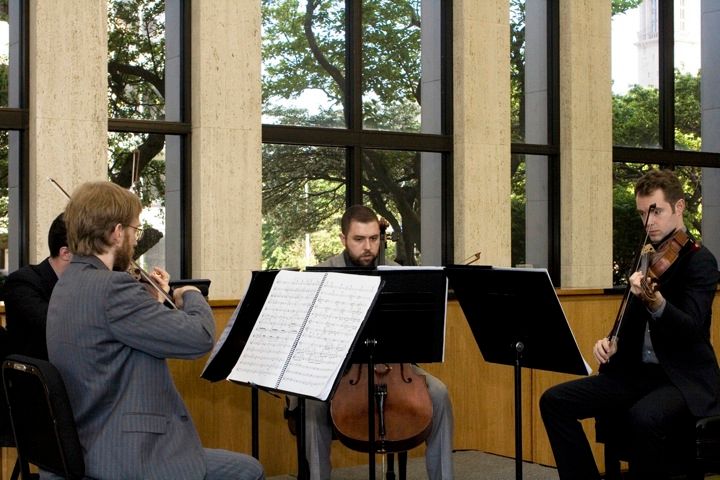
This week, the Center is excited to welcome back the JACK Quartet for a composer workshop in Baird Recital Hall. Longtime friends of the Center, the JACK Quartet have taken part in many Center events, beginning with their first residency in October 2009, during which they worked with student composers and presented a concert that featured works by Xenakis, Sciarrino, Robert Morris, and Elliott Sharp. Two years later, the quartet returned with Aaron Cassidy for a joint residency that included a concert featuring the composer's first quartet (and which also included John Cage's String Quartet in Four Parts and concluded with Ligeti's famous second quartet). One of their most memorable performances was a concert at Buffalo's One M&T Plaza which kicked off the 2013 June in Buffalo Festival and Performance Institute. The performance, part of Eric Huebner's "Music in Buffalo's Historic Places" series, consisted only of Morton Feldman's immense 100-minute String Quartet No. 1.
JACK Quartet at June in Buffalo 2013
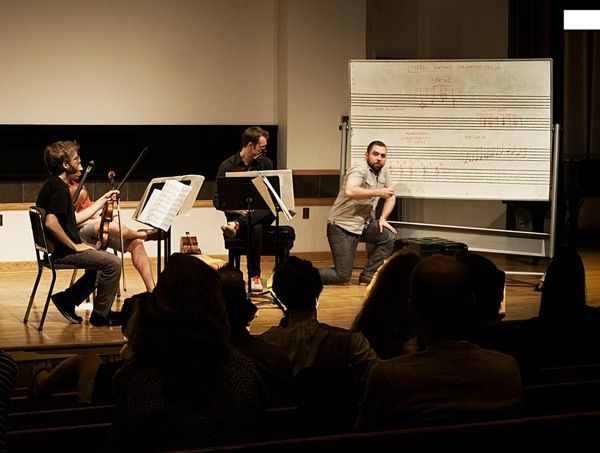
This week, the ensemble—tireless advocates of new music that they are—will present a composer workshop, realizing new works by four UB graduate composers: Roberto Azaretto, Alex Huddleston, Nathan Kelly, and Su Lee. Known for their work helping young composers realize their ideas—the Toronto Star described them as the "musical vehicle of choice to the next great composers who walk among us"—the event is sure to be enlightening for composers and audience alike.
The members of the JACK Quartet met while studying at the Eastman School of Music in Rochester, NY. Having studied with the Arditti Quartet, Kronos Quartet, and members of the Ensemble Intercontemporain (under the direction of Pierre Boulez), the quartet—consisting of John Pickford Richards, Ari Streisfeld, Christopher Otto, and Kevin McFarland—developed their sophisticated new music chops, quickly becoming one of the most active quartets on the scene. They have collaborated with a number of renowned composers, including John Luther Adams, Caroline Shaw, Helmut Lachenmann, Steve Reich, Matthias Pintscher, and John Zorn, with upcoming performances including premieres by Derek Bermel, Roger Reynolds, Toby Twining, and Georg Friedrich Haas. It's no wonder the Washington Post referred to them as "the go-to quartet for contemporary music, tying impeccable musicianship to intellectual ferocity and a take-no-prisoners sense of commitment."
Our composers have been up to really extraordinary things, and the Fall semester saw many of them composing new works, receiving commissions, and having works performed by some of the most skilled performers in the field. Neither snow, nor rain, nor lake-effect thundersnow stays these composers from constantly creating new and exciting work! Here is just a sample of what some of the group are up to:
Nathan Heidelberger has been hard at work on his dissertation, an extended single-movement work for string quartet. The first two sections of the piece were read and recorded last Fall during the Mivos Quartet's residency at the Center, and he was enthusiastic about the results. In addition, Nathan and pianist Daniel Walden were recently granted a Special Award from the Yvar Mikhashoff Trust for New Music (named for the virtuoso pianist who was a professor of music at UB from 1973-1993). Nathan describes their next project: "The grant will help support an upcoming collaborative project: a recital-length program that will combine a new multi-movement piano solo of mine with a complete performance of the Luigi Rossi manuscript, a collection of bizarre 16th-century Italian harpsichord music that includes the only extant keyboard work by Carlo Gesualdo." You can hear Daniel's performance of Nathan's song cycle Descriptions of the Moon, with vocalist Marine Fribourg ,below:
Robert Azaretto had two new works premiered in the Fall. His solo piano piece, lago. paisajismo abstracto. 2., was premiered in Buenos Aires by Bruno Mesz in the gorgeous Teatro Nacional Cervantes, Argentina's national theatre. His flute and bass clarinet duo, paisajismo abstracto. 4., was premiered at the Distat Terra festival in Choele Choel. The latter piece was commissioned by Musica AntiquaNova for Austria's Duo Soufflé.
Matt Sargent
Matt Sargent has had a very busy Fall semester. He collaborated on a duo concert of electroacoustic music with turntablist Dani Dobkin, which was presented at the Hartford Art School in November. Then in December, the Ghost Ensemble performed his work Tide for nine "sliding instruments." The Undue Percussion Duo (featuring percussionists Nick Fox and Trevor Saint) included Matt's stunning small stones in a program they played on six-city Midwestern tour in October. Saint is a frequent collaborator of Matt's, and will be performing a new work of his for solo glockenspiel in March. Matt will see another premiere in March: he was commissioned to write More Snow to Fall, a work for two electric guitars and 'cello, which will be premiered at the Museum of Contemporary Art in Cleveland.
Colin Tucker has received several commissions, and is no doubt hard at work composing new works. Richard Haynes, clarinetist of ELISION, Weston Olencki, trombonist of Wild Rumpus/Fonema Consort, and Aaron Hynds, a tubist at Bowling Green State University all commissioned new solo works from Colin. He also had several works performed in the Fall. His solo saxophone work futures unmade in the boundlessness of the instant was performed at the University of Malaya in Kuala Lumpur by Joshua Hyde, and was taken on a tour of Ohio universities by the New York-based saxophonist, Geoff Landmann. In addition, his sound installation, voice dross, was commissioned by the Echo Art Fair, where it was installed in September.
Chun Ting Pang's Pulsating Garden—a commission by Hong Kong Composers' Guild—was premiered during the guild's annual new music festival, Musicarama, by Korea's Ensemble Eclat. In addition, his Vocalize the Voicelessness for trombone, percussion, 'cello, and piano will have its German premiere in March by Ensemble Ascolta. Chun Ting also became the composer-in-residence of the Hong Kong-based Zheng Quartet, ZhengMusic (the zheng is a Chinese zither). A new commission for the quartet will be performed during this season.
Zane Merritt
photo by Megan Metté
Zane Merritt had two new works premiered in the Fall: his chamber ensemble piece Sex-Bot (serial no. 5347) becomes self-aware and falls in love with an Allen wrench was premiered by Wooden Cities in October (read more about that performance here), and his orchestral work Dramatic Individuals was premiered by the Dubuque Symphony Orchestra in November. This weekend, he and UB 'cello professor Jonathan Golove will premiere his Mercury Aqua Mirage for theremin 'cello and electric guitar at the SUNY New Music and Culture Symposium. At the same event he will perform solo guitar works by fellow UB composers Nathan Heidelberger, Colin Tucker, and Meredith Gilna, and will premiere a new work by Megan Grace Beugger. Megan will have two pieces played at this symposium: in addition to her new guitar piece, her percussion duo Daring Doris will also be performed. Megan is also gearing up for this year's MATA Festival in New York, which will see a performance of her piece for piano-dancer, Liason.
Several composers attended festivals and conferences in the Fall. Su Lee was one of of eight composers selected to attend the Goethe-Institut Boston's December symposium. There, she took part in composition workshops with composers Raphaël Cendo and Isabel Mundry. Su was also commissioned to write a new piece for the New York-based ensemble mise-en, which the group will premiere during their 2015/16 season. Weijun Chen's work In Search of a Shore was heard at the Composition in Asia Festival in Tampa, and he is planning on presenting other pieces at several conferences in the Spring, including the RED NOTE New Music Festival Composition Workshop (Normal, IL), the Mise-En Music Festival (New York, NY), and the Grawemeyer Award for Music Composition 30th Anniversary Conference (Louisville, KY), where his string quartet, Canoe, will be performed by TALEA Ensemble. Just this week, Weijun has been named a composition fellow at this summer's Aspen Festival.
Esin Gündüz recently revised a piece she composed for the Meridian Arts Ensemble (during their Fall 2011 residency at the Center) for performance by the Cleveland-based Factory Seconds Trio. The revised work will be premiered at Baldwin Wallce Conservatory this spring. She is also hard at work on a commissioned work for violists Yuri Gandelsman and Tuba Ozkan, which will be performed in September at Turkey's Mersin State Conservatory. As the composer-in-residence at Buffalo's Friends of Vienna, Esin is writing another trio which will see an October premiere. Also active with the Buffalo-based ResAUnance, Esin (a skilled vocalist) recently made a debut recording of folksong arrangements and original works with the improvisatory ensemble, which should be mixed and mastered by mid-semester.
Ethan Hayden had several works performed in the Fall, including his percussion quintet Clicks & Beeps, which was performed by the Concert Percussion Ensemble at Florida Atlantic University, and his four-voice arrangement of Kurt Schwitter's Ribble Bobble Pimlico, which was performed by ThingNY at two concerts in November. He performed his (tRas) for solo voice and electronics at the INTIME symposium in Coventry, UK in October. Ethan is also the artist-in-residence this year at the Electronic Poetry Center's annual Digital Poetry & Dance concert, at which he'll be premiering a suite of new pieces for voice, video, and electronic sounds called "…ce dangereux supplément…".
Matthew Chamberlain spent his Fall finishing a string trio commissioned by Ensemble Chartreuse, as well as a guitar solo that will soon be premiered by Zane Merritt. Matthew is also the director of UB's Contemporary Music Ensemble, and is often hard at work preparing new works for performance with that group.
Clinton Haycraft
Several composers have been collaborating with choreographer Melanie Aceto, from UB's Department of Theatre and Dance. Clinton Haycraft's work, Advocate, for violins, was choreographed by Aceto, and has already seen three performances throughout the Western New York area. Jiryus Ballan collaborated with Aceto and UB percussionist Alexander Chimienti on a series of works. After joining Aceto's modern dance class as an accompanist (Jiryus is an accomplished Buzuq player), he and Chimienti began an ongoing collaboration that began with live improvisation and eventually coalesced into 25 tracks of recorded compositions. For Jiryus, a key part of the project was the intercultural exchange. "I think the most important thing was the combination of different musical elements from diverse cultures. For example, I used quarter tones in some of the tracks and employed the Maqam [a system of melodic modes used in traditional Arabic music]." He compares this kind of compositional process to the manner in which traditional folk music is created. "In my culture (Palestinian), the folk music was created by the people. They repeated melodies and they remembered them by heart and with time these melodies attained their own unique characteristics." An excerpt of some of these collaborations can be heard below:
With all this activity just last semester, we can't wait to see what's next for these composers in the coming months!
Next week, New York's Mivos Quartet will be in residency at the Center. The group that the Chicago Reader has called “one of America’s most daring and ferocious new-music ensembles” will bring their unique brand of musical ferocity to Buffalo for an evening of contemporary music, at which they'll perform works by Taylor Brook, David Felder, Martin Stauning, and Helmut Lachenmann.
Devoted to the performance of new works for string quartet, Mivos has worked with several international composers with a wide breadth of aesthetic perspectives. The quartet has performed works by composers as diverse as Harrison Birtwistle, Philip Glass, Annie Gosfield, György Kurtág, Alex Mincek, Wolfgang Rihm, and UB's own David Felder and Tony Conrad. Committed to the production of new works and the expanding of the string quartet repertoire, Mivos enjoys close collaboration with composers over extended periods. Such collaborations have resulted in new works by composers such as Mark Barden, Dan Blake, Patrick Higgins, Scott Wollschleger, and Sam Pluta—whose Chain Reactions/Five Events for quartet and electronics can be heard below. As an ensemble dedicated to education, Mivos will begin their residency with a workshop for graduate composers in Baird Recital Hall (Nov. 19, 3:00pm). The quartet will read pieces by UB composers Roberto Azaretto, Nathan Heidelberger, Su Lee, and Zane Merritt.
As a genre, the string quartet manages to combine the nimble agility of a chamber ensemble with the genteel historical respectability of the symphony orchestra. Indeed, sometime during the twentieth century, the string quartet seemed to overtake the symphony as the key genre in which composers were most likely to articulate their musical manifestos, the pièces de résistance of their catalogs. Think of Carter's third quartet and Crumb's Black Angels, or more recently, Thomas Adés Arcadiana and Haas's String Quartet No. 3 "In iij. Noct."—all of which, it's worth pointing out, are in Mivos's repertoire. Since commissioning and premiering new music is a key part of the quartet's mission, Mivos is devoted to continuing this tradition, employing—in the words of the New York Classical Review's George Grella—"a physically, intellectually, and aesthetically energetic engagement with the high Modernist values of harmonic, gestural, and structural complexity."
Next week's concert will feature two works composed just last year: Martin Stauning's delicate, gossamery Atmende Steine ("Breathing Stones") and Taylor Brook's just-intoned El jardín de senderos que se bifurcan. The latter takes its title from the eponymous story by Borges, ("The Garden of Forking Paths"), which presents a conception of time in which all possible outcomes of any event simultaneously co-exist, evoking ideas of a hypertextual multiverse. Brook's piece, winner of the quartet's 2014 Mivos/Kanter Prize, lives up to the ideas evoked by its title by drawing elements from a multiverse of traditions, including Japanese Gagaku, central African music, and free improvisation among others, endeavoring to create an "alternate history of music."
UB faculty composer David Felder will also be featured on the program. Felder's first string quartet, Third Face, will finish out the first half. Consisting mostly of aggressive, dramatic gestures separated by isolated islands of quiet, the piece was described by Andrew Porter in the New Yorker as "lucid, but with a controlled wildness in its making. Written for virtuosi, it challenges them by presenting its fierce, fertile ideas with almost reckless rhythmic and dynamic exuberance." A brief excerpt can be heard below.
While the concert opens with Brook's imagined alternate musical history, Mivos will end the program with the third quartet by Helmut Lachenmann, a composer whose work has constantly commented on the historical traditions of European classical music, as well as the "aesthetic apparatus" of that music's social institutions and contingencies. Certainly one of Lachenmann's most important works in the past 15 years, Grido ("cry") opens with gloriously strident sustained tones, before unfolding into a dense universe of complex harmonies, brilliantly vibrant tremolos, penetrating silence, and violent scratch tones. The piece existentially scrutinizes the string quartet itself, as a genre, a medium, and a source of sonic material.
Mivos's program will thus cover all the extremes: from the understated translucence of Stauning's piece to the sinewy muscularity of Felder's. And the concert will conclude with the strangely meta feat of a string quartet exploring the string quartet via a piece for string quartet, a musical Ouroboros of mind-bending composition and dazzling virtuosity not to be missed!
—Ethan Hayden
Mivos Quartet
Composer Workshop
November 19, 3:00pm
Baird Recital Hall
free admission
Concert
November 20, 7:30pm
Baird Recital Hall
$15 general, $10 seniors, free for all UB students
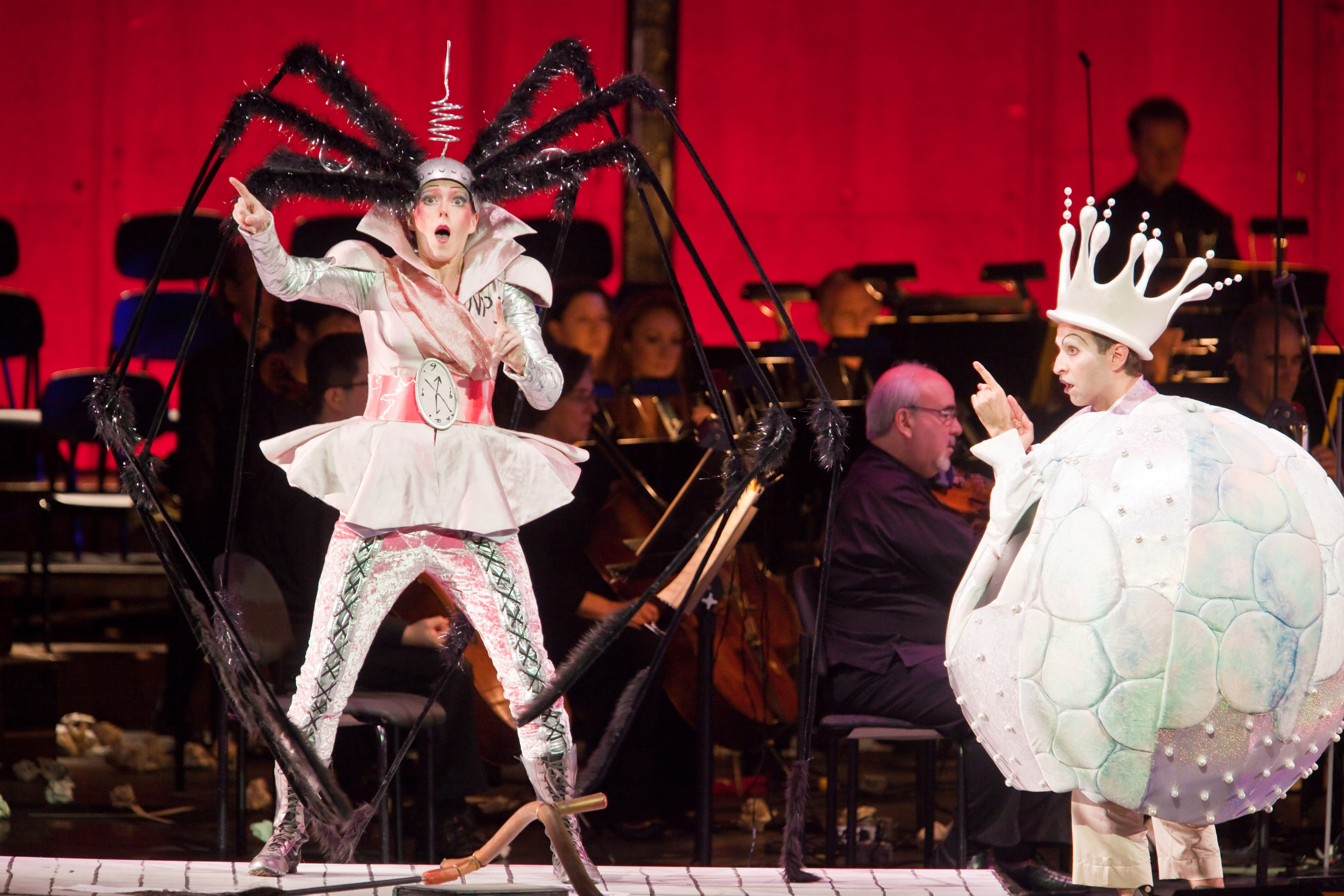
Internationally renowned producer, designer, artist, and choreographer Doug Fitch has been in residency at UB as the first ever WBFO Visiting Professor. Fitch is working with with UB students, staff, and faculty in the Theatre and Music departments to produce an elaborate and surreal new theatre work called How Did We…?. The project will be performed on November 13, 14, and 15th at 7:30pm in the CFA Drama Theater.
Fitch is well known in the contemporary music world for directing the New York premiere of György Ligeti's absurdist opera, Le Grand Macabre,with the New York Philharmonic in 2010. Fitch, along with his production company, Giants are Small, has also directed productions of Janáček's The Cunning Little Vixen (NY Philharmonic), Prokofiev's Peter and the Wolf (LA Philharmonic), Puccini's Turandot (Santa Fe Opera), in addition to works by Carter, Stravinsky, Weill, Hindemith, and Thomson. Beginning in his family's touring puppet theatre and going on to team up with the likes of Peter Sellars (Der Ring des Nibelungen), Robert Wilson (The Civil Wars), and Jim Henson (The Muppets), Fitch is no stranger to collaboration, and excels at bringing diverse artists together to create great works that are far more than sums of parts.
How Did We…?, Fitch's production at UB, has been described as an "opera of images." A recent press release describes the (seemingly indescribable) work:
The show features odd characters, giant ships passing in the night, digital people-surfing, a “Ballet of the Sensory Organs,” water drumming (in which drum chambers are filled with varying amounts of water to create unique sounds), a jungle of social media, high tea, dancing Tibetan Buddhist icons and much more.
The performance will be supported with live music by composers Alfred Schnittke, David Felder, Paul Moravec, Doug Cuomo, Su Lee, Franz Schubert and Frederick Chopin performed by UB’s Slee Sinfonietta, a Balkan banda and an onstage string quintet.
Eric Huebner, world-renowned pianist and member of the Music Deptartment faculty, has worked with Fitch before, playing in the NY Phil's performance of Le Grande Macabre. Huebner—who is also the coordinator of the June in Buffalo Performance Institute—is playing a big part in the production of How Did We…? acting as the project's music director. I had a chance to interview him about the work, and his insights only made me more excited about seeing the production!
Eric Huebner
How did this project come together? How many departments and students are collaborating on it?
I, along with Music Department chair Jeff Stadelman and Theater and Dance chair Lynne Koscielniak, proposed Doug Fitch for the inaugural WBFO Visiting Art Professor position. The production of Doug’s show, How Did We…? is a collaboration between students and faculty from the Music Department and the Department of Theater and Dance. The ensemble cast includes 18 student actors and dancers and nearly two dozen student designers and technicians.
What role does the music play in the production? The piece has been called an "opera of images," how does that phrase relate to the music's role?
The phrase “opera of images” means the story is told primarily by the scenes on stage and the music. In this case, the music moves the action forward. It is the catalyst for nearly all of the scenic changes taking place on stage. Each image or scene morphs organically into the next. Characters (some quite strange!) appear and disappear as if in a dream.
The piece seems to pull together a lot of diverse elements, do they all serve a continuous narrative?
Yes, absolutely. The show is about one man’s journey to become more comfortable with himself. The main character is played by actor Connor Graham, a student in the department of Theater and Dance.
Ligeti's Le Grand Macabre
Fitch is no stranger to contemporary music, having worked on The Grand Macabre and The Civil Wars among so many others. How does that aesthetic sensibility manifest itself in this work, or in particular, in how he utilizes the music in this work?
Mostly, I think it’s his general openness to contemporary music and his own highly developed musical sensibility from having worked with so many orchestra and musicians over the years in addition to his work in opera. He revels in musical abstraction and senses immediately the possibility of connection between the world he is seeking to create on stage and the music that might go with it.
There is a very diverse grouping of composers represented in the piece, from 19th century composers to UB faculty and students. How do the different pieces work together?
As de facto Music Director for How Did We…? my biggest concern was finding music that fit Doug’s vision of a particular scene while making sure the overall collection of pieces and electronic excerpts worked musically together. There are moments when one piece overlaps with another in musically interesting ways and still others where very different pieces of music are juxtaposed, one right after the next. The excerpts from the Schnittke Piano Quintet that open and close the show helps to give the musical score a dramatic underpinning. Mostly the music was excerpted from pre-existing works. In choosing the music, I was looking to include excerpts of works by our own students and faculty as well as my two composers, Paul Moravec and Douglas Cuomo, that Doug Fitch had expressed an interest in working with. The composer Douglas Cuomo wrote original music to accompany the penultimate scene which features Yamantaka—the Tibetan killer of death—which features a part for Alex Glenfield, a Buffalo-based Tuvan throat singer. Additionally, the Pulitzer-prize winning composer and Buffalo native, Paul Moravec arranged a portion of his orchestral work “Capitol Unknowns” for the Slee Sinfonietta. Of course I wanted to include work by our own excellent faculty and student composers and found the perfect compliments for several scenes in works by Professor David Felder and current PhD composition student Su Lee.
The works by Schubert, Chopin and Dinicu provide a depth and dimensionality to the musical score and in the case of the Schubert and Dinicu, are part of the action on stage.
Who is conducting the Sinfonietta? How about the Balkan banda or the string quintet, are they also made up of musicians from the department?
Dan Bassin will be conducting the Sinfonietta. Moshe Shulman, a recent PhD in composition graduate from UB and a violinist will be heading up a trio of musicians, including Miguel Benitez on guitar and Jeremy Spindler on accordion. They will be playing Grigoras Dinicu’s “March Hora” from on top of a tall piece of scenery on-stage at one point in the show.
The opening of the Adagio to Schubert's string quintet in C Major will be played on-stage by a group of student musicians from the Music Department and includes: Aidan Scoccia, Blair Sailer violins; Jessica Oemcke, viola; Lisa Gagnon, cello; Stanzi Vaubel, cello.
Do you know anything about the piece with the "water-drumming”?
Yes! It was choreographed with assistance from Jason Ross—a graduate student in percussion who happens also to be a champion clog dancer! A portion of the stage will be covered in water. I think to say much more will spoil the surprise!
What is it like as a performer being a part of a multimedia production such as this?
These kinds of productions always bring with them an added sense of excitement as well as organizational challenges. We're fortunate in this regard to have the support of a number of individuals associated with the Music Department and the Center for 21st Century Music as well as of course, the technical staff at the Center for the Arts and from the Department of Theater and Dance.
In the video below, Fitch says the piece is about the "unanswered questions we have hovering in the back of our minds." This, of course, makes me think of Ives's The Unanswered Question. What do you, as a musician and teacher, think about music's role in helping us grapple with difficult questions?
I think that it tells us these questions are, in some way, universal. We all hear different things in the music we listen to, but still there is a sense of discovery while listening to any worthwhile piece of music that enriches us and let’s us know that difficult questions may not have “right” answers.
Is there anything else you'd like to say about this project?
Please come see it! Everyone who’s worked on it is very excited about it!
Summer is often a very exciting and active time for composers, and that's especially true for those here at UB. This past summer saw many of our composers having works performed, and participating in conferences, festivals, and seminars in the US and abroad.
Colin Tucker
Colin Tucker had a particularly busy summer. While attending the Darmstadt International Summer Courses for New Music, he presented a lecture recital with renowned Australian saxophonist Joshua Hyde. The lecture dealt with issues of notation, interpretation, and performance practice in the solo pieces that Colin wrote for him (including futures unmade in the boundlessness of the instant). In May, Colin had his newest piece, not this (2014) for bass flute, bass clarinet, saxophone, piano, percussion, mezzo-soprano, and strings premiered by the French ensemble, soundinitiative, in Paris. Finally, his chamber piece, engulfed, constrained in a widening gap (2013), which was premiered at last year's June in Buffalo festival, saw three performances this summer, including two by the East Coast Contemporary Ensemble.
Su Lee also traveled to Europe, as her Melting Crystal for flute, clarinet, violin, viola, and 'cello was a winner of the Kazimierz Serocki International Composers’ Competition in Warsaw, Poland. In addition, her exciting large ensemble piece, Soundless Cry, was performed at the Mise-en Music Festival in New York.
Chun-ting Pang was also at this festival, which saw the US premiere of his Vocalize the Voicelessness for trombone, percussion 'cello, and piano. On the festival’s last day, Chun-ting flew to Finland to attend Sävellyspaja 2014, an annual composition masterclass in Porvoo. While in Finland, he studied with Jukka Tiensuu, Jouni Kaipainen, and Tomi Räisänen, and heard the Avanti! Chamber Orchestra perform his piece, The Flowers Appear on Earth. Later, Chun-ting was privileged to be one of the fellows at the Composers Conference at Wellesley College, a course led by Mario Davidovsky, Steve Mackey, and Augusta Read Thomas. At Wellesley, Chun-ting revised Vocalize the Voicelessness, which had a successful performance at the conference’s final concert.
For the past year, Nathan Heidelberger has had the honor of being the first ever composer-in-residence for Oerknal!, a new music collective based in The Hague. The culmination of this partnership took place in June, a portrait concert of Nathan’s music called Lunatics!, featuring his pieces, My Hands Are Empty (which was premiered by the Slee Sinfonietta in April 2012), Descriptions of the Moon (his epic song cycle for soprano and piano), and Breather, a brand new sextet composed for Oerknal!. You can hear some live audio from the performance here. “It was deeply rewarding to work closely with such a phenomenal great of young performers,” Nathan said, “and I'm looking forward to future collaborations with them. I was grateful to received support from The Center to help cover my travel expenses.”
Juan Colón-Hernández traveled to Valdeblore, France for the Zodiac Festival, where his trio for clarinet, 'cello, and piano, Sobre el camino y otras cosas, was performed. While there, he took master classes with composer Andrew List. Later, Juan's string quartet, A Discontinuous Flux, was awarded third prize at the Malta International Music Competition where he participated in master classes with composer/performer John M. Kennedy. Finally, Juan's solo guitar piece, Tropos, was selected as part of the 12th Annual Festival of Contemporary Music in San Francisco.
Weijun Chen
Weijun Chen's Canoe for string quartet was premiered by the Freya Quartet at the Charlotte New Music Festival. Inspired by the poem 'I Am a Canoe' by the Misty Poet, Cheng Gu, Canoe won 2nd prize in the University of Louisville's Frank Robert Abell Young Composer Competition for New Chamber Music. The reviewer, Perry Tannenbaum, said of Weijun's piece, "Strands of melody broke loose from the quartet harmonies as the score replicated the drift, the loneliness, the longing, the emotion, and the despair of the poem. Toward the end, there were ethereal passages that jumped beyond the template of the poetry and showed that Chen, unlike many of his contemporaries, is unafraid of lingering in intense expression." Weijun's music was also celebrated when his wind ensemble piece, Distance, won the Hat City Music Theater's American Prize.
Wooden Cities prepares to perform in Cleveland, OH
Other UB composers packed up and took their works on the road. Buffalo's up-and-coming new music collective, Wooden Cities—which features a number of UB composers among its members—played a five-city DIY tour across the Rust Belt that included performances in university concert halls, experimental theaters, indy bookstores, and even a dive bar. In addition to performing works by Berio, Eastman, Ives, and Zorn, the ensemble's performances were bursting with new music from UB composers, including Ethan Hayden's (tRas), Nathan Heidelberger's Occasionally, music, Zane Merritt's The Reputation, and Matt Sargent's Tide,in addition to UB faculty composer Jeffrey Stadelman's Koral 8.
Megan Beugger
Several other UB composers had eventful summers. Matt Sargent's large-scale glockenspiel solo, Saint, was premiered by its namesake, percussionist Trevor Saint at the University of Wisconsin, Milwaukee. Matt also began an appointment as visiting lecturer in composition and electronic music at the Hartt School of Music. Megan Grace Beugger spent the summer working on a new piece for her dissertation, as well as editing her Liason for piano-dancer, which was performed by Melanie Aceto at Hallwalls in late July (many of you will remember this intriguing piece from June in Buffalo 2013). In addition to a performance of his bats with baby faces in the violet light at the New York City Electroacoustic Music Festival and performances with Wooden Cities, Ethan Hayden saw the publication of his book on Sigur Rós's ( ) by Bloomsbury's 33 1/3 series.
All in all, a remarkably busy summer for our composers! We can't wait to see what's next for them this year!





 Posts
Posts


