Showing posts with label Yuki Numata. Show all posts

Saturday, May 9, 2015

This Week: Music in Buffalo's Historic Places


Common Council Chambers
The Music in Buffalo's Historic Places series continues next week with a concert by Yuki Numata Resnick at the Common Council Chamber in Buffalo's City Hall.  The series, curated by UB piano professor Eric Huebner, features UB faculty performers, alongside the occasional visiting artist, in spaces of civic and architectural importance.  For Huebner, the idea was "to create a musical program that corresponded in some way with the architecture."  Below is an excerpt from the event's press release, which is available here:
Music in Buffalo’s Historic Places presents violinist and University at Buffalo Assistant Professor Yuki Numata Resnick in a free noontime concert of solo and duo works by Antheil, Bach, Bartok and Honegger in the magnificent Common Council chamber at Buffalo's City Hall. She is joined by cellist and UB associate professor Jonathan Golove as well as by her husband, trumpeter Kyle Resnick.
The Common Council chamber is one of Buffalo’s most revered civic spaces. Officially opened in January of 1932, it is widely regarded as one of the finest city council chambers in the country. The chamber features a beautiful stained glass sunburst, inlaid walnut woodwork and is ringed by stone pillars representing the virtues council members were expected to maintain.
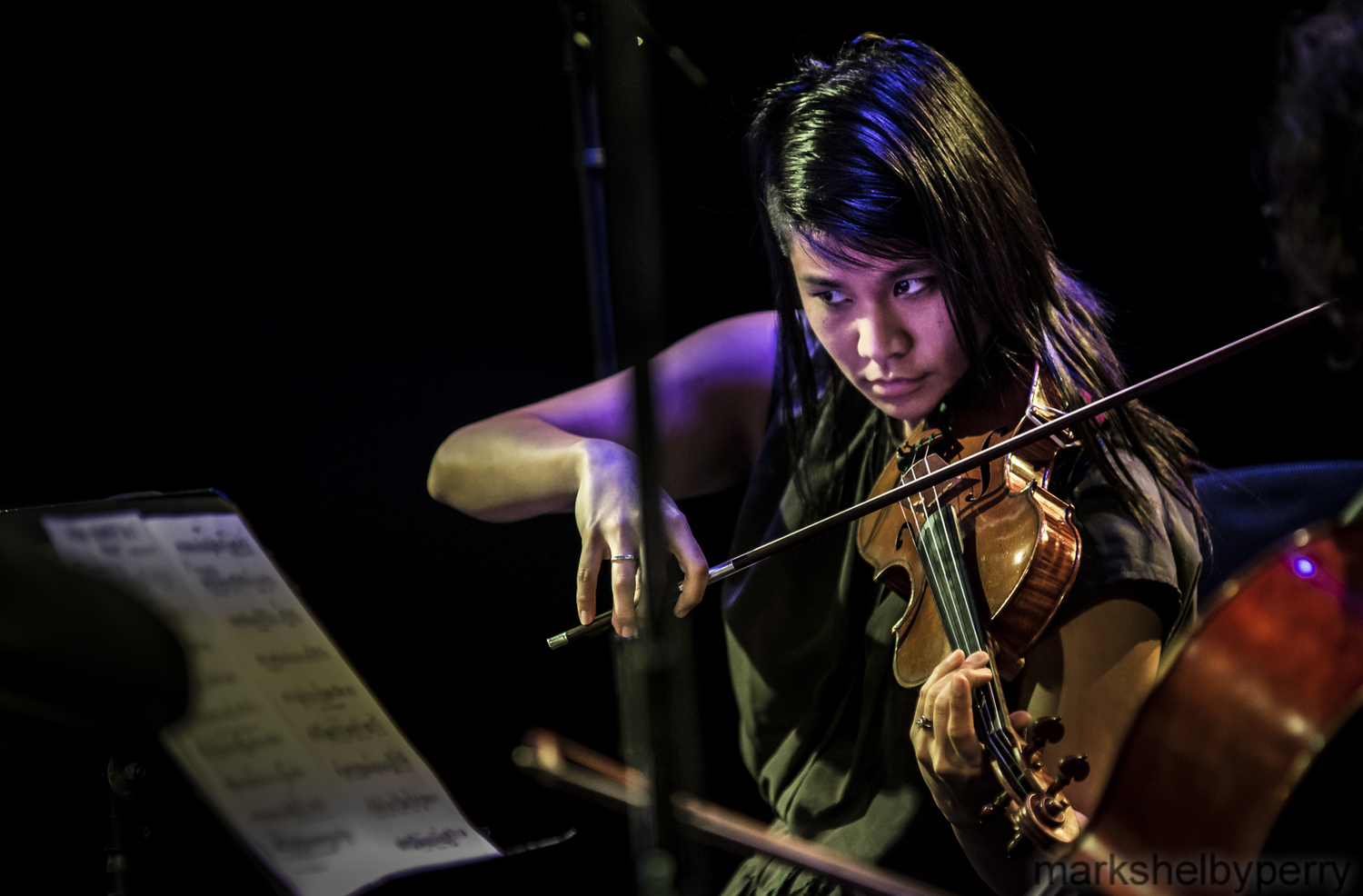
Yuki Numata Resnick
Yuki Numata Resnick was appointed assistant professor of music at the University at Buffalo in the fall of 2013. She is a highly sought after soloist and chamber musician who has performed internationally and with ensembles such as Alarm Will Sound, Enemble Signal, Wordless Music Orchestra, and the Talea Ensemble. A committed advocate of the music of our time, Yuki has premiered dozens of new works in recent years and is actively involved in the commissioning of new music for violin. She has also been engaged in a multi-year exploration of the music for solo violin by J.S. Bach and frequently seeks to link Bach’s music with the music of more recent composers.
The noontime program opens with Arthur Honnegger’s beautiful Sonatina for violin and cello composed in 1932, the year City Hall was officially opened. The neo-classical work, traditional in sound and structure, isemblematic of how composers in the 1920s and 30s often looked back to older musical forms to help organize their music in much the same way the architects of Buffalo’s City Hall might have looked at ancient Roman architecture to inspire the design of the Common Council chamber. The program continues with two modernist works from 1931: a selection of Béla Bartók’s Duos for two violins, here played in a version for violin and trumpet and George Antheil’s Sonatina for violin and cello. The program concludes with J.S. Bach’s B minor Partita for solo violin.
This concert is made possible by the generous support of the Robert and Carol Morris Center for 21st Century Music and by the City of Buffalo.
The full program is available here.  Don't miss this exciting event, a continuation of an always-exciting series!

May 14, 2015
12:00pm
Common Council Chamber, Buffalo City Hall


Next week, we'll continue our series on June in Buffalo faculty composers and resident ensembles with a profile of composer Harvey Sollberger…

Sunday, October 28, 2012

Performer Profile: Violinist Yuki Numata


We've been enjoying having Yuki Numata in town for rehearsals for the Second Fall Slee Sinfonietta concert on Tuesday, October, 30, at 7:30 p.m. Wildly praised by the New York Times as a violinist with “virtuosic flair and dexterous bravery,” Numata is rapidly gaining attention as a charistmatic virtuoso, having performed frequently as a soloist with our own Slee Sinfonietta, the New World Symphony, the Wordless Music Orchestra, the Tanglewood Music Center Orchestra and the Eastman Philharmonia Orchestra. Numata was recently invited to perform Charles Wuorinen’s Rhapsody with the Tanglewood Orchestra, and, at the composer’s request and as a last minute replacement, she performed Wuorinen’s Spin Five with The Slee Sinfonietta. 

Yuki Numata

A few words from Numata’s impressive biography:

“Yuki has an avid interest in new music and as a result, has had the opportunity to work closely with some of today’s foremost composers. These include Charles Wuorinen, Steve Reich and John Zorn. At the Tanglewood Music Center, Ms. Numata was invited to be a New Fromm Player, focusing specifically on the performance of contemporary chamber music repertoire. Yuki holds a great deal of respect for composers of her own generation and has collaborated with many of them including Jeff Myers, Caleb Burhans, Nico Muhly, Andrew Norman and Timothy Andres.

“Additionally, Yuki is an active freelancer and has performed with the American Contemporary Music Ensemble (ACME), the String Orchestra of New York City (SONYC), Alarm Will Sound, Signal, East Coast Chamber Orchestra (ECCO) and counter)induction. In true New York freelancer style, she wears many hats and has played and/or recorded for bands and artists including Passion Pit, The National, Grizzly Bear, Jóhann Jóhannsson and Max Richter. Yuki was a featured soloist on the Duncan Theater’s 2009-2010 season and has appeared at numerous summer festivals including Music in the Vineyards, Tanglewood, Music Academy of the West and The Banff Centre.


Yuki Numata 

“Born in Vancouver, Canada, Yuki received a Bachelor’s degree from the Eastman School of Music and a Master’s degree from the University of Michigan. Her principal teachers include Andrew Jennings, Zvi Zeitlin and Gwen Thompson. Yuki completed a three-year fellowship at the New World Symphony, has served on the faculty of the University at Buffalo and currently resides in New York City.”


Recently, our own University at Buffalo graduate composer Robert Phillips had the opportunity to work with Numata on his piece Shindō no su, for flute, bass clarinet, keyboard + laptop, glockenspiel, violin, viola, and cello. Shindō no su was performed by the Talea Ensemble as part of the Harvard University Summer Composition Institute last August, and conducted by Eduardo Leandro. Robert reports, “Yuki is absolute magic on the violin. She has an incredibly powerful musical imagination and delves into pieces with fierce interpretive rigor, energetically exploring new works with profound curiousity and openness, and shows up at rehearsals with exciting ways of being in the music. She breathed fluidity, dynamism, and fire into Shindō, much of which I had never imagined, and I am very grateful to her for that.”

Come see Yuki Numata perform with visiting hornist Adam Unsworth, UB pianist and New York Philharmonic pianist-in-residence Eric Huebner, and the rest of the Slee Sinfonietta this Tuesday at 7:30 p.m.


Slee Sinfonietta
Tuesday, October 30, 2012, 7:30 pm
Lippes Concert Hall in Slee Hall
Daniel Bassin, conductor
Yuki Numata, violin
Adam Unsworth, horn
Eric Huebner, piano

Ticket information can be found here


Link to this post here


Hornist Adam Unsworth performs with the Slee Sinfonietta!


We’re excited about our Second Fall Slee Sinfonietta concert coming up on Tuesday, October 30, at 7:30 p.m., and are happy to have received a thoughtful write-up in this week’s Buffalo Artvoice by Jan Jezioro, which is largely about the evening’s conductor Daniel Bassin, “Now in his third academic year as the UB Symphony Orchestra’s music director, Daniel Bassin enjoys his hectic schedule of music making. In addition to his duties as the UBSO music director, Bassin has also been conducting some very challenging works on this season’s Slee Sinfonietta series, yet he also somehow manages to find the time to perform often as a trumpeter with jazz ensembles in venues throughout the city. And he does this all while pursuing his PhD in musical composition at the University.” Read the entire article here.

We thought we'd do a little profile on french hornist Adam Unsworth, who will be joining us for the evening, hailing all the way from the University of Michigan in Ann Arbor. His ensemble, the Adam Unsworth Ensemble, has recently released two CDs, Next Step, and Excerpt This!, which received rave reviews, including a terrific piece in All About Jazz, by Ken Kase, "Unsworth's debut recording does what the best jazz should do by asking questions, shunning orthodoxy and predictability and having a few laughs along the way. His virtuosity is undeniable... Unsworth and his group have created something rare and distinctive." Read more about Unsworth's work here

Next Step by the Adam Unsworth Ensemble

Some background on Unsworth from his extensive biography:

“Adam Unsworth is Associate Professor of Horn at the University of Michigan in Ann Arbor. Prior to his joining the faculty at Michigan, he spent nine years as a member of the horn section of The Philadelphia Orchestra and three years in the Detroit Symphony. Adam has appeared as a recitalist and clinician at many universities throughout the United States, and has performed repeated solo and chamber concerts at Carnegie's Weill Recital Hall. He is the leader of his own jazz group, the Adam Unsworth Ensemble, which recorded the critically acclaimed CD, Excerpt This! and now has completed a second recording, entitled Next Step. The group embarked on its first U.S. tour in October 2007.

Next Step, the Adam Unsworth Ensemble's 2008 release, is a culmination of work done after his leaving the Philadelphia Orchestra in 2007, a move made in order to devote more time and energy to teaching and creative endeavors. It features new Unsworth compositions for jazz quintet of horn, woodwinds, vibraphone, bass, and drums, and two original works by multi-woodwind virtuoso Les Thimmig.

“In 2006, Unsworth released Excerpt This!, a groundbreaking recording for the French horn that looks to redefine the virtuosic boundaries of the instrument. Highlighted on the CD are five of Unsworth's compositions for jazz sextet. The instrumentation of horn, violin, alto flute, bass clarinet, vibraphone, bass, and drums is unique and creates a texture that truly embodies the term chamber jazz. Joining Unsworth on Excerpt This! are Philadelphia jazz greats Tony Miceli, Diane Monroe, Ranaan Meyer, and Cornell Rochester, as well as Les Thimmig from Madison, WI. In addition to the works for sextet, the CD includes unaccompanied jazz works for horn by Unsworth, Les Thimmig, and Dana Wilson.”

Adam Unsworth, Yuki Numata, and Eric Huebner,
rehearsing György Ligeti's Trio for horn, violin, and piano,
in UB's Slee Hall, 

Rehearsals over the weekend have been going swimingly, as Maestro Bassin recently tweeted, “Great 1st rehearsal of Feldman's "De Kooning" - my first time conducting his music! These musicians are fantastic! #SleeSinfonietta10/30/12”


Slee Sinfonietta
Tuesday, October 30, 2012, 7:30 pm
Lippes Concert Hall in Slee Hall
Daniel Bassin, conductor
Yuki Numata, violin
Adam Unsworth, horn
Eric Huebner, piano

Ticket information can be found here


Link to this here.


Thursday, October 18, 2012

The Slee Sinfonietta performs seminal 20th century works!


Our September Slee Sinfonietta concert was a great success and enjoyed a huge turnout, and received a very thoughtful write-up in the Buffalo News by Daniel J. Kushner. We’re already gearing up for the second Fall Slee Sinfonieta concert, which will take place on Tuesday, October 30, at 7:30 p.m., in Lippes Concert Hall. Maestro Daniel Bassin will be conducting some of the most seminal works of 20th century chamber music, and will be joined by violinist Yuki Numata, hornist Adam Unsworth, and pianist Eric Huebner.

Program:
Daniel Bassin conducting David Rappenecker's Emergence

Morton Feldman - De Kooning
György Ligeti - Trio for horn, violin and piano

--- intermission ---

Pierre Boulez – Notations 8, 3, 9
Karlheinz Stockhausen - Kreuzspiel
Tristan Murail - Vues aeriennes
Witold Lutosławski - Dance Preludes


We sat down with Daniel Bassin and asked him about the program, how the pieces fit together, and if he could give us a sneak preview of the music in store for us: 

“They’re all major works, each and every one on the program, but the biggest work is Ligeti’s Trio for horn, violin, and piano, which Ligeti considered to be the first work of his late period, and which represents the culmination of the musical ideas he had been working with during the late 60s and 70s, and a maturation into a lyrical and autumnal style. On the other hand, there is Stockhausen’s Kreuzspiel, which Stockhausen said he considered to be his first true composition – he felt that this was his first work that wasn’t a study or copying someone else’s style, but was a true composition of his own. And we added to the program three of Boulez’s twelve Notations, for piano, written when Boulez was only 20 years old, but which present a nice context for hearing the Stockhausen, in terms of the composers’ treatment of the piano, and the techniques they employed related to total serialism. Bookending the concert are pieces by Feldman and Lutoslawski, both of whom are experiencing something of an anniversary – 2012 being the 25th anniversary of Feldman’s passing, and 2013 will be the 100th anniversary of Lutoslawski’s birth.*

“Morton Feldman’s De Kooning is a piece of chamber music with the unique instrumental combination of muted french horn, violin, cello, percussion (crotales, vibraphone, chimes, tenor drum, and bass drum), and piano/celeste. It was originally written to accompany a film on Feldman’s friend, the 20th century painter Willem de Kooning, created by German-American director Hans Namuth. Feldman once remarked of de Kooning’s work, that at first impression it seemed as if his canvases were painted quickly, but when watching de Kooning paint, he saw that he was painstakingly deliberate and slow, and I think the piece, in a way, mimics de Kooning's process. In Feldman’s composition, the individual instrumental tones succeed one another without regard to metric pulse, but rather with a cryptic instruction from the composer that each sound only begin when the preceding one starts to fade away. 

“The concert closes with the third version of Polish composer Witold Lutoslawski’s Dance Preludes.  The piece was originally written for clarinet and piano, and was derived from Polish folk dances and melodies. In an intervening version, Lutoslawski developed the work into a concertante version featuring the clarinet as soloist, however, in this final version composed for the group Czech Nonet, the composer treats the four string players and members of the woodwind quintet equally, while creating chamber orchestral textures which point forward to his more mature symphonic work.While the works in the program by Stockhausen, Boulez, and Ligeti each mark important turning points in those composer’s compositional output, it is with this final arrangement of the Dance Preludes that Lutoslawski made the artistic decision to abandon the folk arrangements and transcriptions that he had previously been compelled to write as a Soviet-era composer.

“The concert will also feature the composition Vues Aeriennes, by a Darmstadt composer from a later generation, Tristan Murail. In this work, the composer seeks to depict an object – in reality a set of musical processes – in four different qualities of light. Murail breaks it down into four movements: 1. morning light (clear light, very obtuse angles, maximum distortion), 2. light in the rain (soft-focus effect, softer angles, slighter distortion), 3. midday light (brilliant light, frontal view, no distortion), and 4. evening light (warm light, long shadows, heavy distortion). The horn player, throughout the four movements, travels an arc across the stage – he begins off stage to the right, in the second movement plays from stage right, in the third movement plays from center stage, and finally concludes the work off stage left.”

We look forward to seeing you all there!

Slee Sinfonietta
Tuesday, October 30, 2012, 7:30 pm
Lippes Concert Hall in Slee Hall
Daniel Bassin, conductor
Yuki Numata, violin
Adam Unsworth, horn
Eric Huebner, piano

Ticket information can be found here


 * Note: Daniel Bassin will be presenting two other concerts associated with the Lutoslawski centennial: on Tuesday, February 2nd, at a Brown Bag concert in Slee Hall featuring chamber music from across Lutoslawski’s compositional career, and on Friday, March 1st, when TJ Borden will give the Buffalo premeire of Lutoslawski’s 1970 cello concerto with the UBSO.


Link to this post here.


Wednesday, September 12, 2012

Robert Treviño conducts the Slee Sinfonietta to kick off the 2012-2013 season with Berg, Ligeti, and Adams!


The Center is pleased to announce the first Slee Sinfonietta concert of the 2012-2013 season, on Monday, September 24th, at 7:30 p.m. in Lippes Concert Hall. We’ll be welcoming a handful of exciting guests, including conductor Robert Treviño, violinist Yuki Numata, and pianist Daniel Pesca, for a concert of pieces by Alban Berg, György Ligeti, and John Adams.

Robert Treviño
Our guest conductor Robert Treviño has an impressively long resumé for someone who his only 28 years old, and is currently serving his second season as the Associate Conductor of the Cincinnati Symphony Orchestra, as well as debuting this year with the California Symphony Orchestra and the Shippensburg Music Festival. He has worked with a long list of ensembles, symphonies, and orchestras, including the Orchestras of Cleveland and Philadelphia, the Symphonies of Cincinnati, Baltimore, Charlotte, Memphis, Napa Valley, New World, the Philharmonics of Chicago, Louisiana, Tanglewood Music Center Orchestra, Aspen Music Festival Orchestra, Suwon Philharmonic of South Korea, Wuppertal Symphony of Germany, Montpellier National Orchestra of France, Universidad Nacional Autonoma De Mexico Philharmonic of Mexico, the Millennium Chamber Players, and the Jusqu’aux Oreilles Festival of Canada. Treviño also served a month-long residency with the Helsinki Philharmonic, where he assisted Music Director Leif Segerstam through a season of the complete symphonies of Sibelius.
Alban Berg

The first half of the program will include Alban Berg's op. 5, Four Pieces for Clarinet and Piano, featuring UB faculty pianist Eric Huebner and UB faculty clarinetist Jean Kopperud, and Berg’s Chamber Concerto for Violin and Piano with 13 wind instruments, which will feature guest soloist violinist Yuki Numata, whose playing has been described by the New York Times as possessing “virtuosic flair and dexterous bravery,” and guest pianist Daniel Pesca, who was recently in residence at the Aspen Music Festival. The second half of the program will feature some exciting and rarely performed works from the late 20th century: György Ligeti's Melodien, and John AdamsChamber Symphony.

For information about tickets, contact the UB Department of Music Concert Series.


Friday, April 15, 2011

A student looks back


Moshe Shulman, PhD candidate in composition at UB, recently shared some observations about his music.

"2011 is my last year in Buffalo, NY. Since 2007 I was studying music composition mainly with David Felder but also with Cort Lippe and Jeffrey Stadelman one semester each. During these years I wrote for brass, woodwind, and percussion ensembles, two string quartets, mixed ensembles including voice, a little piece for piano and a couple of solo pieces. Some of these were successful, some came to be tryouts, one of these even received third prize in a Composition contest in Russia in 2009.


"When the time for writing dissertation piece came, writing for a larger ensemble with a soloist was an obvious choice, mainly because I don’t have anything like that in my portfolio. Another reason for writing a piece for solo violin with orchestra was personal. I started to play violin at the age of five and writing a dissertation piece 28 years later seems like a circle that has been completed. Thanks to David Felder, this project was approved, well-advised and will be realized on April 18th, 2011 in a recording with the Slee Sinfonietta and most talented musician and a friend, violinist Yuki Numata.

"Before getting to what I wanted to achieve in the dissertation work I will try to remember what aspects of music concerned me during these years. One of the first pieces I wrote within the walls of Buffalo University was Frozen Moments for flute, violin, cello and piano. Here are the program notes of that piece:

Frozen Moments is a piece about different states of motion and motionlessness. The piece introduces different musical moments of those states as well as arrivals and departures from them. First movement deals with the sound as motion and silence as static process. Second movement is concerned with repetitions as motionlessness and the motion between the repetitions. The third movement can be actually called anything but Frozen Moment. This movement is full of energy and motion however the static quality is present on a new level. The motionlessness is present within the motion as if one runs down the street and suddenly stops for a second. Beyond that, the motion-motionlessness states are in counterpoint in that movement which gives the listener an option to hear both actions at the same time.

"Another musical aspect that concerned me was writing for a certain instrument as if it were another instrument - for example, treating brass instruments like strings. “Subito” for Brass Quintet is the outcome of that idea. My Second String Quartet was written for the Copland House Project during November 2009. My thought was to create a set of short movements that would exist within a margin of extremes (whatever those extremes might be: speed, dynamics, motion, etc.). Some movements contrast in their extremes with other movements, while others contain their diversities within.
There were many other issues during the years, of course, but these made their way into the dissertation piece that, for now, is titled Kivunim.

"Kivunim is a Hebrew word and it can have multiple meanings. But the ones I am referring to can be translated as directions, movements, goal-oriented processes. Here, in some sense, I come back to the issue I was resolving in Frozen Moments. The soloist and the ensemble arrangement distribute naturally the roles of motion and motionlessness.

"The dissertation defense will take place on May 3rd and everyone is welcome to attend, to listen and hopefully to enjoy."

Friday, February 4, 2011

Within EarShot


In a perfect world, every talented young composer would have the opportunity to hear his or her scores read by a committed professional orchestra. No matter how good your ear may be, there's simply no substitute for the experience of having live musicians engage with your work. Which is why EarShot, a program that teams emerging American composers with orchestras around the country, is such a valuable resource. Through EarShot, some 24 such composers have had readings by the Memphis, Colorado, Nashville, Pioneer Valley, and New York Youth Symphonies.

Earshot comes to Buffalo February 8 - 10 for the Buffalo Philharmonic New Music Readings, highlighted by a free concert by the BPO at Kleinhans Hall on Wednesday, March 9 (7 pm). No tickets are required for this event. Four composers, selected from a national call for scores, will hear their works read by the BPO under the baton of associate conductor Matthew Kraemer, and will receive feedback from mentor composers David Felder, Steven Stucky, and Robert Beaser, and the conductor and BPO principal musicians. The four composers selected, diverse in background and style, are Michael-Thomas Foumai, Austin Jaquith, Nathan Kelly, and Carl Schimmel. EarShot is a partnership among American Composers Orchestra, American Composers Forum, American Music Center, the League of American Orchestras, and Meet The Composer.

In conjunction with EarShot, the Center for 21st Century Music will present a concert at Kleinhans Hall's Mary Seaton Room on Tuesday, February 8 at 7 pm. Violinist Yuki Numata will play David Felder's Another Face, and pianist Eric Huebner will perform selections from György Ligeti's fiendishly virtuosic Etudes, plus rewarding works by György Kurtág and Steven Stucky. The balance of the program will be devoted to chamber works by Frank Zappa, played by Buffalo's eclectic Genkin Philharmonic. If you haven't heard this rock icon's concert music, don't be fooled: titles such as Peaches en Regalia, Igor's Boogie, Eat the Question, and Harry, You're a Beast belie a composer of considerable skill and imagination. 

Tuesday, May 25, 2010

Slee Glee

As is customary for June in Buffalo, UB's own Slee Sinfonietta plays a key role in the concert schedule this year, serving up two programs of music by JiB master composers. On June 2, James Baker leads the ensemble in David Felder's Tweener, Olivier Pasquet's Kasper, 6 Piano Etudes by Augusta Read Thomas, and Roger Reynolds's Aspiration.  

On June 4, Brad Lubman conducts the Slee Sinfonietta in works by Harvey Sollberger (New Millennium Memo), Felder (Partial [Dist]res[s]toration and Canzone XXXI), Thomas (Carillon Sky), and Bernard Rands (Now again - fragments from Sappho). Julia Bentley is the mezzo-soprano soloist in the Rands, and violinist Yuki Numata takes the solo role in Thomas's piece.  You can hear excerpts from Carillon Sky here and here.  

In case you're unfamiliar with the group, the Slee Sinfonietta is the professional chamber orchestra in residence at the University at Buffalo and the flagship ensemble of the Center for 21st Century Music. Founded in 1997 by David Felder, it is comprised of UB faculty artists, visiting artists, regional professionals and advanced performance students. Others activities include tours, professionally produced recordings, and unique concert experiences for regional and international audiences alike.