The Center for 21st Century Music is excited to announce a residency by Irvine Arditti on March 6-10, 2022. He will be joined by the Slee Sinfonietta, conducted by Daniel Brottman, to perform David Felder's violin chamber concerto Jeu de Tarot 2.
Jeu de Tarot 2
Jeu de Tarot 2was commissioned by Ensemble Mise-En, with support from the New York State Council on the Arts. Like its predecessor, Jeu de Tarot (details below), the work is a violin chamber concerto based on selected cards from the Tarot. The work is scored for flute
(doubling), oboe (doubling), B-flat clarinet (doubling), F Horn, Bass
Trombone, Percussion, Harp, Piano (with sampler), violin, viola, cello,
contrabass, and the solo violin. The composition is in 6 movements, numbered 8-13, in this way contiguous with the first Jeu. The movements are:
The Chariot, from the Tarot
8. Death
9. Judgement/Resurrection
10. Temperance
11. The Wheel
12. The Tower
13. The Chariot
Student Composer Recordings
In addition, these four students will have works recorded:
With
this piece I wanted to combine the individual instruments into larger
meta-instruments and approach the piece as if I was writing for a
contemporary jazz combo. I was particularly inspired by the sounds of
Matana Roberts and her album “Coin Coin Chapter two: Mississippi
Moonchile”. I was also interested in a sound I was introduced to by
trombonists David Whitwell and Kalun Leung in which they used an
individual karaoke mic to generate feedback that could be controlled
with the left hand and the trombone. By using the trombone sound as a
type of filter, the sounds of the meta-instruments and the combo are
altered and replace each other.
"Path
of Earth" is one of the three pieces in my "Cosmic Trinity" series. The
trinity includes the Heaven, the Earth and the Mankind. This three
ideas form the skeleton of the Taoist philosophy about the universe. In
these pieces, I attempted to articulate the irresistible nature (force
majeure) of the universe with an entropic composition process derived
from the western scientific concept "entropy," a quantity of disorder in
a system.
(Richard) Ruixing Wang - TBA
Jeu de Tarot
Jeu de Tarotis a chamber violin concerto commissioned by Ensemble LINEA, and its conductor J.P Wurtz, with solo violinist
extraordinaire Irvine Arditti, and is dedicated to these musicians. The
work was composed in 2016-17, and is in seven movements. It is scored
for flute, doubling, oboe doubling, clarinet doubling, horn, percussion,
harp, and keyboard (piano, harpsichord, keyboard controller for
electronic samples), solo violin, violin (doubling mandolin optionally),
viola, cello, and contrabass.
The composition is in seven movements titled after seven selected
cards from the twenty-two major arcana of the Tarot deck. They are:
The Center for 21st Century Music is excited to welcome Matt Sargent (website) to campus for a masterclass followed by a lecture on his compositions.
Matt Sargent (b. 1984) is a composer, guitarist, and music technologist based in upstate New York. His work grows from interests in resonance, computer models of intelligence, and the making/breaking of long-form patterns.
His compositions have been described as “bringing a sharpened sense of the transcendental into the 21st century.” (Paul Muller, Sequenza21) On his 2018 album, Ghost Music, Bill Meyer writes, “this music isn’t about following in anyone’s footsteps; it uses bare resources to establish a bounded and essential place.” (The Wire Magazine)
In demand as an audio engineer and technical producer for contemporary music, Matt recently recorded Alvin Lucier’s Ricochet Lady(Black Truffle), Sarah Hennies’s Spectral Malsconcities (New World Records), Ensemble Signal / David Felder’s Les Quatre Temps Cardinaux (Coviello Contemporary), and Paul Catanese’s Century of Progress / Sleep, among others. He developed networked scoring software for Alvin Lucier and the Swiss-based Ever Present Orchestra, which facilitates performance of numerous large ensemble works composed by Alvin Lucier. In 2021, he co-composed A Murmur in the Trees, for twenty-four basses, with Eve Beglarian and bassist Robert Black. Praising his work on Robert Carl’s album, Splectra (Cold Blue Music), Fanfare Magazine writes, “he could find no better collaborator than composer and sound designer Matt Sargent.”
Matt is a visiting assistant professor of music at Bard College.
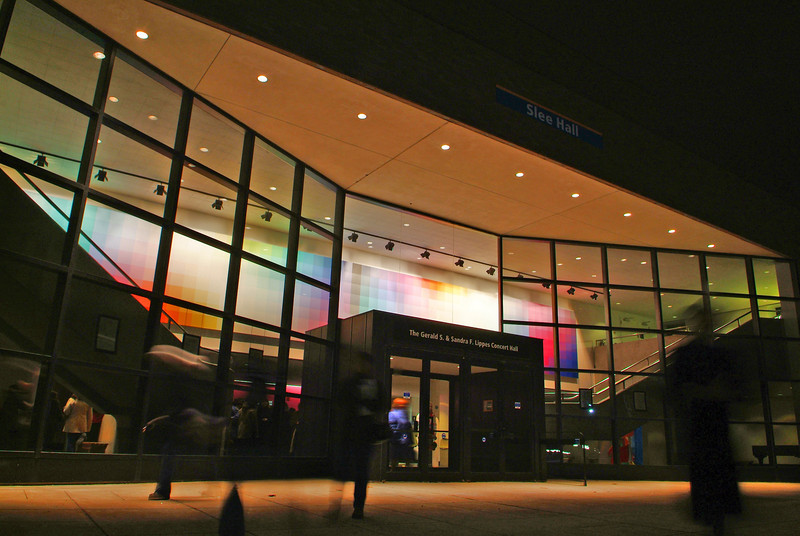
We here at the Center for 21st Century Music are looking forward to a program of solo works by performers in the Slee Sinfonietta on Wednesday, December 1st, at 7:30 pm, in Lippes Concert Hall in Slee Hall at the University at Buffalo.
We are excited to have another live audience again after our September 14th concert honoring the passing of Charles Wuorinen.
Here is our program below, which features a great variety of local Buffalo performers and composers:
Koral 1, by Jeff Stadelman, performed by Tom Kolor, percussion and electronics
Rutaceae, by Robert Phillips, performed by Michael Tumiel, clarinet and electronics
Orbit, by Philip Glass, performed by Jonathan Golove, cello solo
Piri, by Isang Yun, performed by Megan Kyle, oboe solo
Three Etudes, by Steve Solook, performed by Steve Solook, percussion solo
Platinum Spirals, by Joan Tower, performed by Shannon Reilly, violin solo
David's Nimm, by Karin Rehnqvist, performed by Tiffany Du Mouchelle, soprano and electronics
Virtuosic new music ensemble and longtime friend of the Center for 21st Century MusicHanatsu Miroir will record works by UB graduate composers during October 7 - 9. Unfortunately, due to the pandemic travel restrictions no persons from Europe or France are allowed into the US, so they will rehearse via zoom and record remotely. We hope this changes soon!
As this is a remote recording session it will not be open to the public, but please check this page in a few months and we will upload some of the recordings. Hope to see your ears here soon!
We're excited to announce the opening concert of the Center for 21st Century Music 2021-2022 season! We have a program with some big instrumental forces in Lippes Concert Hall at the University at Buffalo on Tuesday, September 14th, at 7:30 pm.
A livestream link will be available for this concert but everyone is welcome to attend in person with masks on and social distancing observed.
The program will be:
Zoe, for string sextet, Charles Wuorinen
For CW, for chamber orchestra, David Felder
Grises osobres lágrimas, for small string orchestra, Christian Baldini
Introduzione all'oscuro, for 12 players, Salvatore Sciarrino
Octandre, for 8 players, Edgar Varése
The program will be conducted by UB alumn Christian Baldini who is now conducting the UC Davis Symphony Orchestra. The concert features a premiere by David Felder, For CW, which honors the recently passed Charles Wuorinen who has been a friend of the Center since the beginning. The evening concludes with Octandré, by Edgar Varése, who was aa early supporter of Wuorinen's music.
David Felder and Charles Wuorinen at the Marriott near UB
Ticket purchasing information and livestream link coming soon!
We are very excited to announce that Stefano Gervasoni will join us as a senior composer for this year's June in Buffalo. Born in Bergamo in 1962, Stefano Gervasoni began studying composition in 1980 on the advice of Luigi Nono: this encounter, as well as others with Brian Ferneyhough, Peter Eötvös and Helmut Lachenmann, turned out to be decisive for his career. After attending the Giuseppe Verdi Conservatory in Milan, where he studied with Luca Lombardi, Niccolò Castiglioni and Azio Corghi, Stefano Gervasoni met György Ligeti in Hungary in 1990, and then, in 1992, he attended the IRCAM Course in Composition and in Computer Music in Paris. The first three years in France launched Gervasoni's international career that eventually led him to be artist-in-residence at Villa Medici in Rome for the 1995-96 biennium.
Stefano Gervasoni has established himself as one of the most important Italian composers of his generation. His commissions include such prestigious institutions as the WDR, the SWR, the Orchestra Nazionale della RAI, the Münchner Kammerorchester, the Festival d'Automne in Paris, Radio France, IRCAM, the Casa da Musica in Porto, the Festival Archipel in Geneva, the Divertimento Ensemble in Milan, the Ensemble Intercontemporain, the Ensemble Modern, the Ensemble Contrechamps in Geneva, the Maerzmusik festival in Berlin, the Ars Musica Bruxelles, the Festival Musica in Strasbourg, the French Ministry of Culture, Milan Teatro alla Scala and Suntory Hall in Tokyo. His catalogue – which includes chamber and vocal music, concertos, works for orchestra, for ensemble and the opera Limbus-Limbo – is published by Ricordi and by Suvini Zerboni.
A winner of numerous prizes, including the recent "Serge Koussevitzky Music Foundation Award" (2018) and Premio della Critica Musicale "Franco Abbiati" (2010), his work has allowed him to be a grant-holder at the Fondation des Treilles in Paris (1994) and at the DAAD in Berlin (2006) and composer-in-residence at Villa Médicis in Rome as fellow at the Académie de France for the years 1995-96 and at the Domaine de Kerguéhennec during the period 2008-2010. He has also been invited to teach at the Darmstadt Ferienkurse, on the courses organised by the Fondation Royaumont (Paris), at Toho University in Tokyo, at the Festival International de Campos do Jordão in Brazil, at the Conservatory in Shanghai, at Columbia University (New York), at Harvard University (Boston) and at Takefu International Music Festival. He has been composer-in-residence at Lausanne Conservatoire (2005) and at Yellow Barn Summer Academy (Vermont, 2016). Moreover, he has been visiting professor at ESMUC in Barcelona for the 2012-13 academic year.
His disc Antiterra, featureing the pieces An, Animato, Antiterra, Least Bee, Godspell, and Epicadenza, was recently released in France by Aeon and bears witness to “a sonic world of great wealth, subtlety, refinement, expressive but also organic, that immediately captures one’s attention” (Philippe Albèra). Other recordings include the Harmonia Mundi CD in the series Musiqu Française d’Aujourd’hui (Ensemble Contrechamps), the Stradivarius CD by Divertimento Ensemble and the CD Dir-in dir released in Germany by Winter und Winter. From 2006 Stefano Gervasoni has held a regular teaching position as professor of composition at Conservatoire National Supérieur de Musique et de Danse in Paris. The musicologist Philippe Albèra wrote a substantial book on Stefano Gervasoni's work, Stefano Gervasoni. Le parti pris des sons, published in 2015 by Editions Contrechamps (Geneva). His last CD, entitled pas perdu has been released in 2018 by Winter & Winter.
We are delighted to announce that Augusta Read Thomas will be a June in Buffalo senior composer for 2021. The music of Augusta Read Thomas (b. 1964 in New York) is nuanced, majestic, elegant, capricious, lyrical, and colorful. She has been championed
by such luminaries as Barenboim, Rostropovich, Boulez, Eschenbach,
Salonen, Maazel, Ozawa, and Knussen, and was described by The American Academy of Arts and Letters
as “one of the most recognizable and widely loved figures in American
Music."
In 2016, Augusta Read Thomas founded the University of Chicago’s Center for Contemporary Composition. The Center comprises ten integrated entities: annual concert series
featuring the Grossman Ensemble, CHIME, visiting ensembles,
distinguished guest composers, performances, recordings, research,
student-led projects, workshops and postdoctoral fellowships.
Recent and upcoming commissions include those from the Santa Fe Opera
in collaboration with the San Francisco Opera and other opera
companies, PEAK Performances at Montclair State University and the
Martha Graham Dance Company, The Cathedral Choral Society of Washington
D.C., The Indianapolis Symphony, Tanglewood, The Kaleidoscope Chamber
Orchestra, Des Moines Symphony, Boston Symphony, the Utah Symphony,
Wigmore Hall in London, JACK quartet, Third Coast Percussion, Spektral
Quartet, Chicago Philharmonic, Eugene Symphony, the Danish Chamber
Players, Notre Dame University, Janet Sung, Lorelei Vocal Ensemble, and
the Fromm Foundation.
Thomas has the distinction of having her work performed more
frequently in 2013-2014 than any other living ASCAP composer, according
to statistics from the performing rights organization (New York
Times). Her discography includes 88 commercially recorded CDs.
Her recent piece for wordless soprano and string quartet, Plea for Peace (embedded below), was commissioned by The University of Chicago
for the Commemoration of the 75th Anniversary of Chicago Pile-1. The
meditative, drawn out sustains of the quartet weave a gentle
counterpoint around an increasingly urgent vocal to a beautiful and
inevitable climax.
June in Buffalo is very pleased to announce that the composer and conductor Robert HP Platz will be among our senior composers this festival. Platz was born in Baden-Baden in 1951, and studied music theory, piano and conducting in Freiburg / Breisgau. He studied composition with Wolfgang Fortner and Karlheinz Stockhausen in Cologne, and later completed his conducting training with Francis Travis in Freiburg. Platz' various collaborations ahve variously taken him to the United Stated, Paris and Japan. From 1989, Platz’ compositions have been part of a journal-like all-encompassing cycle that continues in associative leaps, distributions in space, and a polyphony of forms.
From 1980 to 2001, Platz in Cologne directed the Cologne Ensemble he founded. Composers
such as Scelsi, Xenakis, Kagel, Hosokawa, Sylvano Bussotti and Klaus Huber
wrote for the ensemble, which specializes in contemporary music. With
guest conductors, Platz worked with ensembles and orchestras such as the
Ensemble Modern, the Klangforum and the Vienna series, the German Symphony
Orchestra, the Radio Symphony Orchestra of the WDR, the two SWR Symphony
Orchestras Freiburg / Baden-Baden and Stuttgart, the Radio Philharmonic
Orchestra of the NDR Hannover, and the Lower Rhine Symphoners, the Orchester
Philharmonique du Luxembourg or the Bavarian State Opera.
Platz has lectured and taught in many European countries as well as the USA, Mexico, Israel, Indonesia, South Korea and Japan; 1986-1996 and again in 2002 lecturer at the Darmstadt summer courses. From 1990 onwards, Platz led a composition class at the Maastricht University of Music, combined with a seminar on the performance practice of new music. Since October 2013, Platz has held a professorship for composition and ensemble management for new music at the Musikhochschule Würzburg. From 2000 to 2007, Platz was artistic director of the Schreyahner Herbst festival. Since October 2013, Platz has held a professorship for composition and ensemble management for new music at the Musikhochschule Würzburg.
The Steingraeber piano manufacturer has been building the first midi grand piano with permanently installed transducers according to Platz’ specifications since 2016. Since 2005 the composer has been a member of the Bureau du Directeur of the Henri Pousseur Electronic Studio, Liège. Numerous CDs document the compositional and conducting work of Robert HP Platz. His portrait CD Mauro Lanza with the Ensemble Alternance was awarded by the Académie Charles Cros, his first Hosokawa CD with NEOS received the Clef d'Or as "Best CD of the year 2009".
A disc of Platz solo flute works, Più di un sogno, was released in Feburary of this year, with flutist Roberto Fabbriciani.
We are pleased to announced that Hilda Paredes will be
working with students at this year’s June in Buffalo Festival as one of a number of senior composers and guest lecturers. Hilda Paredes was born in Tehuacan, Puebla in 1957 and is currently based in London, England. While it is fundementally European on the surface, Mexican and pre-colonial culture runs as a deep background thread through much of her work. At the same time, many of her means for manipulating
rhythm and structure have been influenced by her interest in the music
of India.
Firmly established as one of the leading Mexican composers of her
generation, Hilda Paredes has been based in London for 35 years.
Musicians, singers and conductors frequently praise the perfect balance
she achieves between brilliant compositional technique and a keen
sensibility for the particular instruments and individuals for whom she
writes.
The versatility of her work is manifest in a catalogue that includes a
wide range of electroacoustic works created at IRCAM, at SWR
Experimentalstudio and at CIRM, where the electronics of her widely
celebrated chamber opera Harriet, Scenes in the life of Harriet Tubman, were created. Harriet is based on poetry by Mayra Santos-Febres and a selection
of dialogues by Lex Bohlmeijer, and tells the story of Harriet Tubman, who
escaped her childhood of slavery and helped others to freedom via the
Underground Railroad, a network of safe routes to the free states. After the premiere at the Muziekgebouw Amsterdam, the Dutch critic, Joep Stapel, placed Harriet as the number one Best Classical Music of 2018. In 2019, Paredes was awarded a prestigious Ivors Composer Award for this work.
While there is a testimony of constant collaboration with Mexican
poets and artists in her works, she also draws inspiration from music
and cultures from around the world. Her music has been acclaimed by the
critics for the refinement of her craft, marked by the intensity of the
relationship between time, dramatic force and poetic approach.
In addition to this award, Paredes has been honoured with a number of
international accolades, including the PRS for Music Foundation, J.S.
Guggenheim Fellowship, Rockefeller, Fund for Culture Mexico/USA, and the
Fellowship from Sistema Nacional de Creadores (FONCA) in Mexico.
Hilda Paredes’ music has been commissioned and performed by many
prestigious ensembles, orchestras and soloists including Trio Arbós,
Arditti Quartet, Aventure, Collegium Novum Zurich, Contrechamps, Court
Circuit, Ensemble Intercontemporain, L’Instant donné, Hilliard Ensemble,
Ensemble Modern, Ensemble Recherche, Ensemble Signal, Grup Instrumental
de Valencia, ICE, London Sinfonietta, Lontano, The New Julliard
Ensemble, Neue Vocalsolisten, Plural Ensemble, Psappha, Ensemble Phoenix
Basle, MDi Ensemble, Orchestra di l’Arena de Verona, RTE, OFUNAM,
Filarmónica de la Ciudad de México, amongst many others.
Her works have been presented by such prominent international festivals and venues as the Wigmore Hall, Huddersfield Contemporary Music and Edinburgh Festivals in the UK; Eclat and Ultraschall in Germany; Festival D’Automne a Paris, Musica and Octobre en Normandie in France; Wien Modern and Klangspuren in Austria; Akiyoshidai and Takefu Music Festivals in Japan; Archipel in Switzerland; De Ijsbreker Chamber Music Festival in Amsterdam; Warsaw Autumn in Poland; Ultima in Oslo; Melbourne International Music Festival in Australia; June in Buffalo, the Composer Portraits Series at Miller Theatre NY, and Festival of Arts and Ideas in the USA, Ars Musica in Bruxelles; Festival de Alicante, Festival de Música Religiosa de Cuenca and ENSEMS Festival in Spain; and Festival Internacional Cervantino in Mexico.
Congratulations to the selected participants for June in Buffalo 2021, who will be joining the festival remotely this year!
The participants and selected works are:
Jia Yi Lee (Peabody Conservatory, John Hopkins University) - orbit for flute doubling alto, piano, violin, viola and cello.
Matías Homar (University at Buffalo) - Nus Ga Eid for flute, percussion violin, viola and cello.
Joel Kirk (University at Buffalo) - always update status for flute doubling piccolo, clarinet, violin, cello, piano and glockenspiel.
Kunal Gala (Berklee College of Music) - Currents for flute, clarinet, violin, cello and piano.
Nicolas Chuaqui (Eastman School of Music) - The Windowed Present for clarinet, violin, cello, piano
Edgar Girtain (University at Buffalo) - For Aurora No. 3 for Piccolo/Alto Flute, Bass Clarinet, Violin, Cello, Percussion and piano
Zhuosheng Jin (McGill University) - Departure Pulse (August Story) for flute, clarinet, percussion, piano, violin and cello
Owen Eddy (Berklee College of Music) - self and efficacy for flute and piano
Sean Klink (Western Illinois University) - winds across water for crotales, marimba and piano
Sameer Ramchandran (Rutgers University) - Le jardin des ombres for oboe, clarinet, bassoon, horn, percussion, two violins, viola, cello and contrabass.
Patricia Morehead (North Bay Symphony Orchestra) - Sounds and Sighs for John for oboe d’amore doubling oboe and electronics Emanuele Savagnone (Hochschule für Musik und Darstellende Kunst Mannheim) - Forme della luce nello spazio for Clarinet in A, piano, two violins and cello
Jonathan Rainous (University at Buffalo) - Rapture 1 - Exuberance for flute, clarinet, percussion, piano, violin and cello. Treya Nash (University of North Carolina at Greensboro) - Nothing Motorized for clarinet, violin and percussion.
Parker Callister (Eastman School of Music) - crawl for amplified violin and piano.
Xuesi Xu (Florida State University) - wreckage for bass flute, piano and contrabass.
Tyler Adamthwaite (University at Buffalo) - Stone Pierrot for baritone, clarinet, trumpet, and trombone.
Ryan Carraher (University of Washington) - we also shape shift at a distance for baritone, clarinet, trumpet, and trombone.
Lihuen Sirvent (University at Buffalo) - pyrrhic victory for solo violin
John Aulich (University at Buffalo) - slacken tired shrouds for string quartet
James Falzone (University at Buffalo) - String Quartet No. 3 - A Curving Abacus for string quartet
Alex Buehler (University at Buffalo) - Wateriness for string quartet
Axel Retif (CIEM/West London College) - Jo-Ha-Kyu for string quartet
Tsu-Yao Yang (Conservatoire National Supérieur Musique et Danse de Lyon) - Bleu II for string quartet
Sofía Rocha (University of Missouri-Kansas City) - Standing Waves for string quartet
We are very pleased to welcome Jeffrey Mumford as one of our June in Buffalo Senior Composers. Born in Washington, D.C. in 1955, Jeffrey Mumford has received numerous fellowships, grants, awards and commissions. His music has been performed extensively, by major orchestras, soloists, and ensembles, both in the United States and abroad, including London, Paris, Reykjavik, Vienna, The Hague, Russia and Lithuania.
Mumford’s music is appraised for the mesmerizing beauty of his orchestrations, shifting cloud-like and pointillistic textures, and unfolding layered lines. His highly evocative, almost painterly music is influenced by a broad and eclectic range of musicians, from Elliott Carter to Sarah Vaughan. His current projects include for Clare, a new work for solo piano commissioned by pianist Clare Longendyke) as part of her project entitled "UnRaveled", a project responding to and reimagining Ravel's piano music, and a CD of recent concerti.
His most notable commissions include those from the Los Angeles Philharmonic Association and the Library of Congress (co-commission), the BBC Philharmonic, the San Antonio, Chicago & National Symphonies (National Symphony twice), Washington Performing Arts, the Network for New Music, ‘cellist Mariel Roberts, the Fulcrum Point New Music Project (through New Music USA), Duo Harpverk (Iceland), the Sphinx Consortium, the Cincinnati Symphony (twice), the VERGE Ensemble /National Gallery of Art/Contemporary Music Forum, the Argento Chamber Ensemble, the Cleveland Orchestra, the Nancy Ruyle Dodge Charitable Trust, the Meet the Composer/Arts Endowment Commissioning Music/USA, Cincinnati radio station WGUC, the Walter W. Naumburg Foundation, the Fromm Music Foundation, and the McKim Fund in the Library of Congress.
A notable new recording is two Elliott carter tributes by pianist Pina Napolitano as part of her new critically acclaimed CD "Tempo e Tempi" (Odradek Records ODCCDR378). Mumford has taught at the Washington Conservatory of Music, served as Artist-in-Residence at Bowling Green State University, and served as assistant professor of composition and Composer-in-Residence at the Oberlin College Conservatory of Music. He is currently Distinguished Professor at Lorain County Community College in Northern Ohio.
The department is very pleased to welcome the British-based American composer, recording engineer, conductor and arts entrepreneur Aaron Holloway-Nahum. As the conductor, founder and artistic director of Riot Ensemble, his efforts have contributed to the premiers of over 250 original works. Holloway-Nahum has showcased contemporary work from a variety of composers, including Anna Thorvaldsdóttir, Ann Cleare, Kit Downes, Daniel Kidane, Liza Lim, Alexander Hawkins, Clara Iannotta, Lisa Streich and a new work by Georg Friedrich Haas performed in total darkness, for which he learned to (re)tune a piano. He is now also the technical director of Ensemble Nikel, for whom he facilitates performances and live-recordings in addition to strategic marketing and logistics work.
As a composer, his music has been performed in over one dozen countries across four continents, and is characterized by its detailed and ornate timbres, bold melodic unisons, and experimental narrative structures. Upcoming premieres include works for chamber orchestra Ensemble Echapée, the renowned Keuris Quartet and an Opera – his first – based on the true story of Donald Crowhurst. Selected as one of just two composers for the Peter Eötvös Foundation inaugural mentorship class, Holloway-Nahum has held a variety of fellowships over the past decade, including Tanglewood, Bang on a Can, Aspen, Cheltenham, a Copland House Residency, and many more. Notable past performances of his music include the Pannon Philharmonic Orchestra (Hungary), Plural Ensemble (Madrid), and a full length film score recorded at Abbey Film Road. His latest pieces include the mixed media piece, Imaginary Children I: How I would Paint the Future (2020) (embedded below), an evocative and intensely personal reflection on sadness, isolation and joy.
As a recording engineer, Holloway-Nahum has produced as many as 20 albums per year from premier ensembles across the United States and Europe. His clientele includes Ensemble Intercontemporain, Arditti Quartet, Sandbox Percussion, and Adam Swayne.
Holloway-Nahum will give a masterclass and lecture to PhD students in Composition on March 19th.
On Friday, March 12th, at 7:30 pm EDT, the Century for 21st Century Music will livestream a concert of University at Buffalo PhD composers performing their own and one another's works from Lippes Concert Hall.
The program will include:
Alex Buehler, Shatter, for solo trombone and electronics, performed by the composer.
Shatter
(2020) is created from, and inspired by, metallic, glass, and ceramic
sounds; particularly the sounds of shattering glass, cascading metal,
broken crockery, and blacksmith hammering. The moment of violent
breaking and shattering becomes a frozen environment that the trombone
finds itself wandering through and adapting to the necessities of
survival.
Joel Kirk, Studying Shrapnel, for solo flugelhorn, performed by the composer.
Rich Wang, The Yellow Plateau, for solo cello and electronics, performed by Jonathan Golove.
A
cello solo piece for Dr. Jonathan Golove. It has two movements which
are 1: 'Original' and 2: '2020'. The composer used the
electric orchestra combined with Chinese north western folk music
elements to state the river of history in the Yellow Plateau.
Matias Homar, Breathing reality, for brass trio and live electronics.
Alex Buehler - Trombone
Joel Kirk - Flugelhorn
Jonathan Rainous - Euphonium.
Piece
composed for a brass trio during the COVID-19 pandemic. It can be
thought of as a personal reflection on isolation through taking
quotidian sounds from a personal environment and laying them out within a
musical composition.
Tyler Adamthwaite, Fleeting Remnants of the Severed Wonderland..., for solo viola, performed by James Rhodes.
John Aulich, In an absence of sea, for solo flugelhorn, performed by Joel Kirk.
James Falzone, Neither/Nor, for violin, vibraphone and piano.
We very excited that the esteemed composer Ann Cleare will join us in the coming weeks to discuss her recent work and host a masterclass with graduate students. Ann Cleare is an Irish composer working in
the areas of concert music, opera, extended sonic environments, and
hybrid instrumental design. Her work explores the static and sculptural
nature of sound, probing the extremities of timbre, texture, colour, and
form. She creates highly psychological and corporeal sonic spaces that
encourage a listener to contemplate the complexity of the lives we exist
within, exploring poetries of communication, transformation, and
perception.
Her recent projects have focused on creating
experiential environments where sound is given a visual as well as sonic
dimension, such works includeeyam i-v, a
series of five attacca pieces, centred around clarinet and flute
writing in various solo, ensemble, electronic, and orchestral settings,
spanning just over two hours of music that is continuously transformed
in shape, time, and motion around the listener; rinn, a
time travel chamber opera involving a multichannel sonic sculpture that
the singers and actors wear, interact with, and are amplified by;
spatially choreographed chamber pieces such asI should live in wires for leaving you behind,anchor me to the land, and on magnetic fields; a newly-designed instrument that a musician simultaneously wears and plays in eöl; surface stations, multi-layered theatre involving the staging of extended brass instruments, vocal ensemble, and visuals.
Ann Cleare will host a masterclass on Novebember 23rd, and give a lecture to Buffalo PhD students on November 25th.
We are happy to announce that the Emmy-award winning filmmaker Elliot Caplan, famed for his work with the Merce Cunningham Dance Company and John Cage will be giving a lecture to graduate composition students on Friday November 6th. Caplan served as the filmmaker-in-residence
for the Merce Cunningham Dance Company. His work in documentary, art
filmmaking, and performance with choreographer Cunningham, composer John
Cage video artist Nam June Paik and filmmaker Bruce Baillie is
internationally recognized. Caplan’s films and videos are in museum and
film collections throughout the world. Caplan received an Emmy Award
for “Outstanding Cultural and Historical Programming” for his work on
the PBS Network. He is the recipient of numerous grants and awards. Film
and video retrospectives have been presented in Portugal, Holland,
Japan and the United States. He has taught courses, lectured and been in
residence at colleges and universities in the United States and abroad
including co-direction with Michael Kidd and Stanley Donen of the
Dance/Film/Video Workshop at the Sundance Institute. In 1996, Caplan
founded Picture Start Films to facilitate his artistic work.
We are very pleased to welcome the composer James Romig back to Buffalo since last his last visit in 2012. He was a finalist for the 2019 Pulitzer Prize in Music, responds to an increasingly fragmented and accelerated world by creating highly isomorphic works that evolve slowly and reveal themselves gradually. Endeavoring to reflect the fragile intricacy of the natural world, his compositional designs exert influence on both small-scale iteration and large-scale structure, obscuring boundaries between form and content. Critics have described his music as “rapturous, slow-moving beauty” (San Francisco Chronicle), "developing with the naturalness of breathing" (The New Yorker), and “profoundly meditative... haunting” (The Wire). He is a two-time Copland House award recipient and has served as artist-in-residence at numerous national parks including Everglades, Grand Canyon, and Petrified Forest. Recordings have been released by New World Records, Navona, Blue Griffin, and Perspectives of New Music. His scores are published exclusively by Parallax Music Press.
Romig's music combines the systematic, rigerous pitch processes and complex harominic languages often found in the tradition of American Serialism, including that of his former teachers Charles Wuorinen and Milton Babbitt with the minimalist, repetitious soundworlds of the New York minimalists.
On Friday, November 6th, James Romig will give a talk introducing his large-scale piano piece Still and host a masterclass with several of the University at Buffalo PhD composition students.
You can read a little more about each composer, and others at UB, on a blogpost from earlier this year here. As always, Center for 21st Century Music livestream concerts at the University at Buffalo are free and require no online ticket or password.






 Posts
Posts


